


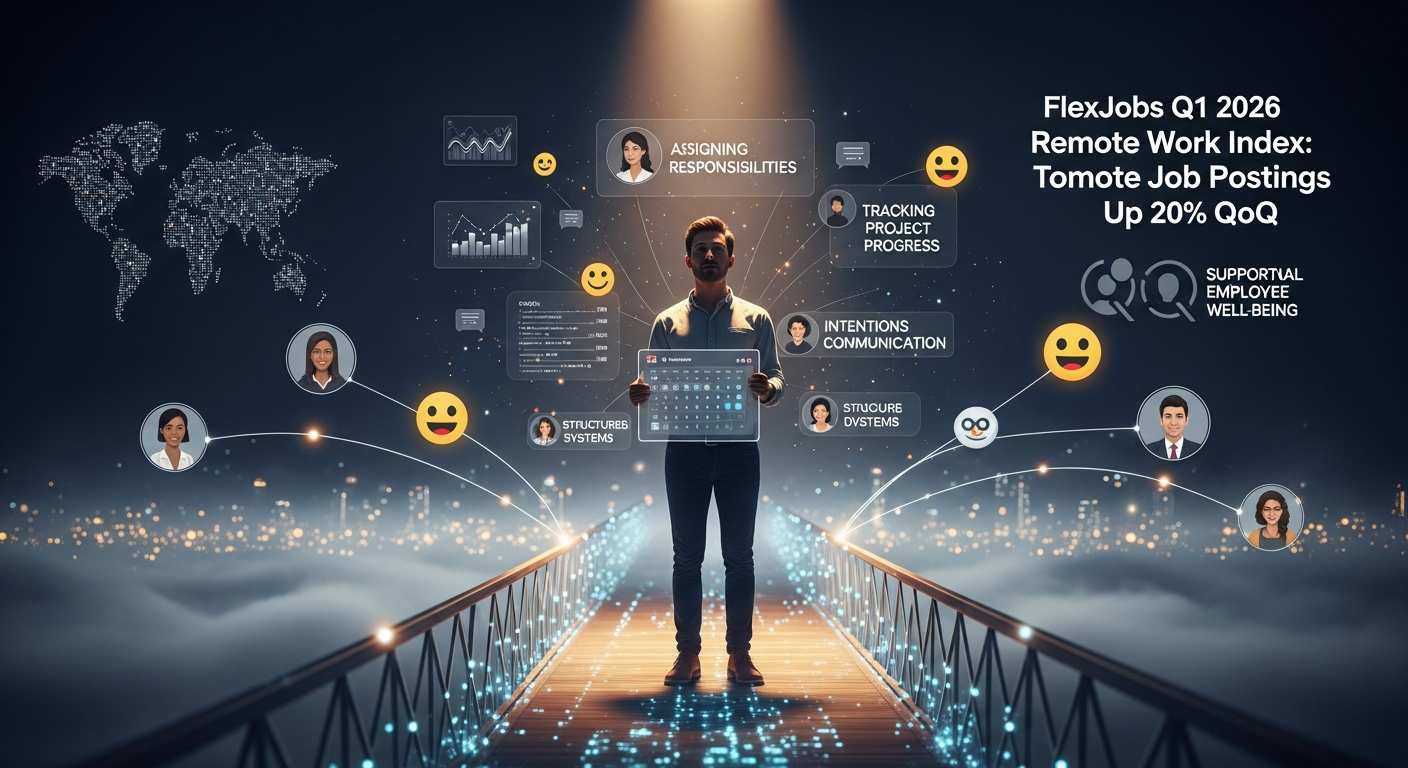
Understanding the Role of Remote Managers
What a Remote Manager Actually Does
You’re not just supervising people working from home when you’re a remote manager.
They connect productivity, communication, and human connection across digital spaces.
They guide teams through structured systems, intentional communication, and trust-based leadership instead of walking around an office.
Assigning responsibilities, tracking projects, supporting employee well-being, resolving conflicts, and making sure everyone stays aligned with business goals are all part of their job.
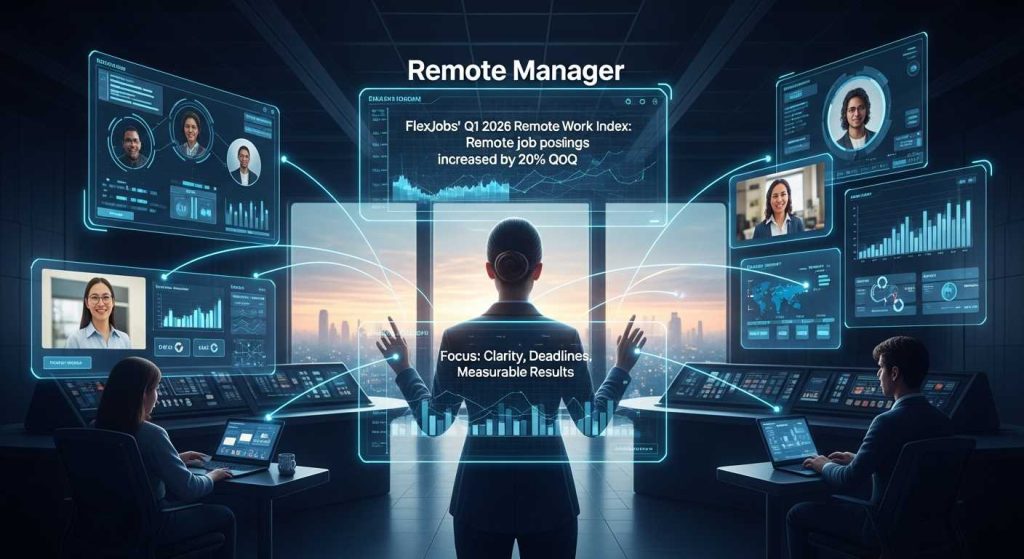
In 2026, this role is even more important because distributed work isn’t a temporary experiment. According to FlexJobs’ Q1 2026 Remote Work Index, remote job postings increased by 20% quarter over quarter. Businesses need leaders who know how to manage outcomes, not just office attendance. Good remote managers know that “being online” isn’t the same as being productive. Instead of focusing on digital presence, they focus on clarity, deadlines, and measurable results.
The best remote managers are also culture architects. Hallway conversations and coffee-break bonding don’t happen naturally anymore, so they need to create intentional opportunities. One-on-ones, async updates, virtual team rituals, and transparent decision-making become essential leadership tools. Remote management is less about control and more about design – creating workflows, trust systems, and human relationships that work without physical proximity.
Why Remote Leadership Is Different From Traditional Management
There’s a lot of emphasis on visibility in traditional management. Managers could see who was late, early, and busy. That illusion goes away with remote leadership. If your team is spread across multiple time zones and locations, you can’t lead effectively by observation alone. Performance-based management should replace presence-based management.
Everything changes when there’s a difference. It’s more important for remote managers to communicate than assume clarity. If your team spans five time zones, a vague instruction like “finish by end of day” becomes risky. Documentation, deadlines, and transparency become non-negotiables. Because confusion spreads faster online than in a physical office, remote managers need to think like system builders.
Remote leadership is also based on trust. Monitoring tools may seem controllable, but they’re bad for morale. Companies are increasingly using AI-powered employee monitoring, raising privacy concerns and trust issues. Trust drives better performance than surveillance, according to effective remote managers. Instead of focusing on mouse movement, they focus on outcomes. People perform better when they feel trusted because ownership replaces fear.
The Rise of Remote Work in 2026
Key Statistics Shaping Remote Management
It’s clear from the numbers that remote work isn’t disappearing – it’s evolving. 28% of full-time workers now work in a hybrid model, while 20% will work fully remotely by 2026, according to Gallup data. Another interesting stat is that 98% of remote workers want to work remotely at least part time for the rest of their careers. There’s a permanent shift in workplace expectations there; it’s not a passing trend.
According to FlexJobs, 85% of workers value remote work over salary when evaluating a job. For a second, imagine flexibility beating compensation. That changes how companies recruit, retain, and motivate employees. Also, remote managers directly affect retention because leadership quality determines whether remote work feels empowering or exhausting.
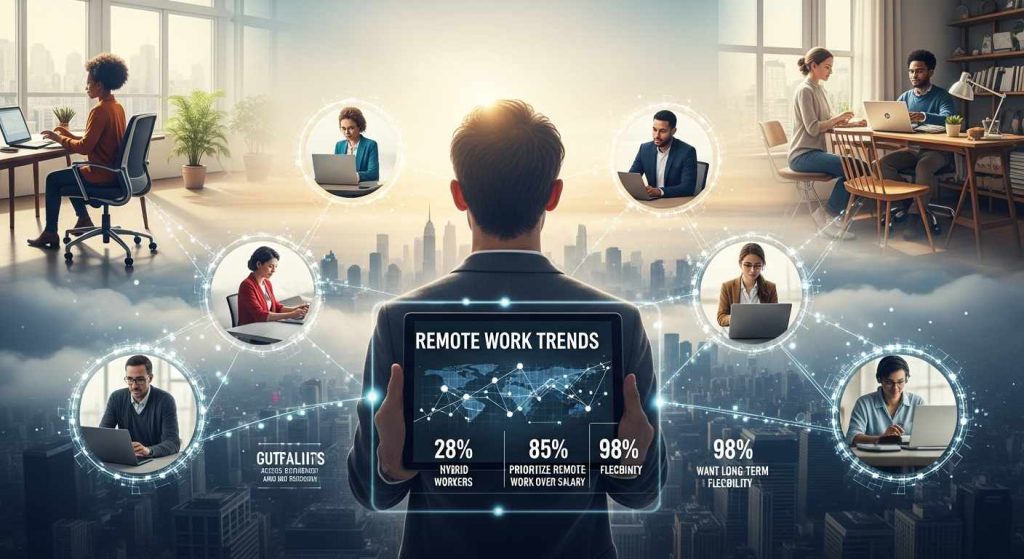
Here’s a quick snapshot of current remote work trends:
| Metric | 2026 Data |
|---|---|
| Hybrid workers | 28% |
| Fully remote workers | 20% |
| Workers prioritizing remote work over salary | 85% |
| Remote workers wanting long-term flexibility | 98% |
| Remote job posting growth (Q1 2026) | +20% |
These statistics prove one thing clearly: businesses that ignore remote leadership are managing yesterday’s workforce, not tomorrow’s.
Why Companies Still Invest in Distributed Teams
The return-to-office pressure hasn’t stopped businesses from investing in remote teams. There’s three things you need: access, efficiency, and resilience. Rather than commuting, companies can hire talent worldwide. Startups in London can hire designers in Vietnam, developers in Poland, and strategists in Canada without opening up three offices.
Cost optimization is also important. Leases, utilities, relocation packages, and in-person infrastructure are expensive. Having remote operations reduces these costs and gives you more access to specialized talent. According to some studies, remote-first companies adapt faster during disruptions since distributed systems are naturally more flexible. It’s like comparing a rigid brick building to a flexible suspension bridge-the bridge bends, but it doesn’t break.
Also, there’s the human side. The more autonomy you give your employees, the more likely they are to stick around. A widely shared workplace story showed how empathy reshaped policy when a family emergency prompted a company to offer work-from-home options. The remote manager is at the center of this transformation. Their job isn’t just to supervise; they’re helping define what modern work looks like.
Core Skills Every Remote Manager Needs
Communication Without Constant Meetings
Managers make the same mistake: they replace office interruptions with endless Zoom calls. Digital chaos isn’t remote leadership. Effective remote managers know that clarity is more important than frequency. We need fewer unnecessary meetings and better information flow.
In 2026, async communication will be the gold standard. Strong managers use written updates, recorded walkthroughs, and shared documentation instead of 30-minute meetings. The research shows teams using async-first communication get 20–30% more deep focus time because employees can work without constant interruptions. That’s awesome. Real progress happens when you work deep.
Precision is the key here. The manager must write clearly, define expectations fully, and eliminate ambiguity before it spreads. Communicating is like building a GPS route—if the directions aren’t clear, everyone gets lost. Strong remote managers make sure the map is clear before they start. You’ll save more productivity by having clear updates, response-time expectations, and documented decisions.
Trust-Based Leadership Instead of Micromanagement
In an office, micromanagement is already annoying. When you do it remotely, it gets toxic. Employees stop focusing on meaningful work when managers keep checking status, demand instant replies, and obsess over online activity. That’s the fastest way to ruin trust.
Leadership requires a mindset shift: measure outputs, not activities. How’s the project going? Did the client like it? Is the deadline still on? Those are the real questions. Not whether someone replied to Slack within six minutes. Experts increasingly warn against “bossware” and intrusive surveillance because it damages engagement and weakens leadership credibility.
Trust-based management sounds easy, but it takes courage. Managers have to accept that sometimes control isn’t real. You can create accountability without killing autonomy with strong systems, clear KPIs, and regular check-ins. Coaches don’t run races for their athletes. Although you train, guide, and support them, they perform best when they’re on their own the outcome.
Emotional Intelligence in Virtual Teams
There’s something strangely quiet about remote work. There are no visual cues from the office, so someone might struggle for weeks before anyone notices. Break room isn’t crowded with tired faces. You don’t look frustrated after a tough meeting. Emotional intelligence is one of the most important leadership skills for remote workers.
Managers need to actively listen, not just react. “How’s it going outside of work? ” can reveal more than a weekly performance review. Burnout often hides behind productivity because high performers keep delivering until the situation deteriorates. Remote managers need to spot subtle signs: short messages, reduced engagement, missed details, or unusual silence.
In addition to project management, psychological safety is equally important. When individuals feel seen, respected, and safe to speak honestly about their concerns, they perform better. Teams with remote managers who prioritize empathy are more likely to be resilient since trust creates trust. Despite technological advancements, humans still require emotional intelligence in order to function effectively.
Best Tools for Remote Managers
Project Management Platforms
A good tool doesn’t replace leadership, but it removes friction. Asana, ClickUp, Jira, and Trello help remote managers get visibility without constantly asking for updates. There’s no need to ask ten different questions to see priorities, deadlines, blockers, and ownership.
Consistent use is key. It’s not software, it’s unclear habits. If half the team updates tasks and half relies on private messages, chaos quickly returns. Managers set rules: where updates go, how deadlines are tracked, and what “done” means.
A good project platform becomes the team’s heartbeat. It reduces reliance on memory and meetings. Managers can focus on coaching and decision-making instead of chasing updates. Leadership shouldn’t be about administrative babysitting—it should be strategic guidance.
Communication and Collaboration Software
In remote work, project management platforms are the skeleton, and communication tools are the brain. You can feel disconnected and slow even if you have a talented distributed team without good collaboration software. Platforms like Slack, Microsoft Teams, Zoom, and Google Workspace have become essential because they centralize discussions, files, meetings, and quick updates.
However, tools can either create clarity or create noise. Many remote teams get caught up in “notification overload,” where every ping feels urgent and no real work gets done. Remote managers solve this by setting clear communication norms. You might use Slack for urgent collaboration, project platforms for formal updates, and email for client-facing communication. It’s important to have a structure because confusion creates hidden stress.
Video meetings are still important, but they should be intentional, not automatic. An hour-long meeting can kill productivity, but a fifteen-minute call can save hours of unclear messaging. Before scheduling a call, strong managers ask this question: “Can this be done asynchronously? ” If the answer is yes, they avoid the meeting. That small habit protects focus and respects employees’ time, which is one of the strongest signs of modern leadership.
Culture is also preserved with collaboration software. A shared channel for wins, celebrations, casual conversations, and recognition replaces some of the social connection lost outside the office. Teams birthday messages may seem small, but culture is built from little things repeated over and over.
Performance Tracking Without Surveillance
The biggest mistake organizations make is confusing performance tracking with employee surveillance. Monitoring software that tracks mouse movements, screenshots, or keyboard activity might look good on paper, but it creates more fear than accountability. Instead of performing for meaningful business outcomes, employees start performing for the software.
Smart remote managers do things differently. Success is measured by measurable goals, like project completion, quality standards, customer satisfaction, revenue targets, and campaign results. Instead of focusing on activity, this method focuses on contribution. While maintaining strong accountability, it respects autonomy.
A simple KPI framework often works better than expensive monitoring systems. For example:
| Performance Area | Example KPI |
|---|---|
| Sales | Monthly closed deals |
| Marketing | Lead generation growth |
| Customer Support | Response and resolution time |
| Development | Sprint completion rate |
| Content Team | Published high-quality outputs |
When employees understand how success is measured, they don’t need constant monitoring. It’s easier for them to self-manage when expectations are clear and fair. The power of leadership comes from clarity, not control.
Using regular one-on-ones as performance tools is also important for remote managers. These conversations aren’t just for reporting progress; they help identify blockers, motivation issues, and growth opportunities. Dashboards show numbers, but conversations show context. It’s important to have both.
Common Challenges Remote Managers Face
Managing Across Time Zones
Time zones are one of the biggest productivity killers in remote work. Initially, they seem manageable—just a scheduling issue. In reality, they hurt collaboration speed, decision-making, morale, and even trust. When one employee always works in the morning while another always attends meetings at midnight, there’s an imbalance.
It’s important for remote managers to think globally, not locally. They need systems built around overlap windows instead of expecting everyone to work on one schedule. You’ll want to reserve the few hours when most team members are available for critical collaboration. Asynchronously handle everything else.
It’s especially important to document this. When someone in Bangladesh finishes an update while someone in Canada is asleep, the next person should be able to continue without waiting for clarification. Processes written down reduce reliance on live interaction. If the handoff is unclear, the whole race slows down.
It’s also important to be fair. The meeting times should rotate when possible so the same people don’t sacrifice their personal time all the time. Time zones matter, not just the company’s schedule, when a manager respects them.
Preventing Burnout and Isolation
It’s flexible, but it can also blur the line between work and life. Your office becomes your living room, so “logging off” is harder. Remote employees work longer hours not because they’re asked to, but because boundaries disappear. It’s there where burnout starts.
Isolation adds another layer. Some people thrive alone, but many miss office life. Without informal conversations, remote work can feel emotionally flat. Employees may stay productive while feeling increasingly disconnected. Silence is dangerous because disengagement often grows before managers notice it.
Remote managers must actively protect their well-being. Encouraging real breaks, respecting offline hours, and modeling healthy boundaries are leadership responsibilities—not optional extras. The team learns that availability is expected if the manager sends midnight messages every night.
It’s also good to have simple rituals. Emotional connection comes from virtual coffee chats, social calls, recognition moments, and honest one-on-one conversations. This isn’t just “soft” management — it affects retention and performance. Not just useful places, but places where people feel human.
Maintaining Company Culture Remotely
Culture doesn’t live in office walls; it lives in repeated behavior. It’s too late for many companies to figure this out. When everyone goes remote, they realize free snacks and open offices weren’t really culture. Culture is about how people communicate, solve conflict, celebrate success, and make decisions.
That culture is shaped by remote managers because their daily leadership creates it. One of the strongest cultural signals is transparency. It’s easier to trust decisions when they’re explained clearly. Usually, when information feels hidden, people start building negative stories in the silence.
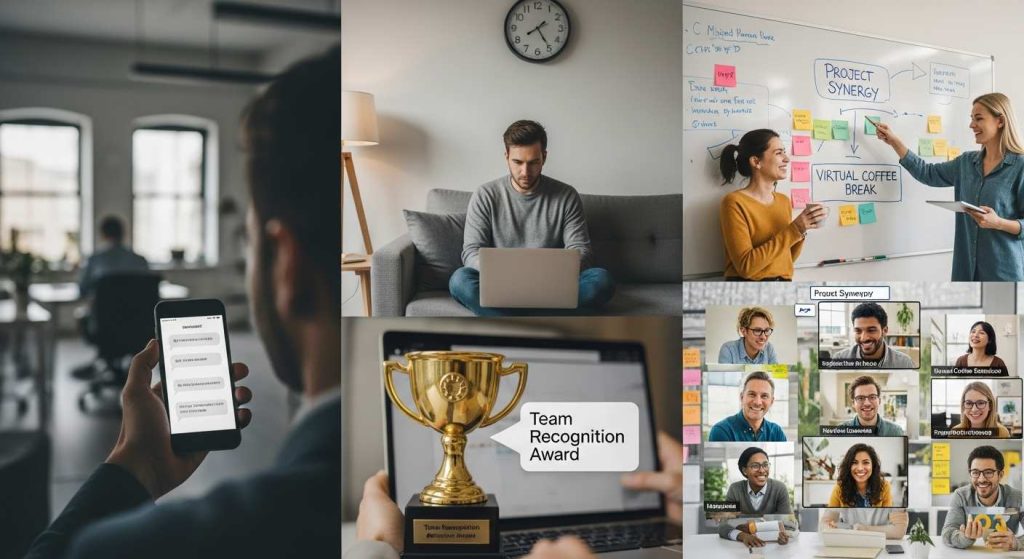
Another powerful tool is recognition. Achievements are often visible in physical offices. If managers don’t highlight wins, they can disappear quietly. Team channels, monthly recognition rituals, and leadership shoutouts make people feel valued.
Consistency is also important for a strong remote culture. Managers punish delayed responses if company values say “flexibility.” People believe behavior, not slogans. More than any mission, a remote manager’s actions define culture statement ever could.
Proven Strategies for Successful Remote Management
Setting Clear KPIs and Expectations
Clarity is the oxygen of remote teams. Without it, people guess—and guessing creates mistakes, delays, and frustration. The most successful remote managers make expectations painfully clear from the beginning. They define what success looks like, how progress is measured, when updates are needed, and what priorities matter most.
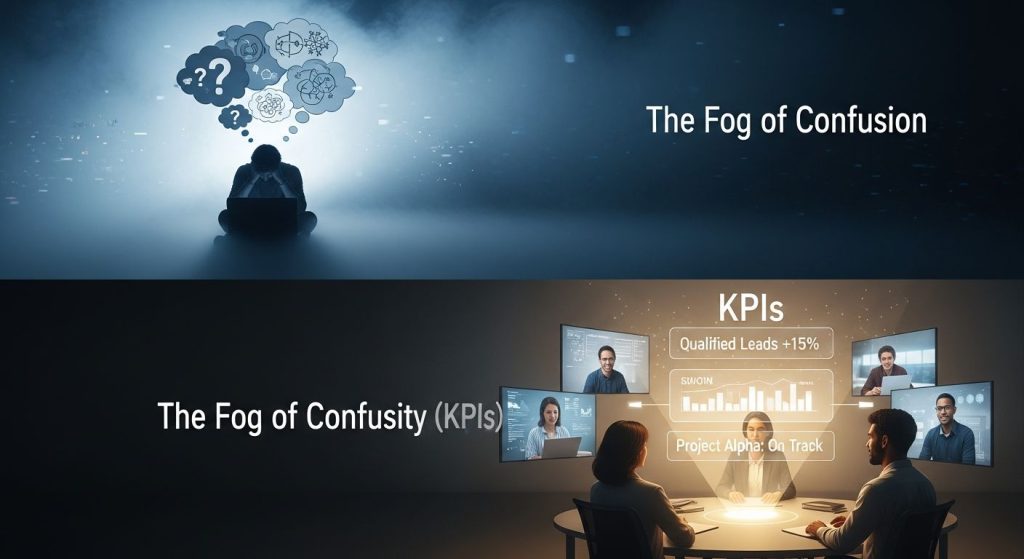
This is where KPIs (Key Performance Indicators) become essential. A KPI is not just a number; it is a shared definition of success. When a marketing manager says “improve campaign performance,” that sounds good but means little. When they say “increase qualified leads by 15% this quarter,” everyone understands the target.
Clear expectations also reduce emotional tension. Employees feel less anxious when they know exactly what is expected. Unclear work creates hidden stress because people spend energy wondering if they are doing enough. Remote managers who define ownership, deadlines, and quality standards create confidence—not just productivity.
Documentation supports this clarity. Written expectations survive beyond meetings and prevent misunderstanding. Great managers treat documentation like insurance: you hope confusion does not happen, but you prepare anyway.
Building Accountability Through Ownership
Accountability works best when people feel ownership, not fear. If employees only act because they are afraid of being checked on, motivation stays fragile. But when they feel responsible for results, performance becomes internal rather than forced.
Remote managers create ownership by assigning outcomes, not just tasks. Instead of saying, “Post these updates,” they say, “Own engagement growth for this campaign.” That small difference changes mindset. One feels like a checklist; the other feels like leadership.
Ownership also grows when employees are trusted to make decisions. Constant approval chains slow everything down and send the message that judgment is not trusted. Strong managers define boundaries clearly—what decisions employees can make independently and when escalation is needed.
Recognition strengthens accountability too. When ownership leads to visible appreciation, people connect effort with meaning. People rarely give their best work for surveillance, but they often do it for trust, respect, and pride.
Creating a Strong Virtual Team Culture
Virtual culture is not built by accident. It requires deliberate design. The strongest remote teams create rituals that make people feel connected, even across distance. Weekly wins, monthly reflection sessions, team learning hours, and shared celebration moments all matter because they create rhythm and belonging.
Managers should also normalize openness. When leaders admit mistakes, ask for feedback, and discuss challenges honestly, psychological safety improves. Employees stop hiding problems and start solving them faster. That openness is especially important remotely because silence can easily be misread as confidence.
Learning culture matters too. Teams grow stronger when managers encourage skill development instead of focusing only on immediate output. Workshops, mentorship, peer teaching, and learning budgets show employees they are being invested in, not just extracted from.
Think of virtual culture like gardening. You cannot force growth overnight, but with consistency—water, sunlight, attention—it becomes strong and self-sustaining. Remote managers are the gardeners of that environment.









Important, thanks