

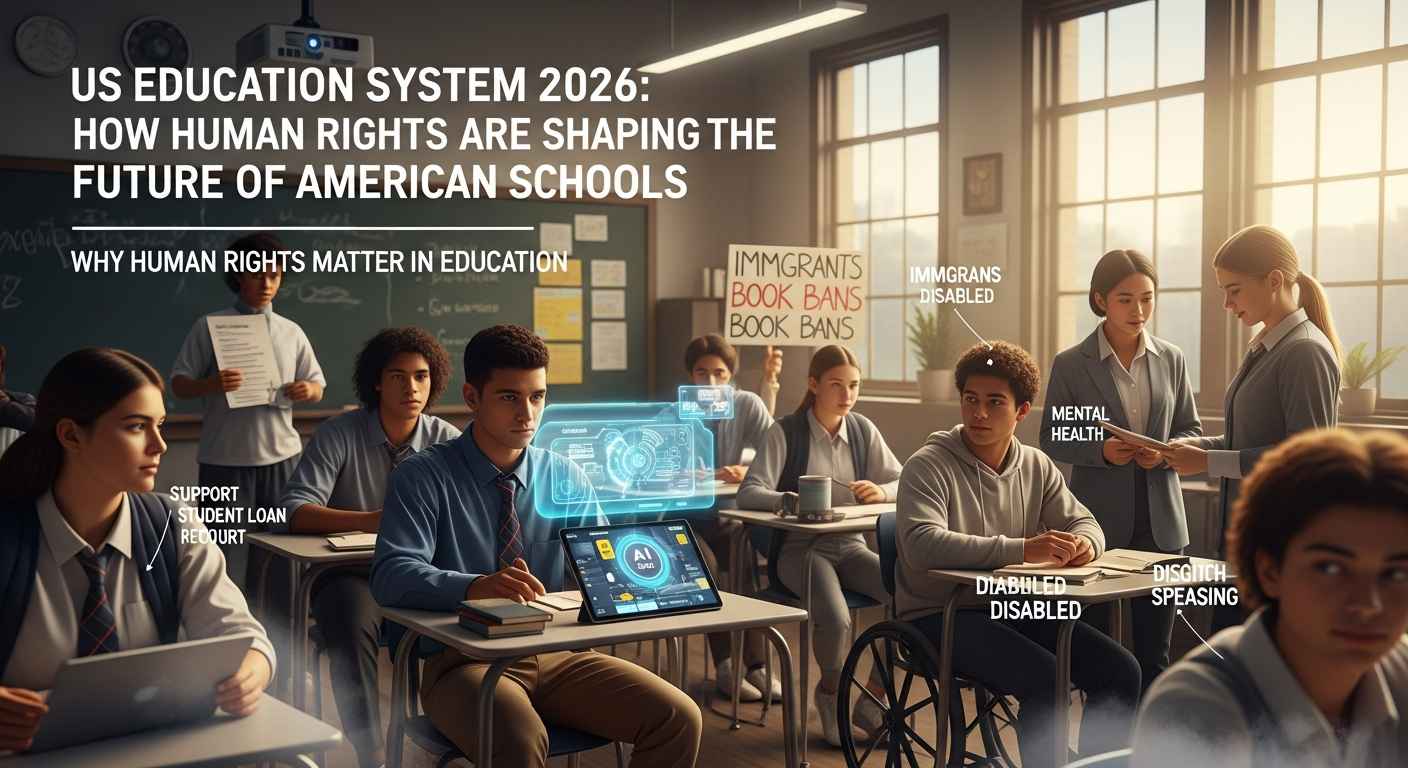
Why Human Rights Matter in Education

Education is not just a privilege; it is a fundamental human right. The Universal Declaration of Human Rights (Article 26) states that everyone has the right to free and compulsory education. In the United States, this principle guides federal and state policies, but implementation remains a challenge.
In 2026, the US education system is going through a lot of changes. Artificial Intelligence (AI) is making its way into classrooms. Restructuring student loans is happening. There’s a fight for equal treatment for immigrants and disabled students. At the same time, debates over book bans, free speech, and mental health services are making headlines.
This article explores every major development in US education through a human rights lens. Whether you are a student, parent, educator, or international learner, you will understand your rights and the latest trends shaping American schools and colleges.
Key Statistic: Over 49.6 million students will attend public elementary and secondary schools in the US in 2025. Almost 20% have special needs or come from non-English speaking families
Federal laws protecting students’ rights – the legal backbone
IDEA (Individuals with Disabilities Education Act)
Children with disabilities are guaranteed free and appropriate public education under IDEA. In 2026, these updates will strengthen enforcement:
- Schools must now provide individualized education plans (IEPs) within 30 days of diagnosis.
- Parents have the right to independent educational evaluations at government expense.
- Due process hearings are now capped at 60 days for faster resolution.
“Without IDEA, millions of children would be left behind. The 2026 amendments ensure accountability,” says Sarah Thompson, a special education advocate in Texas.
Harassment prevention and gender equality
Title IX prohibits sex-based discrimination at federally funded schools. In 2026, the Biden administration expanded Title IX to include:
- Protection for transgender students: Schools cannot ban students from facilities that match their gender identity.
- Pregnancy rights: Pregnant and parenting students can get excused absences, make-up work, and lactation spaces.
- Sexual harassment: Schools must investigate any complaint within 30 days, regardless of whether a police report is filed.
Violations can lead to millions in lost federal funding, making Title IX one of the most powerful civil rights laws in education.
Equal Educational Opportunity Act (EEOA)
This 1974 law remains vital in 2026. It requires states to:
- Take action to overcome language barriers for English Learner (EL) students.
- Avoid segregating students based on race, color, or national origin.
- Provide bilingual education programs where needed.
Currently, over 5 million EL students attend US public schools, speaking more than 400 languages. Most people speak Spanish, Arabic, Chinese, and Vietnamese.
Human Rights Challenges in the Digital Age: Technology in Classrooms
Personalized learning with AI tutors

American schools are embracing AI tools. Platforms like Khanmigo and Coursera Coach provide 24/7 tutoring. Benefits include:
- Individualized learning paths for each student.
- Homework feedback right away.
- Assistance for students with learning disabilities (e.g., dyslexia-friendly fonts, text-to-speech).
Nevertheless, privacy concerns are growing. In 2026, the Student Data Privacy Act was introduced.
- Ban schools from selling student data to advertisers.
- Require a parent’s consent for biometric data collection (fingerprints, facial recognition).
- Require all ed-tech vendors to do annual security audits.
Student data could be used to profile, track, or discriminate against kids based on their race, income, or ability
A modern civil rights battle – The Digital Divide
Not everyone has equal access to technology. The FCC reported in early 2026 that:
- 12 million US students lack high-speed internet at home.
- 9 of them do not own a laptop or tablet.
- Rural and low-income urban areas are most affected.
To bridge this gap, the Emergency Connectivity Fund has been extended through 2028. Families earning up to $55,000/year can receive:
- Free hotspot with unlimited data.
- Refurbished laptops or tablets.
- Technical support in multiple languages.
“Internet access is the new school bus. Without it, you cannot get to class,” says FCC Commissioner Geoffrey Starks.
Students with immigrant or refugee backgrounds – their rights
The landmark ruling in Plyler v. Doe
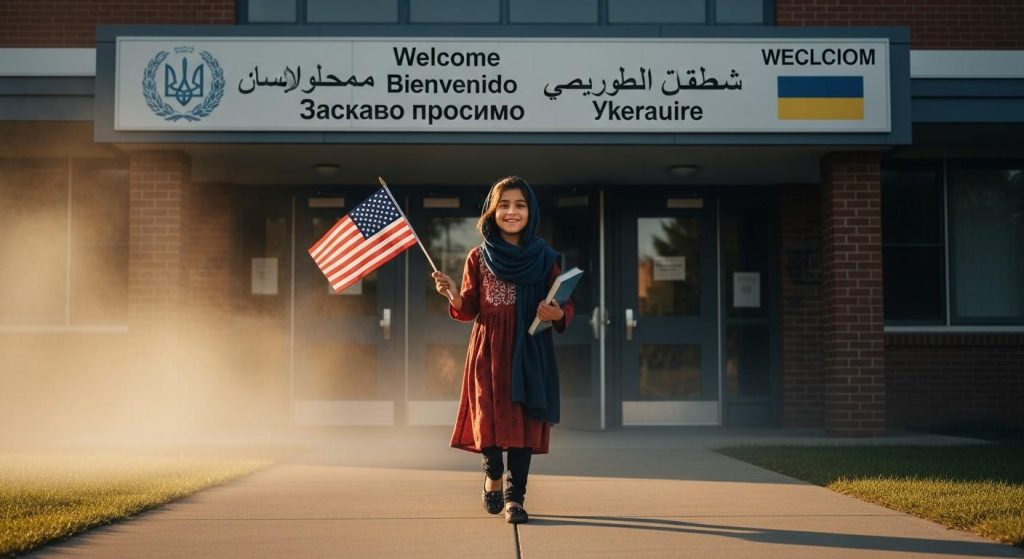
In 1982, the Supreme Court ruled that undocumented children have the right to free K-12 education. This decision remains intact in 2026, despite political challenges. Key protections include:
- Schools cannot ask about immigration status during enrollment.
- Schools cannot require social security numbers.
- A judicial warrant is needed for ICE agents to enter schools.
Support for Refugee Students
Since 2024, the US has welcomed over 50,000 refugee students from Afghanistan, Ukraine, and Sudan. The Department of Education’s Refugee Student Success Program provides:
- Trauma-informed counselling in the student’s native language.
- Accelerated English as a Second Language (ESL) classes.
- Peer mentoring programs pair refugee students with American volunteers.
Real Story: In San Diego, a 16-year-old Afghan refugee named Mariam learned English in 8 months and is now applying for college scholarships. She says school gave her her future back.
Student loans, free speech, and campus rights in higher education
Human rights crisis: student loan debt
US student loan debt exceeds $1.7 trillion, affecting 43 million borrowers. Many argue that unaffordable education violates the human right to development (Article 26 of the Universal Declaration). In response,
- The SAVE Plan (Saving on a Valuable Education) reduces monthly payments to $0 for borrowers earning under $32,000/year.
- Nurses, firefighters, early childhood educators, and nonprofit workers are now eligible for Public Service Loan Forgiveness (PSLF).
- Borrowers who attended fraudulent for-profit colleges (e.g., ITT Tech, Corinthian) can have their loans completely discharged.
Senator Elizabeth Warren says people shouldn’t have to choose between food and college.
Guidelines for free speech on campus in 2026
College campuses remain centers of political activism. New federal guidelines require universities to:
- You can protest peacefully in designated areas (no “free speech cages”).
- Protect faculty members from retaliation based on political or academic views.
- Ban “trigger warnings” that prevent controversial topics discussion.
However, hate speech that incites violence or targets protected groups (race, religion, sexual orientation) is still prohibited under Title VI of the Civil Rights Act.
International Student Rights
Over 1.1 million international students study in the US, including thousands from Bangladesh. Their rights include:
- Equal access to campus facilities and services.
- Protection from discrimination based on nationality or religion.
- For STEM majors, you can work on CPT/OPT programs for up to 3 years.
If you’re facing discrimination or visa issues, contact the Student and Exchange Visitor Program (SEVP) or your university’s International Student Office.
The Unfinished Fight for Racial and Economic Equality
Segregation at schools in 2026
Despite Brown v. Board of Education (1954), many US schools remain segregated. A 2026 report from the Civil Rights Project found:
- Nearly 40% of Black and Latino students attend schools with 90%+ non-white students.
- Predominantly non-white schools receive $2,300 less per student than predominantly white districts.
- High-poverty schools have a 50% higher teacher turnover.
Diversity initiatives and magnet schools
To combat segregation, 18 states have launched magnet schools with diversity quotas. These schools offer specialized programs in STEM, performing arts, and international studies. Admission is lottery-based, not test scores.
Additionally, the Stronger Together Grant Program provides $500 million annually to districts that implement:
- Socio-economic integration plans.
- Cross-district busing programs (voluntary only).
- Bringing English and Spanish speakers together in a dual-language immersion school.
The Overlooked Human Right of Mental Health
Mental health crisis among students
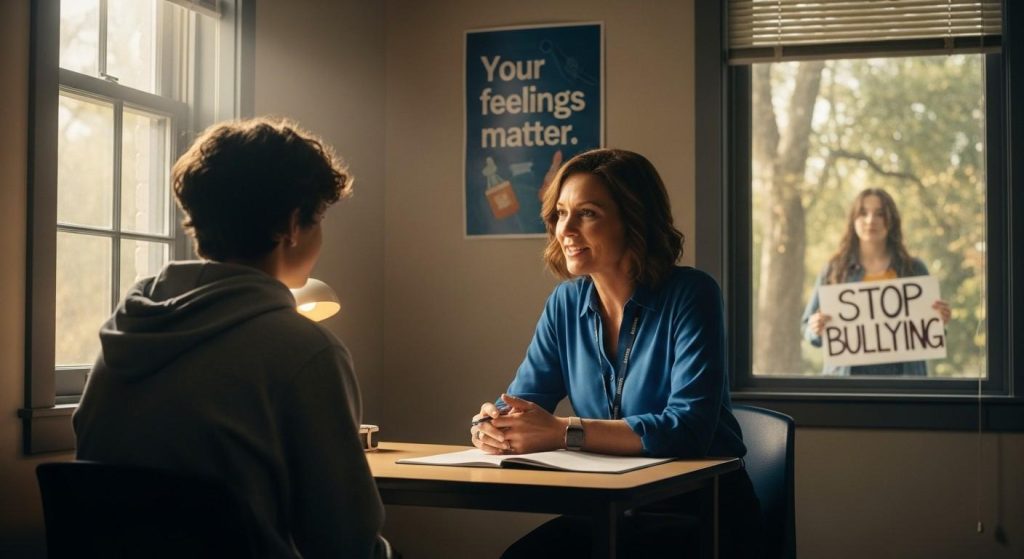
According to the CDC, 1 in 3 high school students will report persistent sadness or hopelessness in 2025. Suicide is the second leading cause of death among teens aged 15-19. In response, 2026 laws now require:
- Mental health days as excused absences (up to 7 days per year in California and New York).
- A licensed counselor for every 200 students (the previous ratio was 1:500).
- Anonymous emotional support chatbots available 24/7 through school portals.
Anti-bullying Laws
All 50 states now have anti-bullying laws. Cyberbullying that happens off-campus but affects in-school learning will be banned in 2026. Schools must:
- Investigate all complaints within 48 hours.
- Provide counseling for victims and bullies.
- You should report severe cases (threats, hate crimes, stalking) to the police.
Bullying is more than just “kids being kids.” It violates people’s rights to safety and dignity.
Frequently Asked Questions (FAQ)
Q1: Can a US school deny admission to an undocumented child?
No. Under Plyler v. Doe (1982), all children have the right to free K-12 education regardless of immigration status.
If my child’s disability rights are violated, what should I do?
Contact the school district’s special education director. If unresolved, file a complaint with the Office for Civil Rights (OCR) or request a due process hearing.
Q3: Are students allowed to protest during school hours?
As long as it doesn’t disrupt learning. Many schools allow walkouts for specific causes (e.g., climate change, gun violence) with prior notice to administrators.
Q4: How can international students report discrimination?
International students have the same Title IX and civil rights protections. We’ll report it
Q5: What is the penalty for schools that violate student privacy laws?
Under the Student Data Privacy Act (2026), fines range from $10,000 to $500,000 depending on the severity and number of students affected.
Conclusion – What’s next?
There’s a mix of progress and persistent inequality in American education in 2026. Technology offers incredible tools, but only if everyone has access. Human rights laws provide strong protections, but only if families know how to use them.
As we move forward, the question is not whether the US can afford student rights. The question is whether it can afford not to. Every child—regardless of race, disability, immigration status, or income-serves a safe, inclusive, and high-quality education.
Final Thought: Education is the foundation of democracy. Protecting student rights protects our collective future.
CTA (Call to Action)
📢 If you found this article helpful, please share it with a parent, teacher, or student who needs to know their rights.
🔔 Subscribe to our news portal for weekly updates on US education policies, visa news, and human rights issues.
💬 Do you have a question or a story to share? Let us know what you think in the comments or email [thenewshant@gmail.com].