



Introduction
There’s no sleep in the cryptocurrency market. A stock market closes at 4 PM and stays closed on weekends, but crypto trades all day, every day. While traditional markets move in percentages that seem modest, crypto can move 20%, 30%, or even 50% in a day. There are incredible opportunities for traders who know what they’re doing, and devastating losses for those who don’t.
Since Bitcoin’s early days, cryptocurrency trading has evolved a lot. It wasn’t uncommon for traders to place manual orders on basic exchange interfaces in 2013. By 2026, sophisticated traders use algorithmic bots, leverage 100x, trade derivatives across dozens of exchanges, and analyze on-chain data.
It’s crazy how big crypto trading has gotten. Cryptocurrency trading volume regularly exceeds $100 billion. There’s more trading activity on major exchanges than on many national stock exchanges. The retail traders who built this market have been joined by professional traders, market makers, and institutional investors.
Here’s the honest truth that many “crypto gurus” won’t tell you: most cryptocurrency traders lose money. Over 80% of retail traders lose all their trading capital, according to studies. Volatility, unpredictability, and unforgiving are the hallmarks of the market. Education, discipline, risk management, and emotional control are all essential for successful trading.
We’ll walk you through everything you need to know about cryptocurrency trading in 2026. You’ll find practical, actionable information in this guide whether you’re a beginner or a pro.
Here’s an honest warning: Trading cryptocurrency is extremely risky. Never trade money you can’t afford to lose. It’s hard for beginners to make money. Make it small. Don’t be afraid to take tiny positions. Before you put your real money at risk, try paper trading (simulations).
What Is Cryptocurrency Trading and Why Does It Matter?
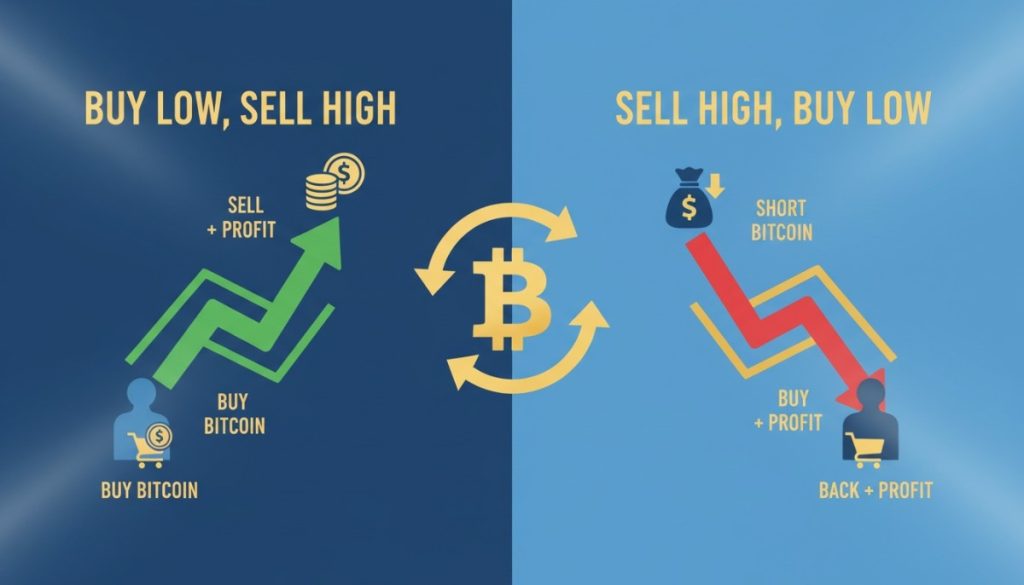
The goal of cryptocurrency trading is to make money from price movements by buying and selling digital assets. Trading isn’t like investing, where you hold assets for years, but instead looks for short-term opportunities.
There are two ways traders profit:
Traders buy low, sell high (long positions): They buy cryptocurrency expecting prices to rise, then sell later. Most beginners know this approach.
More advanced traders can profit from falling prices by selling high and buying low. When markets decline, traders profit by borrowing and selling assets they don’t own, then buying them back at a lower price.
Trading cryptocurrencies differs from traditional trading in several ways:
Bitcoin never closes: Markets are open 24/7/365. The result is that traders can’t just wait for tomorrow – they have to manage their positions all the time.
Volatility is high: There are daily moves of 5-10%. There are usually 20-30% moves. Profit opportunities are created by this volatility, but losses are magnified too.
Crypto trading is easy: All you need is an internet connection and a little capital. There are no broker approvals, minimum account sizes, or accreditation requirements.
There are hundreds of crypto exchanges around the world. Different exchanges have different prices, so you can make money arbitraging.
There are different rules in different countries. It’s possible for regulations to change suddenly, affecting market access.
What’s the point of cryptocurrency trading? Because it provides liquidity for the crypto ecosystem, enables price discovery, and offers profit opportunities that don’t exist in traditional markets. Traders who know how to exploit crypto’s inefficiencies and volatility have a huge advantage.
How Cryptocurrency Trading Actually Works
You can make better decisions if you understand the mechanics of trading.
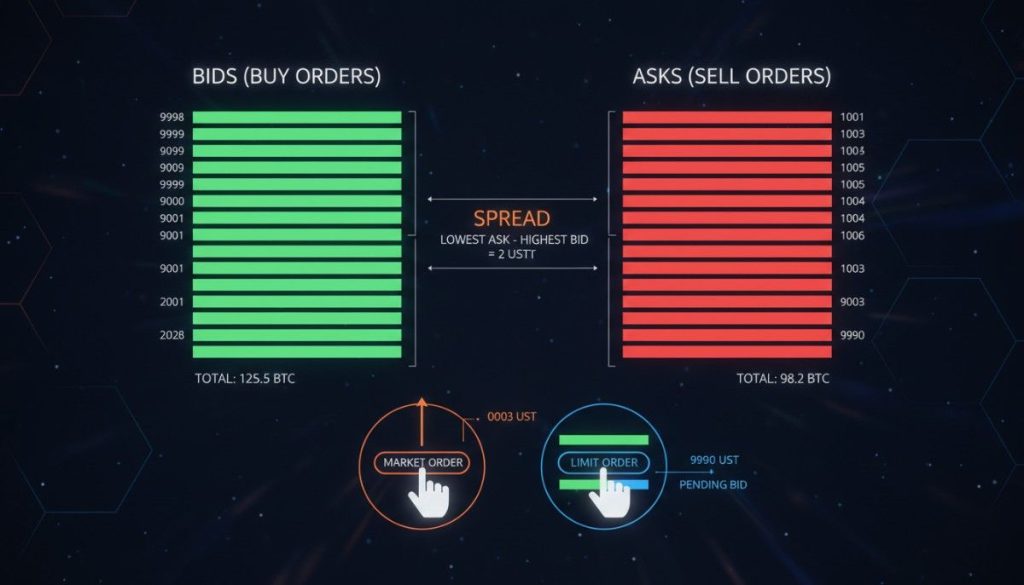
Every exchange relies on its order books. Order books list all buy orders (bids) and sell orders (asks) for a trading pair. Orders are sorted from highest to lowest price. Orders are sorted by lowest to highest price.
Orders are executed immediately at the best price. When you buy or sell, you pay the lowest ask or highest bid. Orders on the market guarantee execution, but not price.
We only execute limit orders if the price is better than what you specified. The price you want to buy or sell is up to you. You can’t guarantee execution with limit orders.
Stop orders (stop-loss) trigger market orders when a certain price is reached. Used to limit losses by automatically selling if the price drops too much.
It’s a combination of a stop order and a limit order. Whenever the stop price is reached, a limit order is placed. In fast-moving markets, it may not execute.
It’s all about order books and liquidity: High liquidity means many orders close to the current price, so big trades don’t affect the price too much. Liquidity is low, so even small trades can make a big difference.
There’s a spread between the highest bid and the lowest ask. It’s good to have tight spreads (small differences). Trading costs go up when spreads are wide.
Exchanges charge fees for trading. There’s usually a lower maker fee (adding liquidity with limit orders) than a taker fee (removing liquidity with market orders). Per trade, most exchanges charge 0.1% to 0.5%.
The slippage happens when the expected fill price doesn’t match the actual fill price. Low liquidity or volatile markets make this more common.
Before you risk real money, you have to understand these basics.
Types of Cryptocurrency Trading
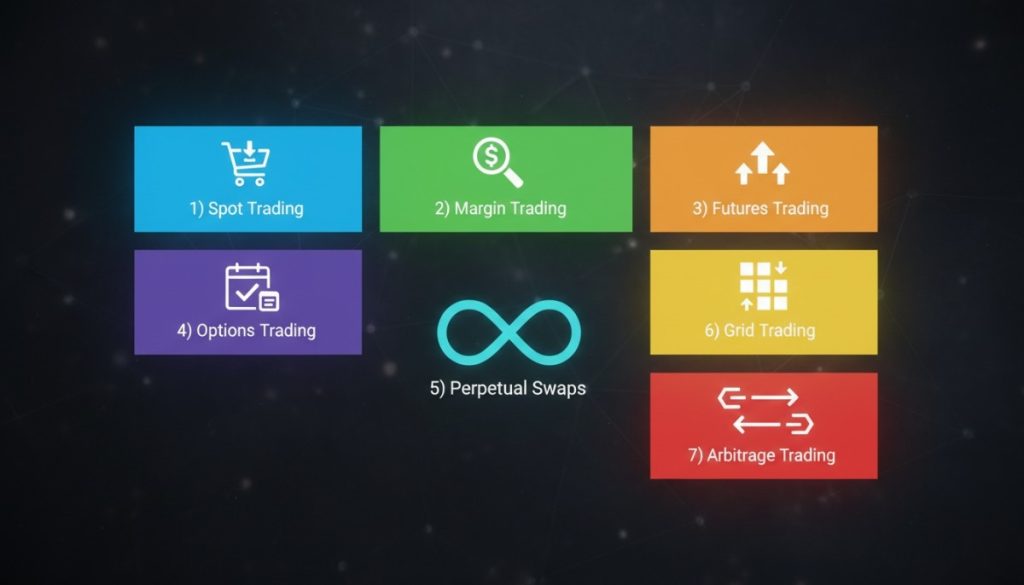
Different trading approaches are best for different risk tolerances, time commitments, and skill levels.
Trading on the spot
The simplest form of crypto trading is spot trading. Buying cryptocurrency directly with fiat currency or another crypto gives you ownership of the assets. We settle positions right away. If you have a private wallet, you can withdraw your crypto.
For beginners, long-term holders, and people who don’t like leverage.
The advantages: It’s easy to understand. Nothing to worry about with leverage. The assets are actually yours. Periods of unlimited holding.
Disadvantages: You have to put up your whole capital to trade. Profits are limited to price appreciation. Falling prices don’t pay off.
Trading margins
Margin trading lets you borrow funds from the exchange to increase your position size. With 1,000 and 10x leverage, you can control a 1,000 and 10x leverage, you can control a 10,000. Multiply your profits (and losses).
There are different exchanges with different leverage ratios. You’re taking on more risk when you use more leverage. When losses exceed collateral, most exchanges liquidate positions (force close).
It’s best for: Experienced traders who know how to manage risk.
Profits are boosted by smaller price movements. The ability to short (profit from falling prices).
Disadvantages: Increased losses. There’s a liquidation risk. Charges for borrowing money. It’s not for beginners.
Futures trading
Futures contracts are agreements to buy or sell cryptocurrency at a predetermined price in the future. Futures traders don’t own the underlying asset, they trade contracts that represent price exposure instead.
You don’t have to worry about perpetual futures expiring. Here are the most popular crypto derivatives. Contract prices stay aligned with spot prices with funding rates (periodic payments between long and short positions).
Every three months, quarterly futures expire. As a result, these trade closer to theoretical fair value, but you have to roll your positions to keep your exposure.
For: Active traders who want leverage and shorting options.
There’s a lot of leverage (often 100x or more). Crypto doesn’t have to be held. Major exchanges have deep liquidity.
The disadvantage is that it’s complicated. There’s a liquidation risk. Perpetual positions have funding costs.
Options trading
A cryptocurrency option gives you the right (but not the obligation) to buy or sell cryptocurrency at a specific price before a specific date. Profit from price increases with call options. You can profit from price decreases or protect existing positions with put options.
Best for: Advanced traders hedging positions or speculating with defined risk.
Benefits: Defined maximum loss (premium paid). Any market condition can be met with flexible strategies.
Disadvantages: It’s complex. It requires a good understanding of Greek (Delta, Gamma, Theta, Vega). Liquidity is lower than futures.
Perpetual swaps
Crypto derivatives are dominated by perpetual swaps. There’s no expiration date on these futures contracts. To keep contract prices in line with spot prices, funding rates transfer payments between longs and shorts periodically.
It’s best for: Active traders looking for leveraged exposure.
There’s no expiration date. Leverage is high. It’s on all the major exchanges.
The downside is that funding costs can add up. It’s high risk.
Great trading
Orders are placed at predetermined price intervals by automated bots. As the price oscillates within the grid range, the bot profits from market volatility.
Best for: Markets that are range-bound. Hands-off traders.
Advantages: Automated. Works in sideways markets. No directional prediction needed.
Disadvantages: Poor performance in trending markets (grids can be broken). Requires careful parameter selection.
Arbitrage trading
Arbitrage is when you take advantage of price differences between two exchanges or trading pairs. You’ll make money if you buy on the exchange where the price is lower, and you’ll make money if you sell on the exchange where the price is higher.
There are three types: spatial arbitrage (different exchanges), triangular arbitrage (three trading pairs on the same exchange), and funding rate arbitrage (perpetuals vs. spot).
Fast execution is best for: Automated traders.
Theoretically, it’s low risk. It’s market-neutral.
The downside is that it’s really competitive. Needs capital and speed. There aren’t a lot of profits.
Major Cryptocurrency Trading Exchanges in 2026
To trade successfully, you have to pick the right exchange. CHECK OUT THE LEADING PLATFORMS IN 2026.
By trading volume, Binance is still the biggest exchange in the world. Spot, margin, futures, options, and hundreds of trading pairs. The lowest fees among major exchanges (0.1% base). Including OCO orders, trailing stops, and API access. Regulatory challenges in some places.
There’s no better exchange than Coinbase. Nasdaq-listed (COIN). It’s easy to use for beginners. Coinbase Advanced Trade (formerly Coinbase Pro) lets you do advanced trading. Fees are higher than Binance, but regulatory compliance is better.
Bit trades derivatives. It’s popular with futures traders. It’s got a 100x leverage. Fast execution, strong liquidity, clean interface. Many competitors charge higher fees.
Besides spot trading, OKX also offers margin trading, futures trading, and options trading. We’re strong in Asia. Advanced trading features. Competitive fees.
The Kraken exchange is a long-standing US exchange with a great security reputation. We offer spot, margin, futures, and stakes. Interface for professional traders (Kraken Pro). High fees, but excellent compliance.
KuCoin offers hundreds of altcoins at low fees. Popular for trading cryptocurrencies with small market caps. There’s no KYC for small withdrawals.
Crypto-currencies are listed on Gate.io. There are low fees. Tokens with low caps are popular here.
When picking an exchange, think about security, fees, trading pairs, leverage, regulatory compliance, liquidity, and user interface. The majority of active traders have accounts on multiple exchanges.
Candlestick Charts and Technical Analysis Basics
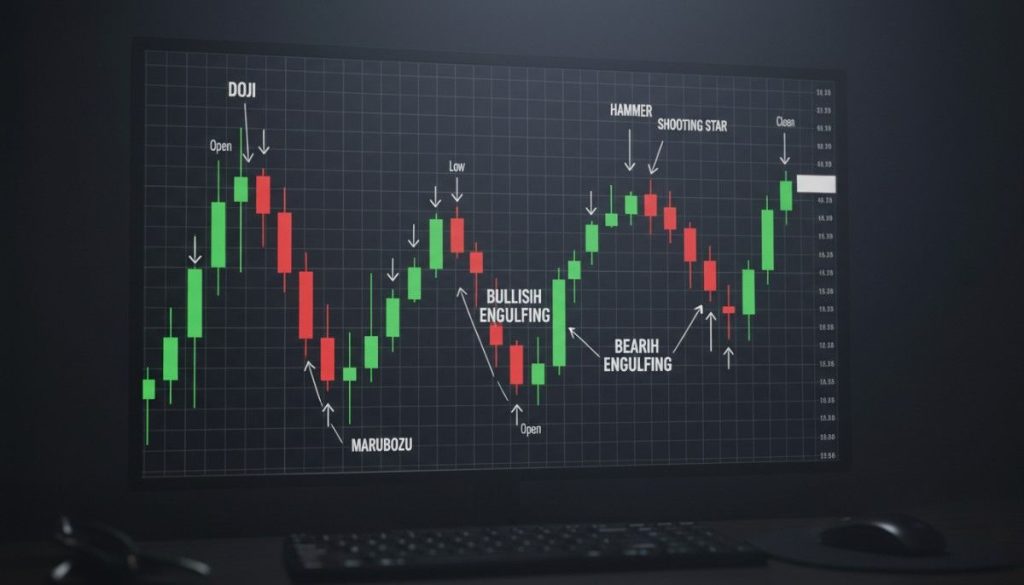
The goal of technical analysis is to identify patterns in price charts and predict what’s coming next. Candlestick charts are standard.
Each candle represents price movement over a specific period (1 minute, 1 hour, 1 day, etc.). Candles show:
- Open: Price when the period starts
- High: Highest price during the period
- Low: Lowest price during this period
- Close: Price at period end
A bullish candle (close > open) is typically in green or white. Price increased during the period.
Bearish candles (close open) are typically red or black. Price decreased during the period.
Wicks (shadows) indicate price rejection. A long upper wick shows sellers pulled the price down from highs. A long lower wick shows buyers are pushing the price up from its lows.
Basic candlestick patterns:
The opening and closing of the doji are almost equal. Indicates an indecision. Can signal trend reversal.
Hammer: Small body at top, a long lower back. Bullish reversal signal after a downtrend.
Shooting stars: Small bottom body, long upper wick. Bearish reverse signal after an uptrend.
Engulfing pattern: Large candle completely engulfed previous candle’s body. Strong reverse signal.
Marubozu: No wicks. Open equals low for a bullish candle or high for a bearish candle. Strong momentum.
Support and resistance: Support is a price level where buying interest prevents further decline. Resistance is a price level where selling interest prevents further advances. When price breaks through support or resistance, that level often flips roles (support becomes resistance, and resistance becomes support).
Trend lines: Lines connecting successive lows (uptrend) or successive highs (downtrend). The break of the trend line suggests a trend change.
Chart timeframes: Short timeframes (1m, 5m, 15m) show more noise and are used by scalpers and day traders. Longer timeframes (4h, 1d, 1w) show clearer trends and are used by swing and position traders.
Essential Trading Indicators
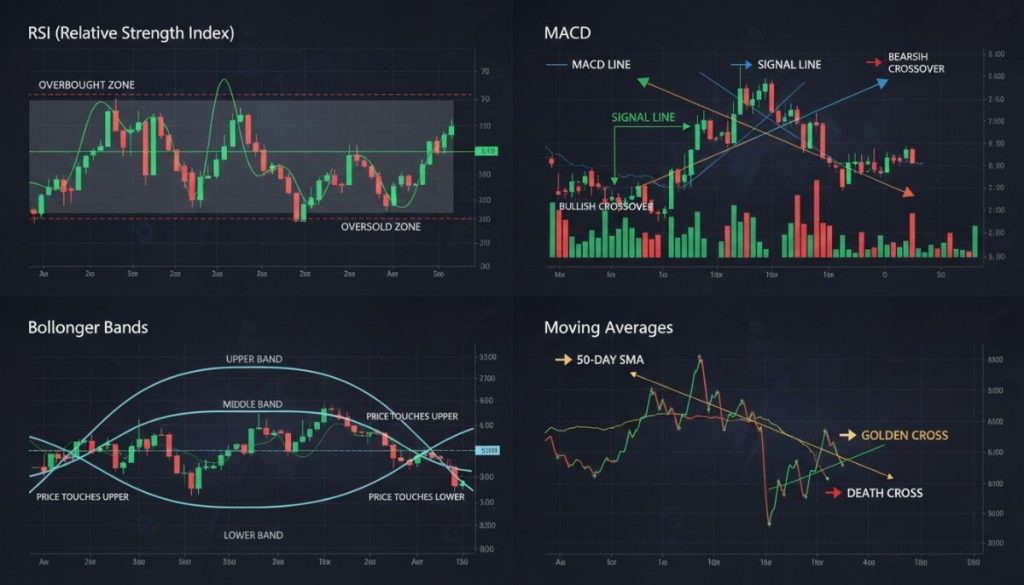
Basically, indicators are mathematical calculations based on price and volume. Indicators aren’t perfect. There are usually 2-4 indicators used together by successful traders.
Averages (MA)
Price data is smoothed by moving averages so you can tell which way the trend is going.
- Keep it simple
A moving average (SMA) is the average price over time. People pay attention to the 50-day and 200-day SMAs.
Recent prices are weighted more in a moving average. Faster price changes.
The 50-period MA crossed over the 200-period MA and that’s a golden cross. There’s a bullish signal.
When the 50-period MA crosses below the 200-period MA, it’s a death cross. Signals of bearishness.
Index of relative strength (RSI)
With RSI, you can tell when something’s overbought or oversold. Scales from 0 to 100.
- Over 70: Overbought (price might reverse)
- Oversold (may reverse) below $30
- The price made a higher high, but the RSI made a lower high (bearish).
- Divergence: Price makes lower low but RSI makes higher low (bullish)
The moving average convergence and divergence (MACD).
Trend direction, momentum, and reversal potential are shown by MACD.
- A MACD line above the signal line means bullish momentum
- Momentum is bearish when MACD is below signal line
- Strength of momentum is shown by histogram bars
- Bullish crosses above zero
- When the zero line crosses: Bearish
Bollinger bands
Bollinger Bands show volatility and potential reversal points.
- Price touched the upper band: Potentially overbought
- Price touching the lower band: Potentially oversold
- Squeeze (bands narrowed): Low volatility, and often precedes a large move
- Expansion (bands widen): High volatility
Volume of indicators
Volume confirms price movements.
- Price up + volume up: Strong uptrend
- Price up + Volume down: Weak uptrend, possible reverse.
- Price down + volume up: Strong downtrend
- Volume down + price down: weak downtrend, maybe reversal
On-Balance Volume (OBV): Cumulative volume measurement. OBV rising suggests accumulation. OBV falling suggests distribution.
The Fibonacci Retracement
Fibonacci levels are based on the golden ratio (0.618) and identify potential support and resistance. These are the common levels: 0.236, 0.382, 0.500, 0.618, 0.786. Price usually retraces to these levels after a big move.
Clouds of Ichimoku
Support/resistance, trend direction, and momentum are shown by advanced indicators. You can tell just by looking:
- Uptrend: Price above cloud
- Downtrend when price is below cloud
- Price inside the cloud: Choppy, no clear trend
Popular Cryptocurrency Trading Strategies
Different strategies suit different personalities, time commitments, and market conditions.
Day Trading
Day trading means opening and closing positions in the same day. No overnight holdings. Traders aim for small profits on many trades.
Timeframe: 1-minute to 1-hour charts
Holding period: Minutes to hours
Time commitment: Full-time (4-8 hours daily).
Required skills: Fast decision-making, technical analysis, emotional control
Good market conditions: volatile, trending, or range-bound (strategy dependent).
Typical profit targets: 0.5% to 2% per trade
Success rate for beginners: Very low (<10%)
Day trading is the hardest trading style. It requires constant attention, fast reactions, and strong emotional control. Day traders lose money.
Swing trading
Swing trading aims to capture “swings” in price over several days to weeks. Traders hold through short-term fluctuations.
Timeframe: 4-hour to daily charts
Holding period: 2 days to 2 weeks
Time commitment: Part-time (1-2 hours daily);
Skills: Technical analysis, patience, trend identification
Best market conditions: Trending markets
Typical profit targets: 5% to 20% per trade
Moderate success rate with proper risk management
Beginners should try swing trading instead of day trading. The pressure is off, there’s more time to think, and there’s less emotional intensity.
Scalping
Scalping aims for very small profits on many trades, sometimes dozens or hundreds daily. Positions last seconds to minutes.
Timeframe: Tick charts, 1-minute charts
Holding period: Seconds to minutes
Time commitment: Full-time, intense focus
Required skills: Extremely fast execution, low latency, automation is often used
Best market conditions: liquid markets with tight spreads
Typical profit targets: 0.1% to 0.5% per trade
Success rate: Very low; requires institutional-grade infrastructure
Scalping is not recommended for retail traders. Professional firms with faster execution, lower fees, and co-located servers dominate this space.
Position trading,
Position trading means holding trades for months or years. Position traders ignore short-term fluctuations, focusing on major trends.
Timeframe: Weekly to monthly charts
Holding period: Months to years
Time commitment: MINIMAL (checks periodically)
Skills needed: macro understanding, patience, conviction
Best market conditions: Strong long-term trends
Typical profit targets: 100%+ over the holding period
Success rate: High among trading styles, but blurred the line with investing
Investing in positions is similar to position trading. You need the least time and energy, but you also need the most patience.
Trend Following
Buying when the price is trending upwards and selling (or shorting) when it’s trending downwards. Follow the trend, don’t predict reversals.
Trends are your friends.
Signals for entry: Prices above moving averages, higher highs, higher lows
A trend reversal has been confirmed (lower highs, lower lows).
Strong trending markets: Best market conditions
Choppy, sideways markets (whipsaws) are the worst.
Reversion Means
Mean reversion says a price will go back to its average after an extreme move. Sell when it’s overbought, buy when it’s oversold.
“What goes up must come down.”
Price far below the moving average, RSI below 30 (oversold)
Signals for exit: RSI goes back to 50, price goes back to moving average
Markets that are range-bound and sideways are the best
The worst market conditions are strong trending markets (you can get run over).
Risk Management for Crypto Traders
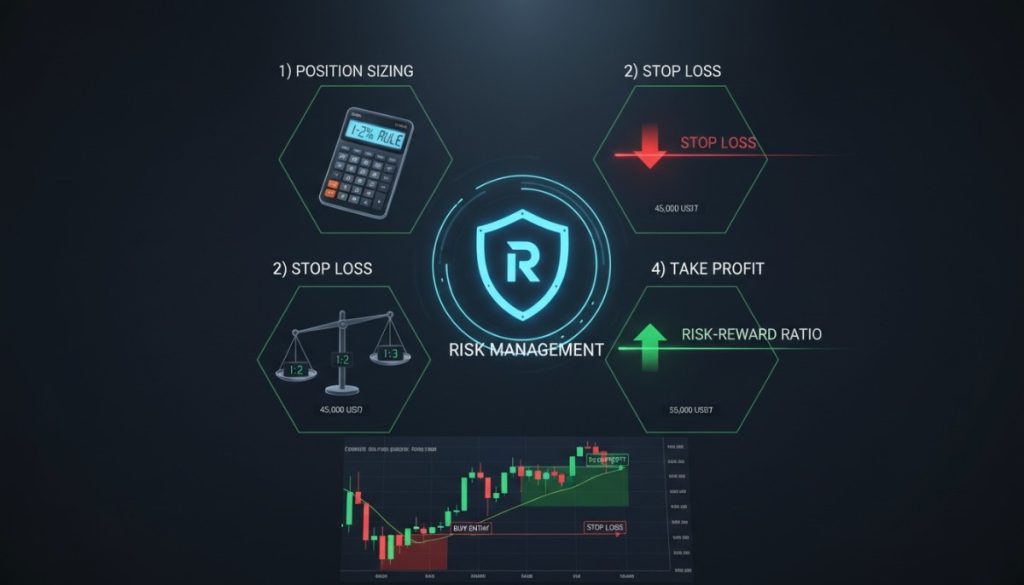
Risk management is more important than strategy. Even the most effective strategy fails without proper risk controls.
Position size: Never risk more than 1-2% of your trading capital on a single trade. If you have 10,000, maximumlosspertradeshouldbe$10,000, the maximum loss per trade should be $100-$200.
You can calculate position size this way: account size × risk percentage ÷ stop loss distance = position size.
The position size is $2,000 for 10,000 accounts, 110,000 accounts, and 1100; the stop loss is 5% away.
Stop losses: Always use them. A stop loss is a predetermined price at which you exit a losing trade. Never trade without a stop.
Stop loss placement: Below recent support for long positions. Above recent short position resistance. Consider market volatility. Too tight of a stop will get hit during normal business hours. Too wide of a stop risks large losses.
Take profits: Predetermined prices where you exit winning trades. Lock in profits systematically rather than hoping for unlimited gains.
Risk-reward ratio: Minimum 1:2 (risk 1 to make 1 to make 2). 1:3 is better. If your stop loss is 5% below entry, your take profit should be at least 10% above entry.
Maximum daily loss: Stop trading for the day if you lose a predetermined amount (e.g., 5% of your account). Prevents revenge trading and emotional decisions.
Stop trading if your account declines by a certain percentage (e.g., 20%). Take a look at your strategy again.
Keep an eye on correlations: Crypto assets move together a lot. If all your long positions are correlated, you don’t diversify your risk.
Don’t leverage too much: Leverage multiplies profits and losses. Beginners should stay away from leverage. Most experienced traders don’t use more than 3x-5x.
Make sure you know what to do in case of extreme volatility. We’ve only placed a few orders. You don’t need to panic.
Trading Psychology: Mastering Your Emotions
Psychology separates successful traders from unsuccessful ones. You can learn technical skills pretty easily. I have a hard time controlling my emotions.
The fear of losing money makes traders sell early (fear of losing profits) or avoid making good trades (fear of losing money).
Greed causes traders to hold too long (hoping for more profits) or take excessive risk (chasing bigger returns).
When you lose, revenge trading happens. As a result, traders increase their position size or break rules to “get even.” This usually makes losing more difficult.
Traders buy when prices have moved up significantly, often around the top, because of FOMO (Fear Of Missing Out).
Confirmation bias causes traders to ignore contradictory evidence in favor of information that supports their position.
Overconfidence follows winning streaks. Traders take excessive risk, believing they cannot lose. The market humbles everyone eventually.
How to manage emotions:
Use a trading journal. Record every trade: entry, exit, size, strategy, rationale, emotions. Review weekly. Identify patterns.
Don’t budge from your plan. You’ve got to write your trading plan. Don’t break it. Deviate only after careful analysis, not on impulse.
Breaks are good. Take a step back after a loss. There’ll be a market tomorrow. The only thing worse than forced trading is losing trades.
Spend some time meditating or exercising. Decision-making is improved by stress management.
When you’re struggling, size down. Reduce position sizes if you’re losing consistently. Start small and build your confidence.
Learn to accept losses. There’s always a loss in trading. You’re going to lose sometimes. You want consistent profits over a lot of trades, not just one big win.
Fundamental Analysis for Traders
Unlike technical analysis, fundamental analysis looks at the underlying value of a cryptocurrency.
The dynamics of token supply matter in tokenomics. How’s the inflation rate? The total supply? Is there a burning mechanism? When will it be distributed? Long-term price is affected by tokenomics.
Check out GitHub for development activity. What’s the status of development? What’s the number of developers? Have you heard anything new? The price doesn’t matter when a dead project fails.
It looks like real adoption is happening, since there are more and more active addresses and transactions. We’re having a problem with declining usage.
What are the competing projects? How does this project differ? What makes you stand out?
What’s the team behind the project? Where are you from? Is their identity public? There’s a higher risk with anonymous teams.
Projects are supported by engaged communities. Twitter, Discord, and Telegram are all good places to check.
Is there a risk of regulatory action? The classification of a security can have a big impact on availability.
Partnerships and adoption: Real partnerships with established companies suggest real value. It’s common to announce “partnerships” that are just marketing agreements.
Narratives drive crypto markets (DeFi summer 2020, NFT mania 2021, AI crypto 2023-2024). Positioning trades is easier when you understand current narratives.
On-Chain Analysis for Traders
The on-chain analysis uses blockchain data to understand market dynamics. Cryptocurrency trading has this unique feature.
Inflows and outflows at exchanges: Lots of inflows indicate selling pressure. A large outflow suggests accumulation (withdrawal to cold storage).
Declining exchange reserves (coins leaving exchanges) are bullish for prices. Reserves (coins arriving to sell) are bearish.
Historically, long-term holders (LTHs) sell at tops. The accumulation of LTHs historically marks bottoms.
Sold by miners and validators: Miners selling rewards creates pressure to sell. Reduced sales suggest confidence.
A rise in active addresses suggests adoption and price support. The number of active addresses is dropping, which suggests interest is waning.
The number of transactions is going up, which suggests network usage. Transactions are falling, so activity is declining.
HODL waves: Age distribution of coins. The fact that so many old coins are moving suggests a potential distribution.
There are a bunch of on-chain metrics: MVRV Z-score (market value to realized value), Puell Multiple (miner revenue relative to historical average), and Reserve Risk (holder confidence).
Trading Bots and Automation
Automated trading bots execute trades based on predefined rules. It’s hard to set up bots, but they remove emotion.
Types of bots:
Grid bots: Place buy/sell orders at regular intervals. Range-bound markets are great for profiting from volatility.
Positions are automatically accumulated by DCA bots. It’s best to enter positions gradually.
Bots that exploit price differences across exchanges. Competitive as hell.
Trades based on indicators (RSI cross, moving average cross, etc.).
There are a lot of bot platforms out there, including 3Commas, Pionex, Binance’s Grid Trading, and Bybit’s Trading Bots.
The risks of bots: They follow rules exactly, including going into losses. Nothing to do with discretion. Bots that aren’t configured right lose money fast. Market conditions change too fast for bots. Losses can happen because of technical problems (API disconnects, server downtime).
The best approach is to start from scratch. First, learn how to trade manually. Automate only strategies you’ve proven profitable manually. Don’t worry about big allocations. Keep an eye on bot performance.
Tax Implications of Cryptocurrency Trading
Trades can create taxable events. It’s a mistake to ignore taxes.
Trading events that are taxable:
- Fiat to crypto
- Buying and selling cryptocurrencies
- Buying with crypto
- Making money from futures or margin trading
Non-taxable events:
- With fiat, you can buy crypto
- Transferring money between wallets you control
In many jurisdictions, FIFO (first-in-first-out) is the default. Gains are minimized with HIFO (highest-in-first-out). There’s also LIFO (last-in, first-out).
The traditional wash sale rules don’t apply to crypto in the US right now (can’t claim loss if you buy the same thing within 30 days).
Capital gains, losses, and taxes: Most jurisdictions require reporting. In the US, you’ll need Form 8949 and Schedule D.
Keep track of everything: date, asset, amount, price, proceeds, and fees. The exchanges provide reports, but using specialized crypto tax software (CoinTracker, Koinly) is recommended.
Estimated taxes: If you trade profitably, you might have to pay estimated taxes. Penalties can be imposed if you don’t pay.
Get a professional to help you with crypto tax rules. Talk to a tax professional who knows about cryptocurrencies.
Common Trading Mistakes to Avoid
Time and money can be saved by learning from others’ mistakes.
The first mistake is trading without a plan. Getting in and out of trades randomly. You don’t have an entry criteria, an exit criteria, or a risk management system. It turns into gambling when you trade.
The second mistake: Taking on too much risk. I lost 50% of my account in a few trades because I had too big a position size. Don’t risk more than 1-2% per trade.
Mistake 3: No stop loss. Let’s hope losing positions recover. Catastrophic losses start with small losses.
Moving stop losses is mistake 4. Widening stops when price approaches “because it’ll bounce.” This makes small losses big.
The 5th mistake: Revenge trading. After losses, you try to get even by increasing your risk. Compounding losses is bad.
Mistake 6: Leverage too much. Leverage up to 50x or 100x. It only takes one small move against you to wipe out your whole account.
FOMO buying is mistake 7. I buy when the price is “mooning.” Usually I buy near the top.
Panic selling is mistake 8. Selling because the price is “crashing.” Usually sells near the bottom.
The 9th mistake: Ignoring the market. If a market is range-bound, use trend-following strategies, and if it’s trending, use mean reversion strategies.
The 10th mistake: Overtrading. I’m taking too many trades. Trading when there’s no good setup. Trades are forced.
The Future of Cryptocurrency Trading
In the coming years, crypto trading will be shaped by a few trends.

The regulatory landscape is changing: More exchanges will get licenses. We’re going to have to watch derivatives markets more closely. We’re going to automate tax reporting (Form 1099-DA in the US).
Crypto is now being traded by hedge funds, market makers, and banks. The result is more liquidity, but also a change in market dynamics.
Algorithmic trading and artificial intelligence: AI-powered trading systems might replace humans in the future.
Layer-2 and cross-chain trading: You can trade across different blockchains and layer-2 networks.
Growth of decentralized exchanges (DEXs): DEX trading volume keeps on growing. Centralized exchanges could be challenged by solutions for order book DEXs and better user experience.
Trading real-world assets (RWAs) on blockchain: Stocks, bonds, commodities, and real estate will be tokenized. Traders will get exposure to traditional assets.
Dominance of derivatives: Perpetual swaps already dominate crypto trading. We’re going to see more options and more complex derivatives.
Evolution of mobile trading: Mobile apps will become sophisticated enough for professionals.
It’s all going to be better for traders in the future with more access, more instruments, more competition, and more regulatory clarity.In the coming years, crypto trading will be shaped by a few trends.
The regulatory landscape is changing: More exchanges will get licenses. We’re going to have to watch derivatives markets more closely. We’re going to automate tax reporting (Form 1099-DA in the US).
Crypto is now being traded by hedge funds, market makers, and banks. The result is more liquidity, but also a change in market dynamics.
Algorithmic trading and artificial intelligence: AI-powered trading systems might replace humans in the future.
Layer-2 and cross-chain trading: You can trade across different blockchains and layer-2 networks.
Growth of decentralized exchanges (DEXs): DEX trading volume keeps on growing. Centralized exchanges could be challenged by solutions for order book DEXs and better user experience.
Trading real-world assets (RWAs) on blockchain: Stocks, bonds, commodities, and real estate will be tokenized. Traders will get exposure to traditional assets.
Dominance of derivatives: Perpetual swaps already dominate crypto trading. We’re going to see more options and more complex derivatives.
Evolution of mobile trading: Mobile apps will become sophisticated enough for professionals.
It’s all going to be better for traders in the future with more access, more instruments, more competition, and more regulatory clarity.
Conclusion
It’s possible to make a lot of money trading cryptocurrency, but only if you’re disciplined, educated, and manage your risk properly. Beginners lose money most of the time. Successful traders treat trading like a business, not like gambling.
Take it slow. Learn the basics of technical analysis. You’re better off mastering one or two strategies than jumping from one to another. Make sure you size your positions right and stop losing. Keep your emotions under control. Keeping a trading journal is a good idea. Make sure you keep an eye on your performance.
Starting with spot trading and small positions is a good idea. Don’t use leverage until you’ve had months of consistent profits. You should paper trade (simulate) before risking real money. Losses are part of trading — the goal is to be profitable over many trades, not to win every one.
Cryptocurrency markets will keep offering volatility and opportunity. It’s possible to participate profitably with the right preparation. Take risks, but respect them. Trading money you can’t afford to lose is never a good idea. Don’t stop learning.
Frequently Asked Questions (FAQs).
Q1: Is cryptocurrency trading profitable?
Yes, many traders make money. It’s true that most beginners lose money. It takes education, discipline, risk management, and emotional control to be profitable. Trade like it’s a serious skill that takes years to master.
Q2: How much money do I need to start trading crypto?
There are no minimums on most exchanges. Very small accounts, however, are hard to manage because position sizing gets restrictive. A little success can never hurt.
Q3: What is the most suitable cryptocurrency for day trading?
For beginners, Bitcoin and Ethereum have the highest liquidity, tightest spreads, and most predictable behavior. The volatility of altcoins is higher (more profit potential, more risk), but they’re also less predictable.
Q4: How much leverage should I use?
You shouldn’t use leverage (1x) if you’re a beginner. Experienced traders rarely trade more than 3x-5x for spot trading or 5x-10x for futures. It’s not a good idea to leverage more than 10x.
Q5: What is the difference between market and limit orders?
The market orders execute immediately at the current price (guaranteed execution, not price). Orders with limits only execute at your specified price (guaranteed price, not execution).