

History of the World Trade Organization
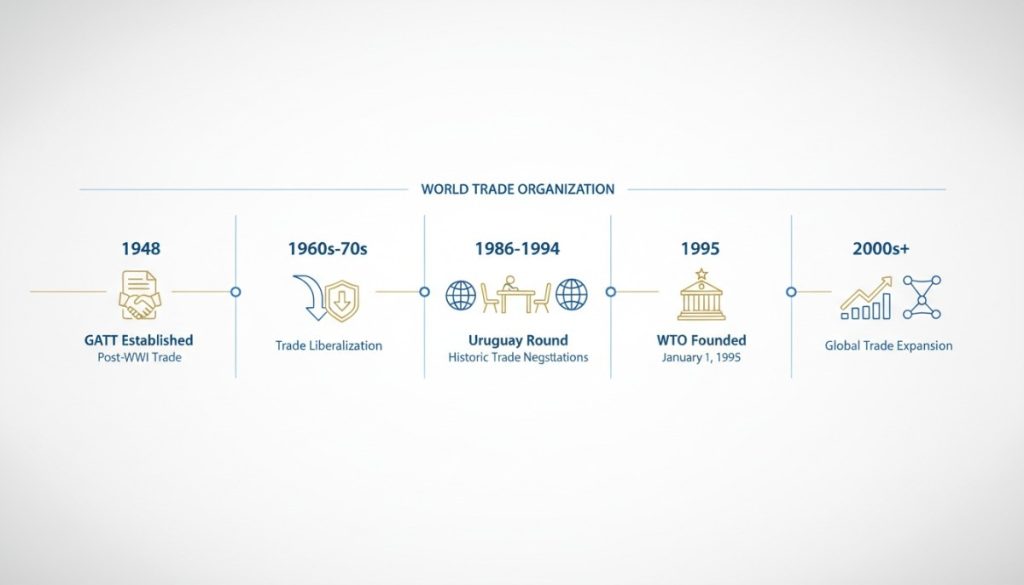
January 1, 1995 was the official start date for the World Trade Organization. This replaced the General Agreement on Tariffs and Trade (GATT), which had governed international trade since 1948.
In order to manage global trade rules effectively, the WTO was designed to be stronger and more structured. Trade relations and economic cooperation needed a formal institution as globalization expanded during the late twentieth century.
Among the world’s biggest trade negotiations, the Uruguay Round led to the creation of the WTO. Reforms in agriculture, services, intellectual property, and dispute resolution were included in the agreement.
Most countries in the world are members of the organization today, and it’s still influencing trade policy.
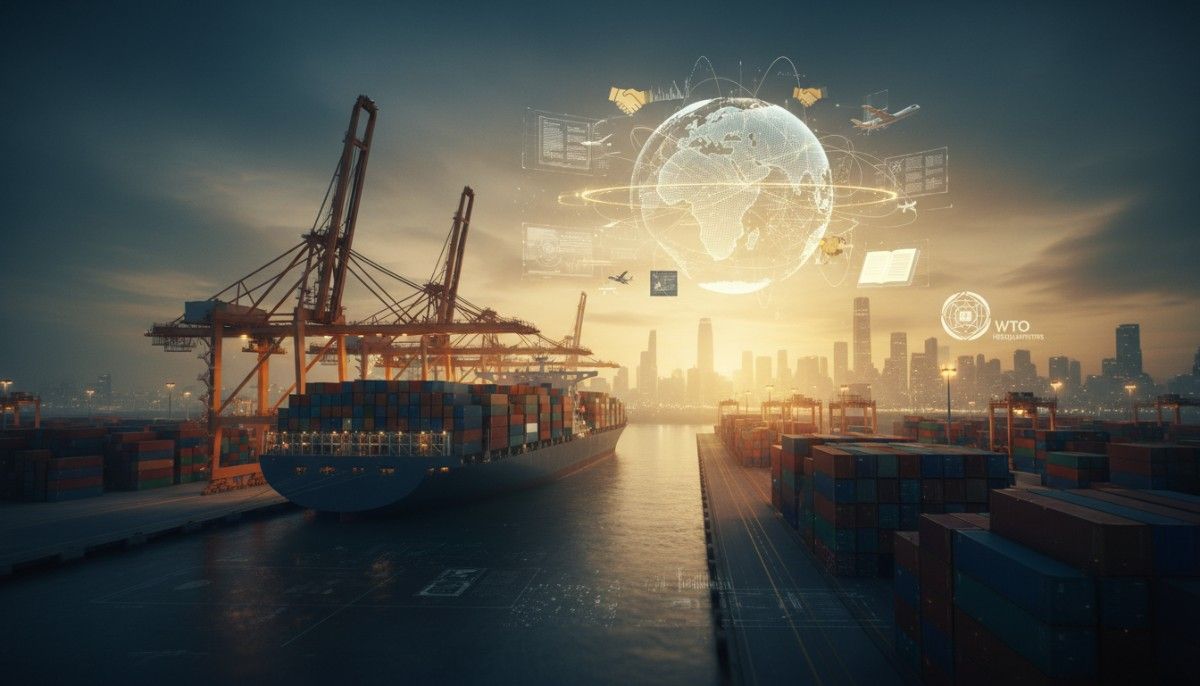
World Trade Organization, or WTO, is one of the most influential international organizations in the world. It’s important to maintain fair trade practices among nations since it was established to regulate and facilitate global trade.
Economic development relies heavily on international trade. To create jobs, strengthen industries, and improve living standards, countries rely on imports and exports. Trade between nations can flow smoothly, predictably, and fairly with the World Trade Organization.
Businesses, governments, and consumers all have a lot to do with the WTO, from resolving trade disputes to negotiating trade agreements. As the world gets more interconnected, the organization still plays a huge role in global commerce and international cooperation.
Main Objectives of the World Trade Organization
There are several important objectives that the World Trade Organization is working towards in order to improve the international trade system.
1. Promoting Free Trade
In order to increase international trade, the WTO encourages countries to reduce barriers to trade such as tariffs, quotas, and import restrictions. By doing this, we are able to create a more open environment for global trade.
2. Ensure fair competition
By working to prevent unfair trade practices, including dumping and illegal subsidies that may harm the international competitive landscape, the organization aims to prevent unfair trade practices.
3. Resolving Trade Disputes
Trade agreements and policies are governed by the WTO, which provides a legal framework for resolving disputes between countries related to these agreements and policies.
4. Supporting Economic Development
In order for developing countries to participate effectively in global trade, they are provided with technical assistance and support.
5. Encourage trade negotiations.
It serves as a platform where member nations are able to negotiate trade deals and economic policies with each other.
Structure of the World Trade Organization
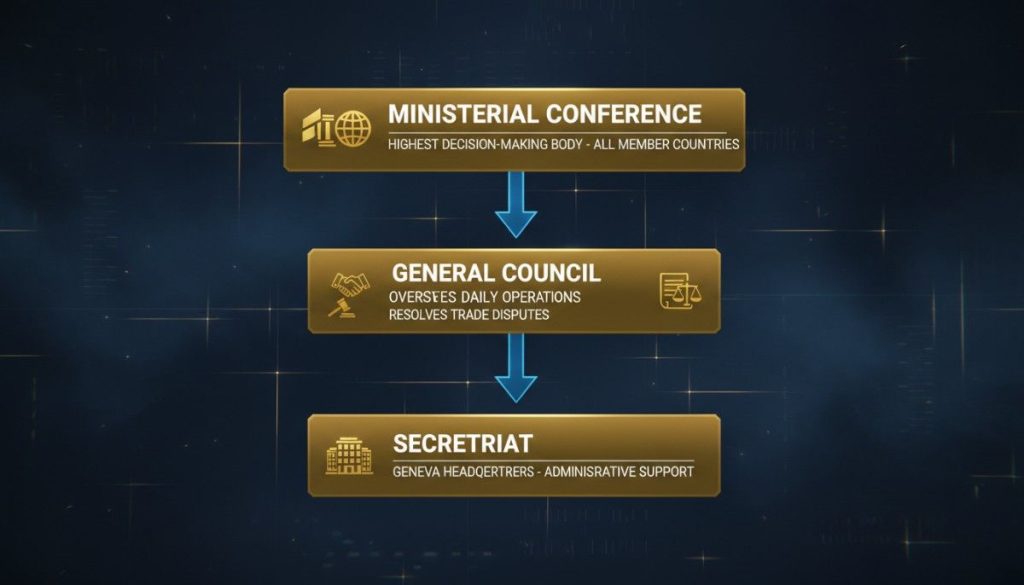
A number of major bodies and councils make up the WTO, which operates through a number of different channels.
The Ministerial Conference
In the WTO, the Ministerial Conference is considered to be the highest decision-making body. Each member country has representatives who meet regularly for the purpose of discussing trade matters and policy decisions that affect all members.
The General Council
There are several committees within the General Council that are responsible for overseeing daily operations as well as trade agreements.
Dispute Settlement Body
Members of this body are responsible for handling trade disputes amongst members, as well as ensuring that WTO agreements are adhered to.
Secretariat
The WTO Secretariat is responsible for providing administrative and technical support for the organization’s activities. The headquarters of the company are located in Geneva, Switzerland.
Importance of the World Trade Organization
There is no doubt that the World Trade Organization plays an important role in maintaining the stability of the global economy.
Through the creation of common trade rules, the organization is able to reduce the uncertainty that surrounds international trade. A transparent and predictable set of trade regulations can make it easier for businesses to operate with more confidence.
As part of the WTO, nations are also encouraged to cooperate peacefully in economic matters. It is more common for trade disputes to be resolved through legal procedures rather than through political conflict.
A major benefit of international trade for consumers is that countries can import goods at lower prices and consumers have access to a greater variety of products as a result. There are numerous opportunities for companies to expand into international markets and increase their profits by doing so.
Participation in global trade is a powerful tool for developing countries to stimulate economic growth, reduce poverty, and improve infrastructure.
WTO Agreements and Trade Policies
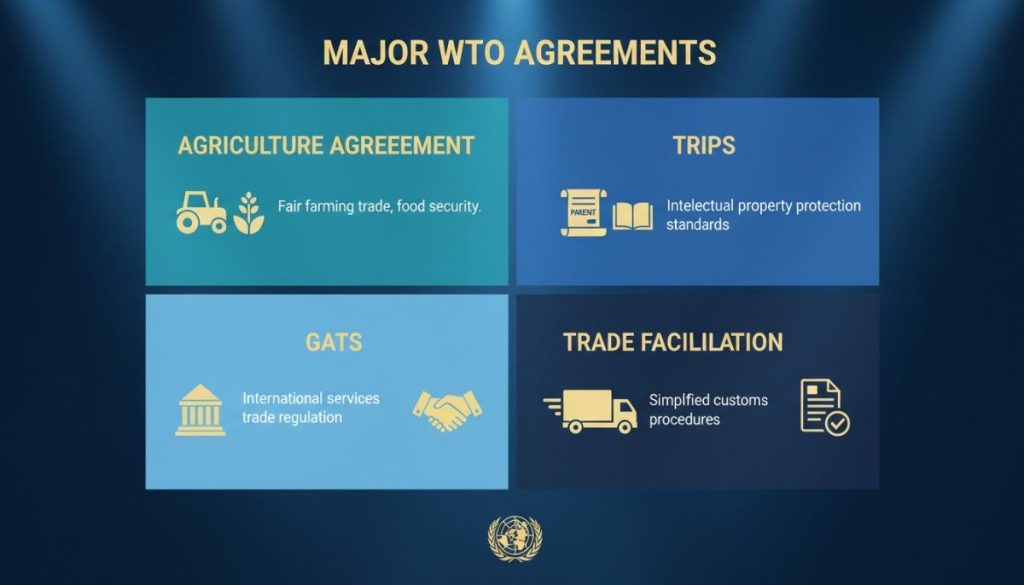
Multiple international agreements that regulate the trade between member countries are overseen by the World Trade Organization.
Agreement on Agriculture
As a result of this agreement, agricultural trade policies, food security, as well as the reduction of trade distortions in the farming industry will be discussed.
Trade-Related Aspects of Intellectual Property Rights (TRIPS).
The TRIPS agreement establishes an international standard for intellectual property protection, which includes patents, copyrights, and trademarks.
The General Agreement on Trade in Services (GATS).
It is the GATS that regulates international trade in services such as banking, telecommunications, tourism, and education, among others.
Trade Facilitation Agreement
By concluding this agreement, the customs procedures will be simplified and the movement of goods across borders will be improved.
Dispute Settlement System
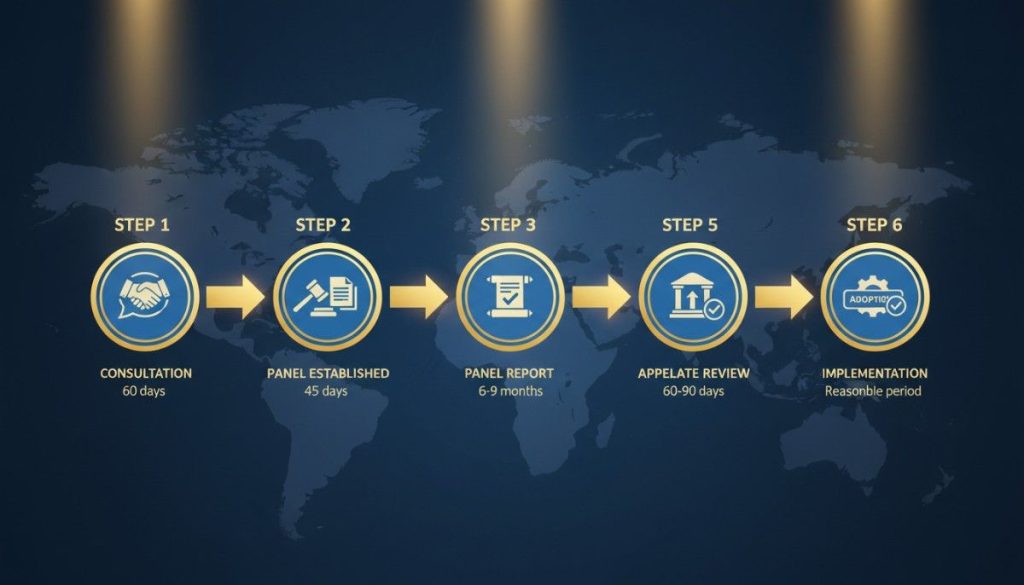
The WTO plays an important role in resolving international trade disputes, and this is one of its most important functions.
It is possible for countries to approach the WTO dispute settlement system when they think that another member has violated the terms of a trade agreement. There are independent panels that review the case and issue rulings based on international trade law after reviewing the case.
It is through this system that fairness is maintained and that trade conflicts are prevented from escalating into larger political disputes as well.
With regard to tariffs and subsidies, IP rights, import restrictions, and intellectual property rights, the WTO has handled disputes over the years.
Advantages of the World Trade Organization
The World Trade Organization (WTO) provides many benefits to the world economy in a variety of ways.
Economic growth
The growth of international trade encourages the creation of new jobs, investment, and production.
Consumer Benefits
By opening up trade between countries, consumers are able to access a wide range of goods and services that are affordable.
Business expansion
By gaining access to international markets and customers, companies are able to expand into larger markets.
Stable trade environment
There is a reduction in uncertainty and a promotion of long-term business planning when trade rules are in place.
Peaceful international relations
In order to strengthen diplomatic relations between countries, economic cooperation can be a powerful tool.
Challenges Facing the World Trade Organization
There are a number of challenges that the WTO faces despite the fact that it is an important organization.
Trade Wars
As a result of conflict between major economies, international trade systems can be disrupted and international cooperation can become weakened.
Protectionism
In order to protect their domestic industries, some countries impose tariffs and restrictions on imports, thereby restricting free trade.
Global economic inequality
There are times when developing countries find it difficult to compete fairly on the international market.
Digital trade issues.
Global trade is facing new challenges in terms of regulation due to the rapid growth in e-commerce and digital services.
Climate and sustainability concerns.
There is an ever-increasing influence of environmental issues on international trade policies and economic agreements.
WTO and Developing Countries
WTO focuses a great deal of attention on developing countries in its negotiations.
A major part of the organization’s mission is to provide technical assistance, training programs, and trade support to poorer nations so they can participate in the global economy.
It is widely acknowledged that many developing economies are heavily dependent on exports, such as agriculture, textiles, and raw materials. The WTO is working to create fair trade opportunities for these countries through its agreements.
It has been argued by critics that some trade rules still favor wealthier nations and multinational corporations despite the fact that others do not. It is as a result of this situation that there is continuing debate about trade fairness as well as economic equality.
The Future of the World Trade Organization
Technological advancements, digital commerce, and the changing geopolitical environment continue to drive the evolution of global trade at a rapid pace.
A majority of the WTO’s attention will likely be focused on the following areas when it comes to modernizing trade rules:
- In the digital age, trade has become increasingly important
- Intelligence generated by artificial means
- Sustaining the environment is an important issue
- Securing the supply chain is one of the most important issues
- Regulating e-commerce in the United States
Despite the expansion of globalization, international cooperation will remain essential to maintaining a stable trade system and a growing economy in the long run.
As well as improving the decision-making process, the organization may also need to strengthen the dispute resolution mechanism to ensure the process is fair.
Why the World Trade Organization Matters
The World Trade Organization has an impact on nearly every aspect of our daily lives in the modern world. From the food people eat to the technology they use, global trade has a profound effect on economies and the consumer experiences around the world.
Economic conflict and trade barriers could create instability in the economy and reduce opportunities for growth, if there were no international trade rules in place.
It is the role of the WTO to provide a framework that facilitates cooperation, transparency, and economic development. Despite the challenges facing the organization, it continues to play an important role in promoting international commerce and supporting the global economy despite the challenges it faces.
Conclusion
As one of the most significant institutions governing global trade and economic cooperation, the World Trade Organization continues to be one of the most important. There are a number of ways in which the WTO helps countries maintain stable and fair trading relations by implementing trade agreements, dispute resolution systems, and policy negotiations.
In spite of the challenges that the organization faces, such as trade disputes, protectionism, and economic inequality, its role in supporting international commerce is undeniable. Despite the fact that the global economy continues to evolve, the World Trade Organization remains essential to the promotion of sustainable economic growth and peaceful international cooperation in the future.
Frequently Asked Questions (FAQs)
1. What is the World Trade Organization?
As an international organization, the World Trade Organization regulates global trade and sets international trade rules for its member countries.
2. When was the WTO established?
It was on January 1, 1995 that the World Trade Organization was officially established.
3. What is the WTO’s main purpose?
The main purpose of the World Trade Organization is to ensure that international trade between nations is fair and smooth.
4. Where is the WTO headquarters located?
Geneva is the headquarters of the World Trade Organization.
5. Why is the World Trade Organization significant?
The significance of the WTO can be attributed to its role in resolving trade disputes, promoting economic growth, and creating stability in international trade.