



Choosing a truck driving career is a smart move
Like the heartbeat of the body, the trucking industry powers the economy. You’ll find almost every product in a grocery store, warehouse, or shopping mall on a commercial truck. Truck drivers are in high demand year after year just because of that. Freight transportation remains one of North America’s most important industries in 2026, so there will be a lot of demand for CDL drivers. There’s a driver shortage in the trucking industry, with estimates ranging from 60,000 to over 80,000 unfilled positions.
Many people look for “truck driving schools near me” because they want a stable income without going to college. There are lots of CDL training programs that can be completed in just a few weeks, so you can get into the workforce fast. Compared to careers requiring expensive university degrees, trucking offers a faster path to financial independence. In refrigerated freight, hazardous materials transportation, or oversized loads, some long-haul drivers make well above average. In addition, industry reports show that driver pay is going up because of freight demand and driver turnover.
Many people are attracted to the lifestyle as well. It’s nice to travel across states without being trapped in an office environment for some drivers. Others prefer local delivery jobs that let them go home every day. There’s no such thing as a one-size-fits-all career in trucking anymore. There are now regional routes, dedicated contracts, and flexible schedules for different lifestyles.
The profession has also been improved by technology. In modern trucks, advanced safety systems, automatic transmissions, GPS routing, and driver comfort features make long hours a lot less exhausting. Experts believe that human drivers will continue to be essential for years to come, since trucking requires judgment, safety awareness, and problem-solving.
How Does a Truck Driving School Work?
Students who attend a truck driving school learn how to safely operate commercial vehicles and get a Commercial Driver’s License (CDL). Just like pilot school, but for highways instead of skies. The schools combine classroom instruction, simulator training, and hands-on driving experience to prepare students for the real world.
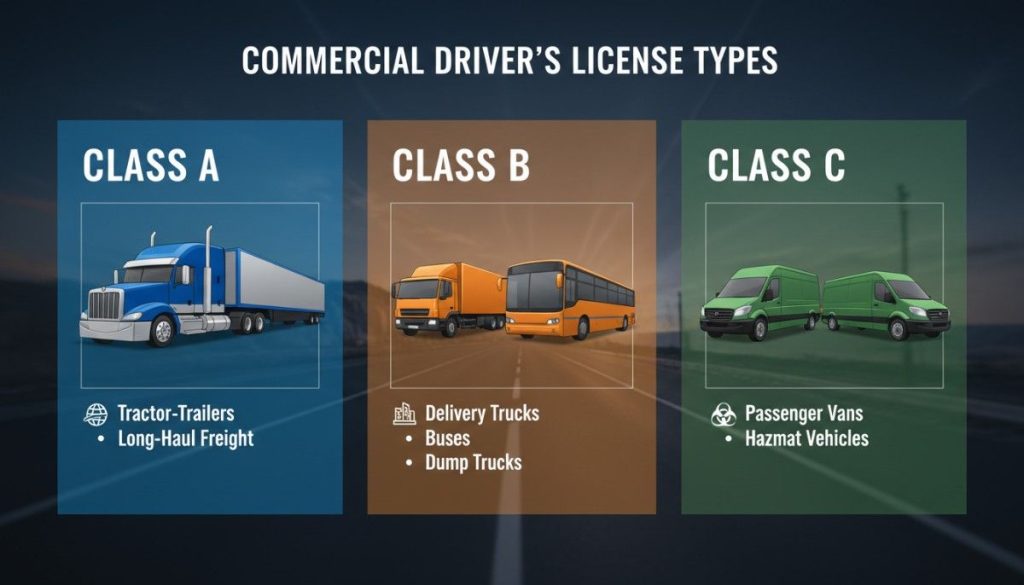
Most CDL schools focus on three main license categories:
| CDL Type | Vehicle Type | Common Jobs |
|---|---|---|
| Class A | Tractor-trailers, semi-trucks | Long-haul freight, tanker, flatbed |
| Class B | Straight trucks, buses | Delivery trucks, buses, dump trucks |
| Class C | Specialized small commercial vehicles | Passenger vans, hazmat vehicles |
CDL programs with Class A licenses are the most popular because they offer the most career options. Tractor-trailers, inspections, backing maneuvers, and transportation laws are all taught to students. Defensive driving techniques are also covered, as well as emergency response procedures.
Many people don’t realize how technical trucking has become. In today’s world, commercial drivers have to know about federal safety regulations, electronic logging devices, cargo security, and route planning. It’s easier to become a professional truck driver with a truck driving school than with a regular license.
In addition to hard skills, good schools teach soft skills. Due to the fact that drivers often represent transportation companies directly, communication, professionalism, customer interaction, and time management are becoming increasingly valuable. Employers want reliable, safe, and efficient drivers, not just people who can steer.
Training quality affects both safety and job prospects, so choosing the right school is important. Recently, federal regulators increased scrutiny on poorly run CDL programs, with thousands of schools getting reviewed for not meeting standards. It’s more important than ever to research schools carefully.
Finding the Best Truck Driving School
In the process of searching online for “best truck driving school near me”, you may feel overwhelmed by the number of programs that you may come across in your area. In some schools, excellent training and job placement support are offered, while in others, the focus is primarily on enrolling students as quickly as possible rather than offering them a quality education. A little knowledge of what to look for can help you save time, money, and frustration in the long run.
In order to check if an organization is accredited and licensed, the first thing to do is to call them. An entry-level driver training school must comply with all federal entry-level driver training standards (ELDT) as well as be properly registered with the state. In the future, if you attend a school that does not offer recognized certification, you may have serious difficulties when applying for jobs or performing the CDL test. It was found that many trucking schools failed to meet minimum training standards, which led to an increase in the regulation of the industry as a result of recent federal reviews.
It is as important to have good reviews and a good reputation as to have a good curriculum. As a result of reading online reviews from former students, you will be able to discover whether or not the instructors are patient, the equipment is modern, and whether graduates are able to find employment after completing the program. Instead of relying solely on flashy advertising to find the right school for you, look for schools that have consistent positive reviews. A school with older trucks but excellent instructors might be able to provide better training to its students than a school with a shiny campus but poor quality of instruction.
It is also important to have behind-the-wheel training hours as part of the process. The prices of some schools are advertised at a low level, but they only provide a limited amount of actual driving experience. There is no way to master a commercial truck driving skill from a classroom alone. It is akin to learning to swim from a book. You will feel more confident about your abilities at your first job if you spend more time practicing maneuvers, highway driving, backing, and parking than if you spend less time practicing these things.
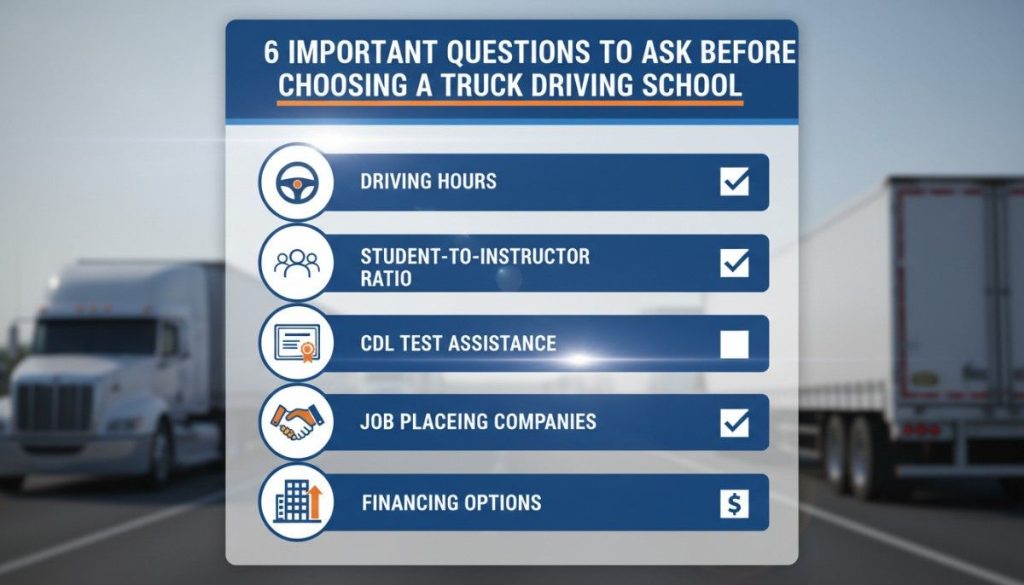
Before enrolling in the program, it is important to ask yourself the following questions:
- Can you tell me how many hours of actual driving experience are included in this package?
- Can you tell me how many students there are to each instructor?
- What is the school’s policy regarding CDL testing? Does the school assist with the test?
- How can I find out if job placement services are available in my area?
- What are some of the companies that recruit graduates?
- Can you offer financing options to your customers?
You can also gain a deeper understanding of the campus if you visit it in person rather than by looking at it online. Observe how instructors interact with students and how they interact with one another. The condition of the trucks should be checked to make sure they are well maintained and operational. In order to provide a professional learning environment, a school usually demonstrates its commitment to providing a quality education.
Training costs and financial aid for CDLs
One of the biggest concerns for future drivers is training cost. CDL school tuition can range from a few thousand dollars to over $10,000 depending on the location, program length, and included certifications. At first glance, that may seem expensive. But compared to traditional college programs costing tens of thousands per year, truck driving school can still be one of the fastest returns on investment.
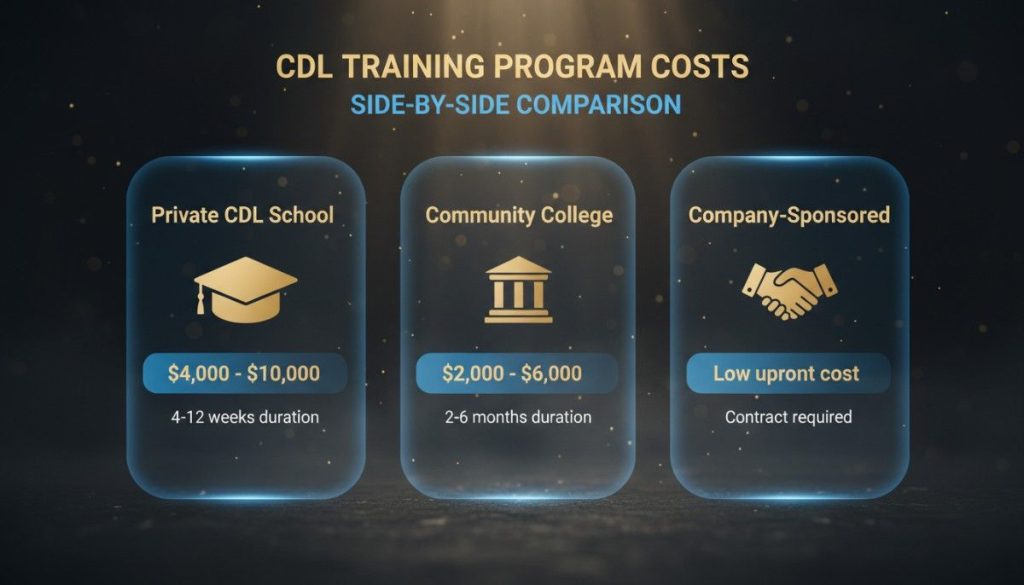
Here’s a general comparison of training costs:
| Program Type | Average Cost | Duration |
|---|---|---|
| Private CDL School | $4,000–$10,000 | 4–12 weeks |
| Community College CDL Program | $2,000–$6,000 | 2–6 months |
| Company-Sponsored Training | Low upfront cost | Contract required |
The schedules at private schools are usually more flexible and the completion times are faster. Although community colleges have lower tuition, they often have long waiting lists. Student programs sponsored by companies are popular because they’re cheap. These programs usually require graduates to work for a specific company after they graduate.
In 2026, financial aid options will continue to grow. Workforce development grants, veterans benefits, unemployment retraining assistance, or employer sponsorships are all available to students. After graduates finish several months of work, some trucking companies reimburse tuition. It’s a win-win situation, where employers get drivers and students don’t have to take on too much debt.
You should read contracts carefully before accepting sponsored training. There are penalties for leaving the company early in some agreements. It’s like joining a sports team with a scholarship—you get support, but you’ve got responsibilities.
Students should also take into account hidden fees like CDL permit fees, DOT physicals, drug tests, and licensing fees. You’ll avoid unpleasant surprises if you ask for an expense breakdown from schools.
The things you learn at truck driving school
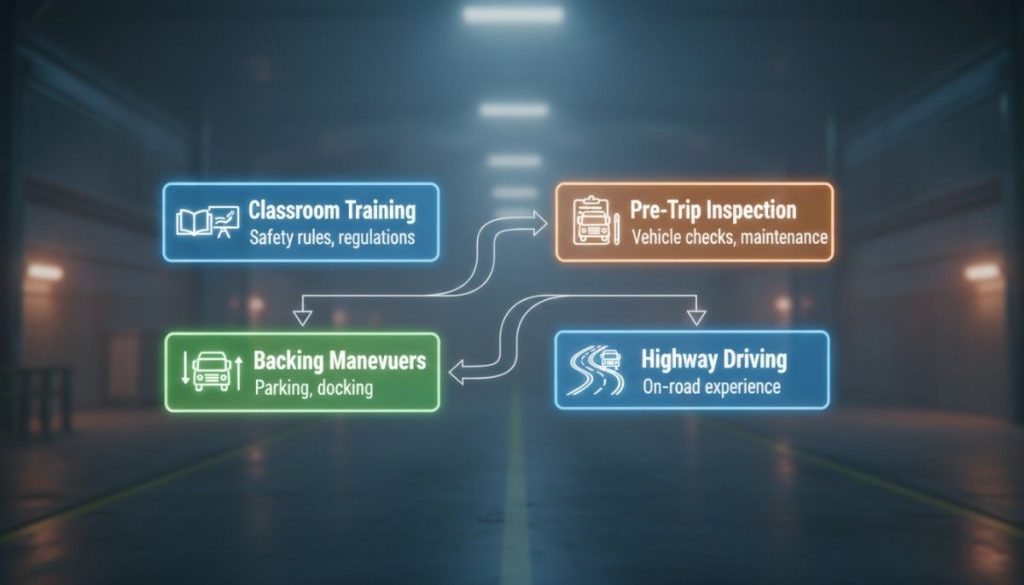
You don’t just learn how to shift gears or steer a trailer at truck driving school. Training builds confidence, awareness, and professional responsibility. Classroom lessons usually cover safety laws, vehicle systems, and federal transportation regulations.
At first, the classroom portion might seem boring, but it provides the foundation for every professional driver. In addition to hours of service rules, cargo securement, trip planning, logbooks, and hazardous driving conditions, students learn about hazardous driving conditions. You need to know these rules because trucking companies and government agencies strictly enforce them.
The best way for students to gain confidence is through hands-on training. Pre-trip inspections, straight-line backing, offset backing, alley docking, and highway driving are all taught by instructors. In the beginning, maneuvering a semi-truck through tight spaces feels intimidating, like navigating a giant ship through a narrow canal. Students gradually learn control and precision with repetition and coaching.
CDL education isn’t complete without safety training. Commercial vehicles can cause serious accidents if they’re operated carelessly. Defensive driving, weather awareness, braking techniques, and emergency procedures are all taught in schools. Recent accidents and licensing concerns have been attributed to poor training, so federal agencies are pushing for stronger safety standards.
Trucking technology is also taught in many schools. In modern fleets, electronic logging devices, GPS systems, lane departure warnings, and automatic braking are becoming standard. To succeed in the industry today, drivers need to be mechanically aware and tech savvy.
Depending on the program, you can get endorsements for tankers, doubles/triples, passengers, or hazardous materials. Because specialized freight jobs usually pay more than dry van routes, endorsements can increase earning potential.
Find the best truck driving school for you
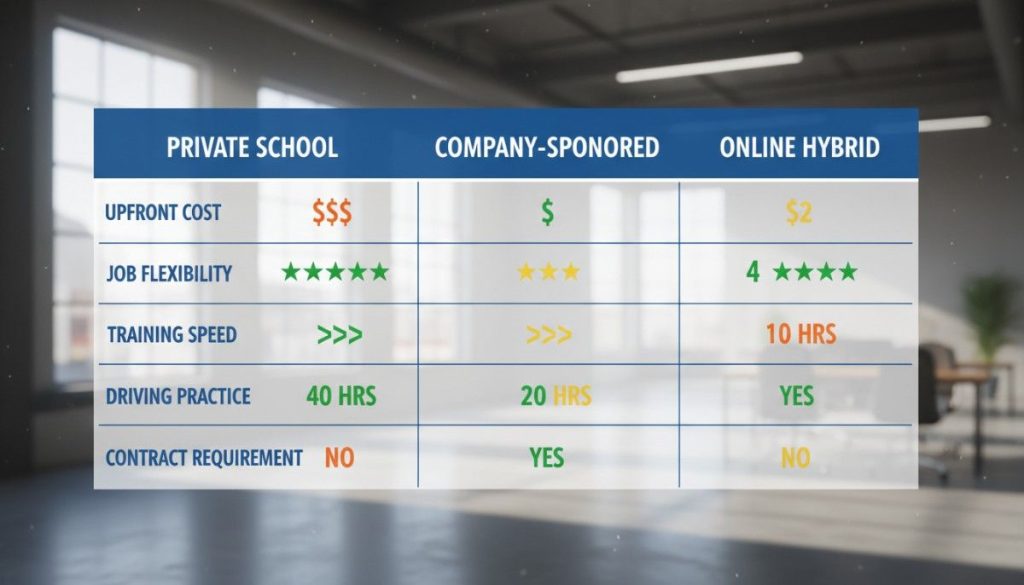
Truck driving schools don’t all work the same way. Others are all about speed and enrollment volume, while others are all about producing highly skilled drivers. The differences between schools can make a big difference in your career.
Private CDL schools usually don’t require employment contracts for independent training. After graduation, students have more freedom to choose employers, which can make jobs more flexible. Trucking schools often hire instructors who used to work in the industry.
Programs sponsored by companies work differently. In exchange for employment commitments, transportation companies train students. Due to the lower upfront costs, this option appeals to people with limited savings. Graduates must work for the sponsoring company for a set period, so there’s less flexibility.
It’s also become more common to do CDL programs online. Driving skills still need to be practiced in person, but some classroom instruction can now be done online. For students juggling work and family responsibilities, online learning is convenient. It’s impossible to replace real behind-the-wheel practice with an online program.
Here’s a comparison table:
| Feature | Private School | Company-Sponsored | Online Hybrid |
|---|---|---|---|
| Upfront Cost | Higher | Lower | Moderate |
| Job Flexibility | High | Limited | Moderate |
| Training Speed | Fast | Fast | Flexible |
| Driving Practice | Extensive | Varies | Limited in-person |
| Contract Requirement | No | Yes | Sometimes |
The price shouldn’t be the only thing students consider when choosing a school. Sometimes cheap programs cut corners on driving time or equipment quality. You can literally make the difference between safety and disaster in trucking if you get the right training.
Discussions in the industry also reveal mixed opinions about the shortage of drivers. Some experienced drivers say the issue is more about retention and working conditions than license holders. It’s just as important to pick the right school as to choose the right employer.
After graduation, job placement
A reputable truck driving school will offer its students job placement assistance, which is one of their biggest advantages. In order for a program to be successful, it must maintain relationships with regional and national carriers that actively recruit its graduates. There are even schools that host hiring events where students are interviewed before they have completed their training program.
As an entry-level driver, you usually begin your career with a position in over-the-road (OTR) because these positions offer valuable experience to you. It is true that OTR drivers may spend a considerable amount of time away from home, but it also gives them the opportunity to develop skills and increase their income quickly. Often times, after gaining a considerable amount of experience, drivers decide to move into local or dedicated routes where schedules are more predictable.
In terms of starting salaries, they vary based on factors such as location, freight type, and endorsements. In most cases, long-haul drivers, tanker operators, and hazardous materials operators earn higher wages than local delivery drivers. As carriers compete with one another for qualified drivers, pay rates continue to rise, according to industry data.
It is true that some schools offer guaranteed employment, but students should be aware of the specifics behind these claims. Getting job placement assistance does not necessarily mean that you will be able to land a premium job as soon as you graduate. Drivers who are new to the field may still need to gain experience before they are able to access higher-paying jobs.
The importance of networking in the trucking industry cannot be overstated. It is possible to gain guidance about reputable companies and career paths from instructors and recruiters. The ability to build professional relationships early on in your career can open doors for you later on. In addition to training, truck driving schools can also be seen as an entry point into a vast professional network that can prove to be very beneficial in the future.
As a rule, the most successful graduates are usually those who combine safe driving habits with professionalism as well as good communication skills. In order for a company to maintain an excellent safety record, drivers must represent their brand positively while maintaining an excellent safety record.
Avoid these mistakes when choosing a CDL school
It is common for new students to make avoidable mistakes when it comes to selecting a truck driving school. Oftentimes, people make the mistake of focusing entirely on price when they make their decision. If you go to a cheaper school, you may save money in the beginning, but you will end up spending more in the long run if the training is poor or employers don’t respect the reputation of the program.
The other mistake is to ignore the driving hours that you have accumulated during the day. It is not enough to watch instructional videos on how to operate a car and practice briefly in a parking lot to prepare for the real world and the fast paced traffic conditions on the highway. There is no doubt that students should give priority to schools that offer substantial hands-on experience to them.
The terms of company-sponsored contracts can also be confusing to some people who rush into them without fully understanding them. In order to avoid financial penalties, it is essential that you read employment agreements carefully so that you know what you are agreeing to. It is always a good idea to ask questions before signing anything.
Ignoring a school’s reputation is another serious issue that needs to be addressed. In light of the fact that government agencies are increasingly monitoring substandard CDL programs, enrolling in a school with a low rating can result in licensing complications in the future. As with any profession, success is a result of consistent effort and professionalism on the part of the professional.
Trends in trucking for the future
A growing number of students entering CDL schools today are entering into a world that is more technologically oriented than it has ever been before, and the trucking industry is changing rapidly as a result. Commercial drivers will remain essential because their judgment cannot easily be replaced by machines, which is why experts believe that automation discussions will dominate headlines in the future.
There is also an increase in the number of safety regulations that are becoming stricter. CDL schools, as well as driver qualifications, have come under increased scrutiny from federal agencies in an effort to reduce accidents and improve the quality of training. Due to the increasing value placed on properly trained drivers by employers, those students who graduate from reputable programs will likely benefit from stronger industry standards than their counterparts from less reputable programs.
Trucks powered by electric or alternative fuels are another emerging trend that is on the rise. There is a significant investment being made by major manufacturers in cleaner transportation technologies. Onboard electronics, charging systems, and energy efficiency may soon become vital technical skills that drivers may require in order to stay safe on the road.
Additionally, artificial intelligence and route optimization tools are also transforming the logistics industry. A driver today works with sophisticated systems that assist him in managing the fuel efficiency of his vehicle, the maintenance schedules of his vehicle, and the tracking of his freight. It is becoming more common for technology to act as a co-pilot rather than being replaced by it.
In the future, there is also a tendency toward greater specialization in the workplace. In addition to having better job security, drivers with endorsements and advanced certifications may also earn higher wages. The need for skilled professionals will continue to grow as freight networks become more complex in the coming years.
Conclusion
Choosing the best truck driving school near me is the first step toward entering one of the most important industries in the modern economy, and it is also the first step toward getting the job you desire. The trucking industry continues to offer a wide range of career opportunities, competitive pay potential, and multiple career paths for people willing to learn and hone their driving skills in order to become professional drivers.
It is important to choose the right training program in order to achieve the desired results. The accreditation of the school, the number of driving hours, the quality of the instructors, the job placement assistance, and the level of financial transparency matter when comparing schools. A CDL education that is of the highest quality can help build confidence, safety awareness, and offer long-term career opportunities.
In spite of technological advancements and stricter regulations, skilled drivers will continue to be an important part of the trucking industry’s evolution. The right truck driving school can make a big difference in your ability to get where you want to go faster and in a safer way, regardless of whether your goal includes traveling across the country, working locally, or building a long-term logistics career.
FAQs
1. How long does truck driving school take?
Depending on the schedule and the type of CDL license you wish to obtain, most CDL training programs last between 4 and 12 weeks. The duration of community college programs may be longer than that of university programs.
2. What is the average cost of CDL school?
The cost of tuition ranges from $2,000 to $10,000 depending on the school, the number of training hours, and the endorsements included in the program.
3. Can I get financial aid for truck driving school?
Yes, of course. There are a lot of students who qualify for grants, workforce training programs, benefits for veterans, or tuition assistance from companies.
4. Is trucking an attractive career choice for 2026?
It is true. It is clear that the demand for qualified drivers remains strong, and many carriers continue to increase wages and benefits in an effort to attract the best candidates.
5. What should I look for in a truck driving school?
It is important to choose an instructor who is accredited, experienced, has a substantial amount of driving hours, has modern equipment, has solid reviews, and offers job placement support that is reliable.