


What Is a Criminal Justice Forensic Science Degree?
The criminal justice forensic science degree sits at the crossroads of law, investigation, and laboratory science. Think of it as the bridge between police work and scientific discovery. In real life, forensic science is a lot more technical, detail-oriented, and intellectually demanding than it looks in crime dramas. By studying this degree, you’ll learn how to investigate crimes using scientific methods, evidence analysis, and criminal law.
Students who enter this field quickly realize it’s not all about solving murders. A forensic science program can include chemistry, biology, toxicology, fingerprint analysis, blood pattern analysis, and even psychology. Science courses teach you how evidence is collected, preserved, and interpreted, while criminal justice courses teach you how legal systems work. This combination makes professionals who can support investigations with factual, evidence-based conclusions.
It’s for people who love puzzles, science experiments, and critical thinking. Students who want meaningful work where every detail matters will love it. These guys are modern-day detectives armed not only with intuition, but with microscopes, data, chemistry, and technology as well.
Understanding the Blend of Criminal Justice and Science
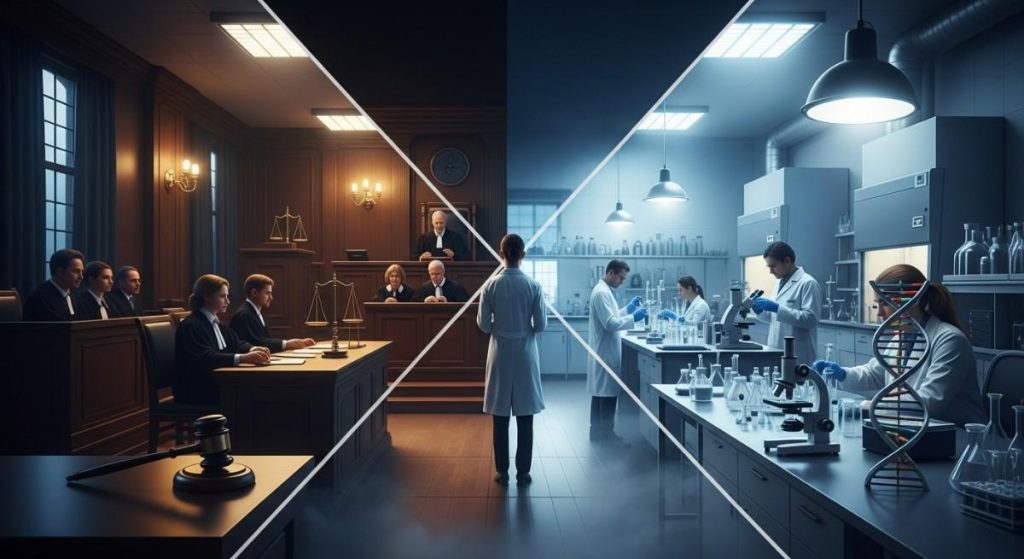
There’s nothing like a forensic science degree because it combines two completely different worlds. There’s criminal justice, which focuses on law enforcement, courts, investigations, and legal systems. A science, on the other hand, is based on experimentation, evidence, and objective analysis. Combining these disciplines makes professionals who can interpret evidence in ways that can influence entire legal cases.
Criminal justice students often start with criminology, constitutional law, ethics, and investigative procedures. Future professionals can take these courses to learn how crimes are prosecuted and how evidence must be handled to stay legal. When evidence is mishandled, it can ruin an entire case, which is why chain-of-custody procedures are so important.
There’s also a science side to the degree. In addition to chemistry, biology, genetics, toxicology, anatomy, and sometimes physics, students study physics too. It’s important for forensic professionals to know how to test blood samples, identify chemicals, analyze DNA, and evaluate microscopic evidence in the lab. Students can even practice evidence collection techniques under realistic conditions at some universities.
This field is exciting because every case is like a jigsaw puzzle with half the pieces missing. Forensic professionals help investigators reconstruct events with clues that are invisible to the average person. You can unlock an entire investigation by a tiny strand of hair, a digital footprint, or a fingerprint left on glass.
Employers value graduates with interdisciplinary skills because of this balance between justice and science. It’s common for police departments, federal agencies, laboratories, cybersecurity companies, and intelligence agencies to hire people who understand both legal and scientific aspects of investigations.
What You Will Learn in a Forensic Science Degree Program
Curious students can become highly trained investigators with a criminal justice forensic science curriculum. Forensic science programs focus on practical application, unlike many traditional degrees. Students apply scientific methods to criminal scenarios in classrooms, laboratories, and simulated investigation environments.
The curriculum usually starts with general education and foundational science. The basis of most forensic programs is chemistry and biology because understanding chemical reactions and human biology is key to analyzing evidence. Toxicology, microbiology, and genetics are also studied, which help forensic scientists identify crime-related substances.
Students learn about legal systems, police methods, corrections, and criminal behavior in criminal justice classes. Forensic evidence only matters if it can withstand courtroom scrutiny, so understanding legal procedures is essential. DNA samples can be useless if legal procedures aren’t followed during collection or documentation.
The field of digital forensics is growing fast. Global cybercrime is on the rise, and investigators need experts who can recover deleted files, track hackers, analyze digital devices, and investigate online fraud. In forensic science programs, universities are now incorporating cybersecurity and digital evidence analysis because modern crimes are more tech-based.
Hands-on lab work is the best part of a degree. You’ll learn how to dust fingerprints, analyze ballistics, interpret bloodstain patterns, and do DNA tests. Students can get real-world experience before they graduate by doing internships with law enforcement agencies or forensic laboratories.
There’s a lot of work in forensic science because it’s so technical. Precision is huge in this field. Even a tiny calculation error or contamination problem can ruin an investigation. That’s why universities train students to think critically, stay organized, and communicate well.
Types of Criminal Justice Forensic Science Degrees
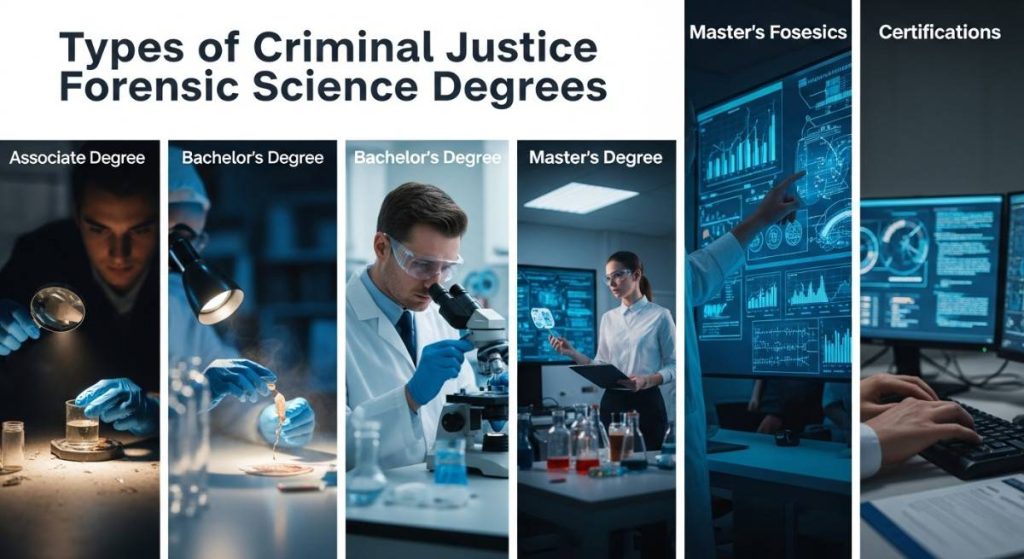
There are different kinds of forensic science degrees.
Students can choose different education paths based on their career goals, budget, and time commitment.
It’s important to understand the differences between degrees before enrolling, because they open up different doors.
| Degree Type | Typical Duration | Career Opportunities |
|---|---|---|
| Associate Degree | 2 Years | Evidence Technician, Lab Assistant |
| Bachelor’s Degree | 4 Years | Crime Scene Investigator, Forensic Analyst |
| Master’s Degree | 1–2 Years | Senior Analyst, Specialist, Research Roles |
| Certifications | Few Months | Specialized Skills in Cyber or DNA Analysis |
The fastest way to get into the field is with an associate’s degree. Basically, these programs teach you how to do forensics and basic criminal justice concepts. In law enforcement and laboratories, graduates often work in support roles. In spite of the fact that this route is faster and cheaper, advancement opportunities might be limited without more education.
Today, bachelor’s degrees are the standard qualification for most forensic science jobs. According to the Bureau of Labor Statistics, forensic science technicians usually need a bachelor’s degree. The Bachelor’s degree gives you deeper scientific training and broader investigative knowledge, which makes you more competitive in the lab and on the case.
Students can specialize in forensic toxicology, forensic psychology, cyber forensics, or DNA analysis with a master’s degree. Getting an advanced degree is great for leadership positions, research careers, and federal jobs. A postgraduate degree can help you stand out in a competitive job market.
Forensic science is evolving, so specialized certifications are getting more important. It’s easy to stand out in niche areas where demand is growing, like cybersecurity, digital investigations, or forensic accounting.
Choosing the right degree path depends a lot on your long-term goals. If you’re passionate about chemistry, you might prioritize chemistry-heavy programs. If you’re into cybercrime, you might focus on digital forensics.
Skills Needed to Succeed in Forensic Science
It takes more than academic knowledge to succeed in forensic science. In this field, you have to have technical expertise, emotional resilience, and an investigative curiosity like no other. Memorizing scientific concepts isn’t enough; professionals have to apply them under pressure while maintaining extreme accuracy.
The ability to think analytically is one of the most important skills. Scientists examine incomplete information constantly and come up with logical conclusions. Assembling this process is like putting together a puzzle with some pieces missing, hidden, or intentionally misleading. Even when cases seem emotionally charged, professionals need to evaluate evidence objectively.
Another important trait is attention to detail. Criminal investigations can be complicated by tiny mistakes. An overlooked fingerprint or mislabeled sample can turn the whole case around. Forensic professionals develop meticulous habits and rigorous documentation practices throughout their training.
Communication skills are just as important. Students often think forensic scientists spend all day in laboratories, but they often testify in court too. It’s important for professionals to explain complex scientific findings in terms juries, attorneys, and judges can understand. When you can’t clearly and confidently communicate your findings, it doesn’t matter how good you are in the lab.
It’s also important to be emotionally strong. There are some professionals who work on cases involving violence, abuse, or death. Professionalism requires maturity and psychological resilience when dealing with emotionally difficult evidence. Students who enter the field inspired only by TV portrayals are often surprised by the work’s emotional weight.
Complete the package with problem-solving skills. There’s rarely a neat ending to a criminal investigation. It’s okay if the evidence isn’t complete, contaminated, or contradictory. Forensic scientists stay flexible and persistent, always searching for answers through scientific reasoning.
Career Opportunities After Graduation
You can go into an impressive variety of careers with a forensic science degree in criminal justice. Most people think of crime scene investigators, but the field has a lot more to offer than that. Upon graduation, graduates can work in laboratories, law enforcement, cybersecurity, intelligence, private consulting, and federal agencies.
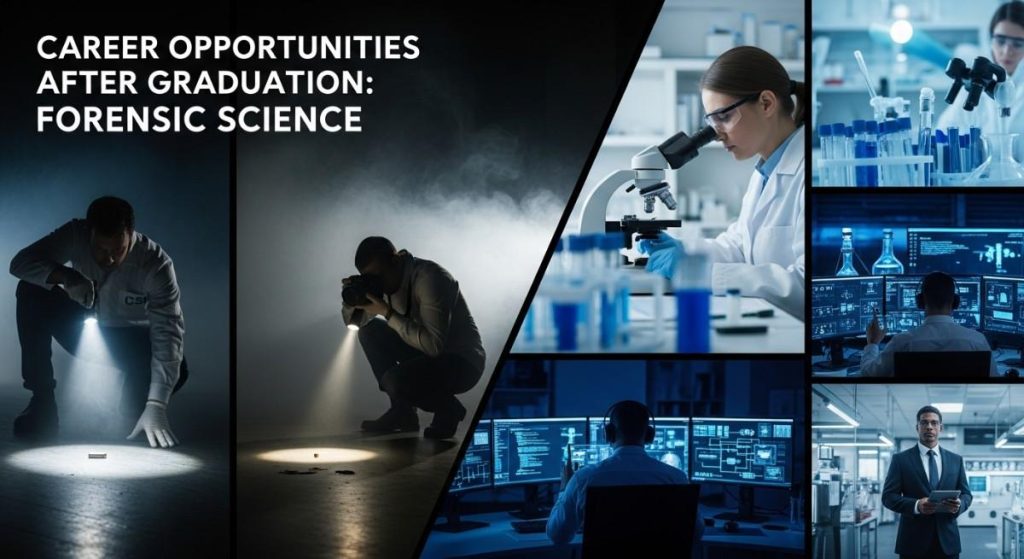
CSI (Crime Scene Investigator) is a popular role. Photographing evidence, collecting samples, and documenting findings are all things these professionals do. The work they do forms the foundation of many investigations because improperly collected evidence can’t be used in court.
As a forensic lab analyst, you can also make a lot of money. The majority of their time is spent analyzing DNA, toxicology samples, fingerprints, firearms evidence, or trace materials. It’s common for lab analysts to specialize heavily in one area, becoming experts at identifying highly specific patterns of evidence.
Digital forensics is one of the fastest-growing specialties. Investigators analyze computers, smartphones, networks, and digital systems connected to crimes. Demand for digital forensic experts continues to rise as online fraud, hacking, and cyberattacks increase worldwide.
The Federal Bureau of Investigation and Drug Enforcement Administration also hire forensic professionals. Roles in these fields usually involve advanced investigations, national security, and specialized lab work.
These are some common careers in forensic science:
- Detective at a crime scene
- I’m a forensic toxicologist
- Analyzer of DNA
- Examiner of digital forensics
- Become a ballistics expert
- Analyzer of fingerprints
- I’m a forensic accountant
- Technician for evidence
- Investigations into cybercrime
- An autopsy tech
A forensic science technician’s median annual wage in May 2024 was $67,440, according to the Bureau of Labor Statistics. Your salary can go up if you specialize, get certified, have management experience, or work for the government.
Salary Expectations and Job Outlook
The money shouldn’t be the only reason you pursue forensic science, but salary expectations do matter. Fortunately, forensic science offers a stable income and meaningful work. You’ll make more or less depending on your specialization, location, education level, and employer.
According to the Bureau of Labor Statistics, forensic science technicians made $67,440 in 2024, with top earners making over $110,000. Besides a good salary, government jobs often have good benefits packages, pension plans, and job stability.
Here is a general salary overview:
| Career Role | Average Salary Range |
|---|---|
| Crime Scene Technician | $50,000 – $75,000 |
| Forensic Laboratory Analyst | $60,000 – $90,000 |
| Digital Forensics Specialist | $75,000 – $120,000 |
| Forensic Toxicologist | $70,000 – $110,000 |
| Federal Agency Specialist | $80,000 – $130,000+ |
Growth in jobs is another plus. According to the Bureau of Labor Statistics, forensic science jobs will grow 13% between 2024 and 2034. Technology advancements, DNA databases, cybercrime, and a growing demand for scientific evidence are all contributing to this growth.
Still, students should know it’s a competitive field. In oversaturated regions, many graduates apply to numerous jobs before landing a job, according to Reddit discussions. It’s common for employers to prioritize candidates with science backgrounds, internships, and lab experience.
One recommendation from experienced professionals is to get a solid foundation in chemistry or biology. A broader scientific background can boost your employability and give you options outside of forensics.
Online vs On-Campus Forensic Science Degrees
In forensic science programs, technology has transformed education. You can get an online degree or a traditional campus-based degree today. Based on your learning style, career goals, and lifestyle, each option has pros and cons.
The flexibility of online forensic science degrees appeals to working adults and busy students. People with jobs or family responsibilities can often complete lectures, assignments, and discussions from home. If you take out commuting and housing expenses, tuition may be cheaper.
It’s hard to learn forensic science online since it’s so hands-on. A virtual simulation can’t replace real lab experience, which is a crucial part of training. Online programs sometimes address this problem with hybrid models that require occasional campus visits or partnerships with local labs.
On-campus programs provide better access to lab equipment, mock crime scenes, research opportunities, and professors. In the real world, students often use microscopes, DNA testing tools, and evidence analysis tools.
University internships are easier to get because universities have a lot of partnerships with police departments, forensic labs, and government agencies. Future jobs can be landed through these connections.
The decision between online and campus education comes down to your personal circumstances. Those looking for maximum flexibility may thrive online, while those looking for intensive lab training might do better on campus.
Choosing the Right College or University
An entire career can be shaped by choosing the right forensic science program. Education, lab access, and industry reputation aren’t all the same. It’s important for students to evaluate universities carefully.
One of the most important things is accreditation. Employers respect accredited programs because they meet professional standards. Science training and career preparation are often better in programs recognized by forensic science organizations.
It’s hugely important to have a good curriculum. Some programs are heavy on criminal justice theory, but they’re not very scientific. Others focus on laboratory science. It’s best to pick programs that include chemistry and biology if you want to be a forensic analyst.
You should also consider internships. An internship can make a huge difference in your employability after graduation. Networking opportunities are usually better at universities with partnerships with law enforcement, forensic laboratories, or government organizations.
Faculty expertise is also something students should look into. It’s hard to learn about forensics from textbooks alone. Professors with real forensic experience can help. A classroom education with former investigators, laboratory analysts, or federal agents adds practical depth.
As always, cost is a big factor. Programs in forensic science can be expensive, especially when laboratory fees are included. Students can make smart financial decisions by comparing tuition, scholarships, internships, and graduate outcomes.
Challenges Students Should Know Before Enrolling
There’s nothing easy about forensic science. Students who enter forensic programs are often surprised by how technical, methodical, and competitive real forensic work is.

The heavy science workload is one of the biggest challenges. For students who don’t like lab sciences, chemistry, biology, genetics, and statistics can be overwhelming. As opposed to fictional depictions where investigators magically solve crimes in minutes, real forensic work requires extensive documentation, repetitive testing, and meticulous analysis.
It’s also competitive out there. Even though overall job growth is good, entry-level jobs tend to draw a lot of applicants. In online discussions, professionals say internships, networking, and practical lab skills are key to landing a job.
Emotional exposure is another challenge. In some cases, forensic professionals have to deal with traumatic evidence from violent crimes, accidents, or abuse. Maintaining professionalism in tough times requires emotional resilience.
Shift schedules can also be tough. Crime scenes don’t follow business hours, so investigators may work nights, weekends, or emergency calls. Having a lot of cases and strict deadlines can be stressful for laboratory professionals.
It’s true that forensic science has its challenges, but many professionals find it rewarding because they’re making a real difference to justice and public safety. It’s not easy to find a career that gives you that sense of purpose.
Is a Criminal Justice Or Forensic Science Degree Worth It?
Getting a criminal justice forensic science degree can be worth it for the right person. There aren’t many careers that combine intellectual challenge, scientific discovery, and real-world impact. Every day is a new problem to solve, a new technology to learn, and a new opportunity to make a difference.
Because forensic science keeps evolving with technology, this degree has a lot of long-term potential. DNA advancements, cybercrime investigations, artificial intelligence tools, and digital evidence analysis are changing criminal investigations. The demand for professionals who can adapt to these innovations is likely to last for years.
The career can offer stable income growth, especially for specialists and analysts. It also looks like there’ll be a good demand for jobs in the future.
There’s still a commitment required for success. Students who come into the field expecting nonstop excitement might struggle with the scientific rigor and competitive nature. People who like science, investigation, problem-solving, and precision-based work are the best candidates.
A degree like this is great for people who want careers that matter to society. Fingerprints, DNA samples, and digital clues can help solve crimes, protect innocent people, and support justice through factual evidence.
Conclusion
Getting a degree in criminal justice forensic science is one of the most fascinating educational paths out there. Law, science, investigation, and technology all come together in this career field. The forensic profession stands at the forefront of scientific justice, from analyzing DNA to uncovering cybercrime.
Though it’s demanding, competitive, and technically rigorous, it also delivers intellectual excitement and meaningful work. Students who embrace science-based coursework, develop analytical skills, and gain real-world experience can land rewarding jobs in labs, law enforcement, cybersecurity, and government.
As technology reshapes criminal investigations, forensic science professionals will become more important. Investigators who can combine scientific expertise with critical thinking and ethical responsibility are the future. This degree can lead to a career unlike any other if you love solving puzzles with evidence and logic.
FAQs
1. Is forensic science more difficult than criminal justice?
In addition to criminal justice coursework, forensic science courses include advanced science subjects like chemistry, biology, genetics, and laboratory analysis.
2. Can I work for the FBI with a forensic science degree?
Yes, of course. A lot of federal agencies hire forensic professionals to do lab analysis, cybercrime investigations, and intelligence work.
3. Do forensic scientists attend to crime scenes?
It happens to some people. Unlike crime scene investigators, laboratory analysts work mainly in forensic labs analyzing evidence.
4. Is a master’s degree necessary for forensic science careers?
No, not always. Getting a master’s degree can improve advancement opportunities and specialization options, but many entry-level jobs only need a bachelor’s degree.
5. What is the highest-paying Forensic Science career?
With advanced certifications and years of experience, digital forensics specialists, forensic toxicologists, and federal forensic experts often make the most.