
Why Traditional Career Advice Is Failing
The New Reality of Work in 2026
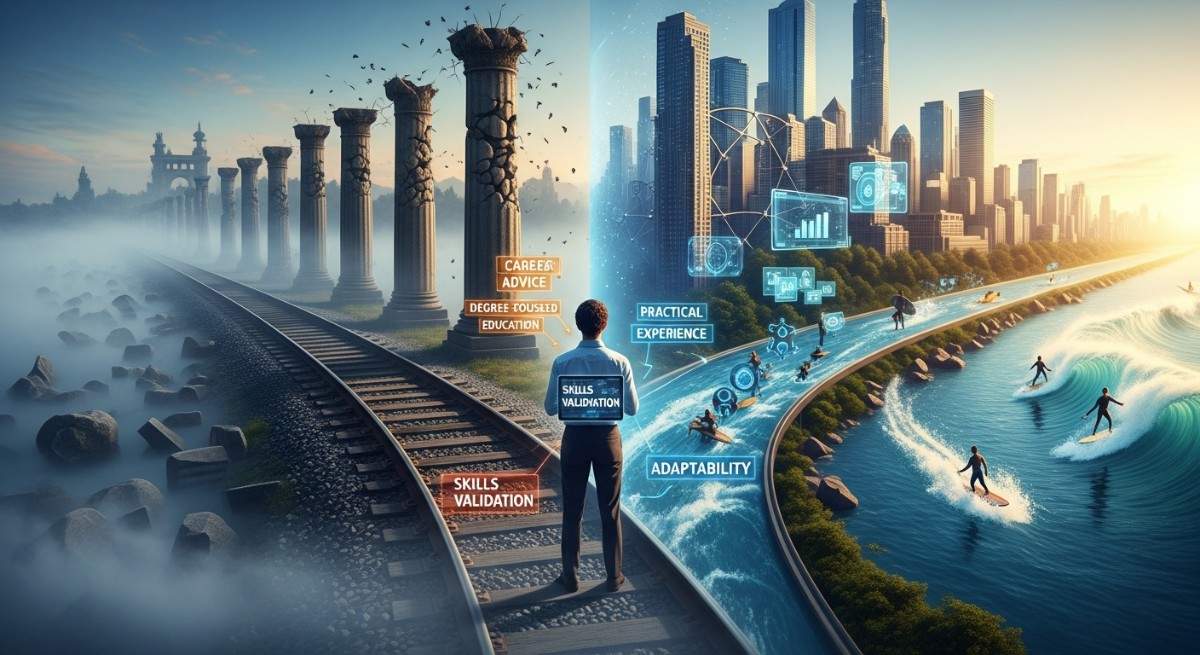
Modern workplaces aren’t like the ones your parents prepared you for. AI tools are rewriting workflows, remote work is changing where talent gets hired, and companies are choosing adaptable employees over traditionally qualified ones. Employers now prioritize skills validation, practical experience, and adaptability more than degrees alone, according to recent labor market research.
Take a second to think about that. There was a time when people thought degrees were the key to success. More and more employers are looking for skills like solving problems, using AI, communicating effectively, and adapting quickly. It’s a seismic shift.
In the meantime, remote work has opened up opportunities for people outside big cities. Researchers found remote work increased upward mobility, especially in regions with fewer career options. Geography matters less now, but skill visibility matters more.
There was an assumption of stability in the old rules. Flexibility is the key to success in the new world. Getting a job is less like getting on a train and more like surfing. Surfing is all about balancing, adjusting, and learning how to ride unpredictable waves. Change could wipe out workers who cling too tightly to old systems.
A lot of people don’t realize how fast the career world is changing. The “safe” path looked predictable ten years ago: get a degree, get a stable job, work hard, climb the ladder, retire. How’s today going? There’s something wrong with that script. Artificial intelligence is changing job descriptions, remote work is changing opportunities, and employers are valuing skills over credentials. Recent workforce reports show companies are prioritizing adaptability, critical thinking, and AI fluency over traditional summaries.
Here’s why playing it safe is riskier than ever
It’s still common for people to think safe choices are safe. Ironically, it’s often the other way around these days. Automated and generative AI are reshaping entire industries. Many sectors are automating repetitive work, so entry-level jobs are shrinking.
Many workers are waiting for certainty before adapting, which is dangerous. Nowadays, certainty is hard to come by. It’s usually too late to take advantage of a trend once it becomes obvious.
Playing it safe used to mean sticking with one company, avoiding risks, and following a predictable routine. Nowadays, playing it safe means slowly becoming obsolete. Standing still on a moving walkway going backward is like standing still on a moving walkway. It’s not like you’re moving, but you’re still losing ground.
Career contrarians know something powerful: discomfort is often a sign of growth. Being willing to experiment, pivot, and reinvent yourself is one of the most valuable career traits.
Rule #1–#5: Breaking the Education and Experience Myths
Stop Believing Degrees Guarantee Success
Even though college degrees still matter, they’re not as valuable as they used to be. Practical skills, AI literacy, communication skills, and adaptability are becoming increasingly important to employers. Nearly half of employers say they’re putting skills first when hiring.
All of a sudden, the game changes.
There’s no doubt that the internet has democratized knowledge. Now, anyone with a strong portfolio, real-world experience, and proof of capability can compete with degree holders. Alternative paths into high-income careers have been created by bootcamps, online certifications, freelancing, and creator platforms.
Employers don’t ask “Where did you study? ” instead of “Can you fix our problems?” That is a huge mindset shift.
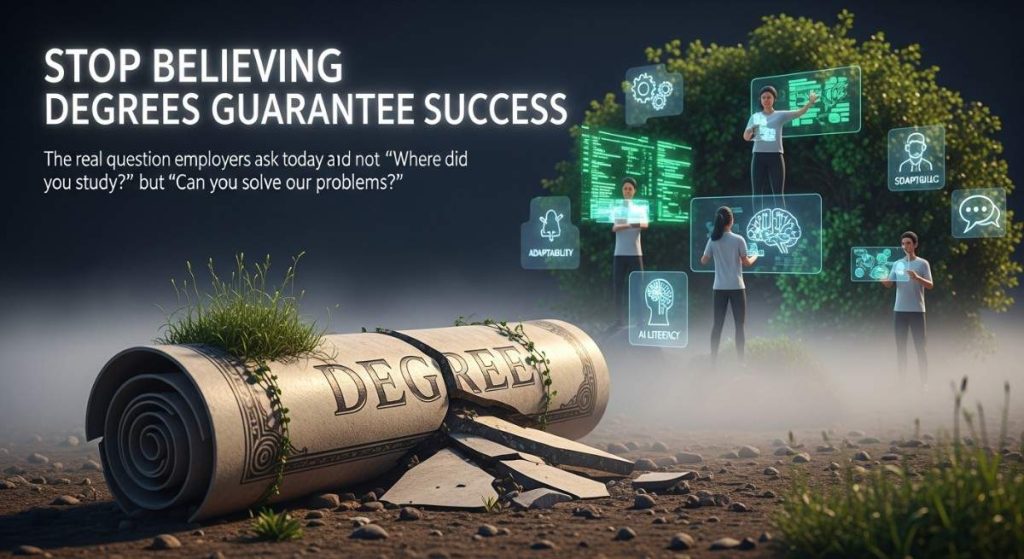
That doesn’t mean education isn’t important. You can’t just rely on education. You can think of degrees like gym memberships. It doesn’t make you fit just because you bought one. Your results depend on how you use them.
Experience Alone Is No Longer Enough
It’s been assumed that experience automatically increases value for years. However, experience without adaptation can quickly become outdated.
Think about a marketer with 15 years experience who won’t learn AI tools, automation platforms, or data analytics. Compare that to someone with just 5 years experience but deep expertise in AI-driven workflows. Is one candidate more future-proof than the other?
The research on workforce transformation shows companies value hybrid human-AI expertise more and more. That means years in the workforce aren’t as important as relevant, evolving skills.
Experience is still important, but it has to be paired with continuous learning. Otherwise, experience can become a cover for professional stagnation.
Loyalty to One Company Can Hurt You
The older generation often celebrated staying at the same company for decades. In today’s world, that strategy can limit income growth, skill expansion, and job opportunities.
Change roles strategically to earn bigger salary increases instead of waiting years for internal promotions. The average company spends twice as much on attracting new talent as it does on retaining its existing employees. Those are strange realities, but they’re true.
You’ll also learn about new systems, industries, leadership styles, and technologies when you’re mobile. Your adaptability is compounded by those experiences. Employees who stay too comfortable in one environment may unknowingly reduce their market value.
Having loyalty is admirable, but blind loyalty can be costly.
Certifications Are Not Magic Tickets
Certifications make people feel productive, so they love collecting them. What’s wrong? Digital badges aren’t as important to employers as demonstrated outcomes.
Certification can open doors, but it doesn’t guarantee mastery. Take a look at fitness again. Strength isn’t built by watching workout videos. Earning certificates without applying the knowledge makes you shallow.
Especially in AI-heavy industries where tools evolve fast. Rather than endlessly stacking credentials, today’s workers are building projects, experimenting publicly, and solving real problems.
Your resume is not your biggest asset
People still think the resume is the key to career success. That’s not true.
It’s more important than ever to have a good reputation, network, online presence, and evidence of your work. Before making a hiring decision, employers are searching LinkedIn profiles, portfolios, GitHub repositories, and creator content.
Career identities are getting decentralized. Rather than one document summarizing your history, your value is now on multiple platforms.
You can think of your resume as a trailer. There’s a movie in your digital footprint.
Rule #6–#10: Breaking Productivity and Hustle Culture Rules
Being Busy Does Not Mean Being Valuable
We worship busyness in the modern workplace. There’s nothing like an overflowing calendar, nonstop meetings, and sleepless productivity marathons. There’s a difference between activity and impact.
Artificial intelligence is exposing this truth aggressively. Many repetitive tasks that were once viewed as “hard work” are now automated. It’s not the busiest workers who survive; it’s the clearest thinkers.
Work ethic, strategic decision-making, emotional intelligence, and creative problem-solving are becoming premium skills. It’s becoming more and more obvious that fragmented attention kills productivity at work.
Workers who create leverage, not just motion, are the future.
Work-Life Balance is Not Always Balanced
There’s no perfect work-life balance in real careers. They move through seasons instead.
When you’re launching a startup, you have to push hard. Sometimes you have to slow down to recover. It’s okay to prioritize family sometimes. There are times when you invest a lot in your career.
It’s easy to assume life should always be evenly distributed. You’ll feel guilty and frustrated when you don’t meet that expectation.
Contrarians know rhythm is more important than balance. You can think of life like music. One flat note repeated forever doesn’t make a great song. During their journey, they rise, fall, accelerate, and pause.
Networking is more Significant than Applying
It’s hard to fill a job with a cold application alone. Opportunity is driven by relationships.
In overcrowded remote hiring markets, where thousands compete for the same jobs, that reality becomes even more important.
You don’t have to fake small talk at conferences to network. The goal is to build relationships consistently. As you share ideas online, help others solve problems, collaborate publicly, and stay visible, your career will take off.
Opportunities often flow through trust long before formal applications appear.
Remote Work Requires Different Skills
People think remote work is liberating until they realize how much they have to manage themselves. More and more companies want workers who can communicate clearly, document effectively, and work independently.
The competition for remote jobs is also getting tougher, especially at the entry level. Candidates now have to prove they can work asynchronously without constant supervision.
Remote workers should act less like employees and more like owners solving problems.
AI Is Not Your Enemy
Conversations about AI are dominated by fear. Workers who reject AI completely might fall behind faster than those who embrace it.
AI skills improve hiring prospects across multiple industries, according to research. Increasingly, companies want employees who are comfortable using AI tools.
It’s important to think of AI as a multiplier, not a replacement. Automating repetitive tasks, summarizing information, brainstorming ideas, and speeding up workflows are all things AI can do. However, humans still provide judgment, creativity, emotional nuance, and strategic thinking.
Future workers won’t be “human versus AI.” They’ll be “human enhanced by AI.”
Rule #11–#15: Breaking Career Growth Assumptions
Promotion is not the Only Path to Success
There used to be a lot of ladder climbing in traditional careers. Careers today tend to resemble jungle gyms. Make a sideways moves, freelance work, consulting, creator businesses, and portfolio careers can generate enormous success without traditional promotions.
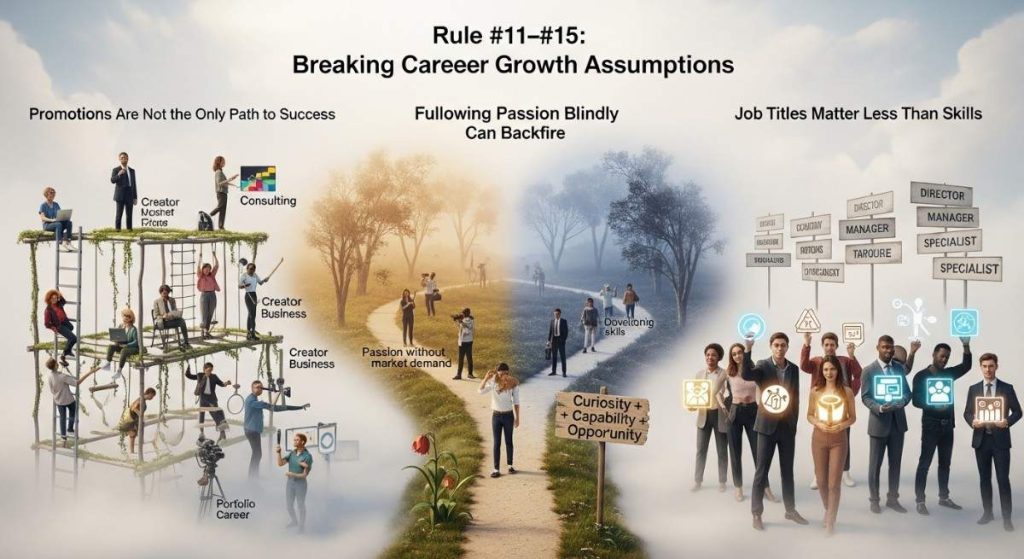
Working as an independent specialist can be more lucrative than working as a middle manager. Some people build online audiences that create income streams that aren’t related to their jobs.
Success is getting more customizable.
Following a Passion Blindly Backfires
It sounds inspiring to follow your passion, but passion rarely pays the bills. It’s a hobby if there’s no market demand for it.
Curiousity, capability, and opportunity are the keys to a smarter strategy. People who are successful develop valuable skills first and then allow passion to emerge through mastery.
Competence can create passion, not the other way around.
Job Titles Matter Less Than Skills
It’s because titles signal status that people chase impressive titles. There are a lot of differences between companies when it comes to titles.
In one company, a “director” might have less responsibility than a “manager.” There’s a transfer of skills. It’s not about titles.
A career contrarian focuses on gaining leverage skills: communication, AI fluency, negotiation, leadership, storytelling, sales, systems thinking, and adaptability.
It’s like universal currency.
Stability Is an illusion
It’s common for workers to stay in jobs they dislike because they think there’s stability there. It’s a constant cycle of layoffs, restructurings, and technological changes.
It’s possible for even the most invincible company to change overnight.
Stability comes from employability, not employment. Professionals who can adapt quickly, build relationships, and generate value across environments are the safest.
There’s a difference between relying on one tree for survival and learning how to grow a forest.
Personal branding is No Longer Optional
Back then, personal branding sounded self-promotional. It’s practical today.
It’s common for people to Google you before hiring you. Recruiters look at LinkedIn. Your clients look at your public work. Your digital presence helps employers figure out your communication style.
When you have a strong personal brand, people know what you do and why they should trust you.
You get opportunities when you’re visible.
Rule #16–#20: Breaking the Future-of-Work Myths
Side Hustles Are Becoming Essential
The risk of relying on one income stream is increasing. Diversified income is more appealing than ever thanks to economic volatility, automation, and changing hiring trends.
Having a side hustle also gives you a chance to experiment. Small freelance projects today could turn into full-time businesses tomorrow.
There’s more to side hustles than just money. As a result, they build autonomy, resilience, and flexibility.
Learning must never stop
There’s a rapid decline in the half-life of knowledge. There’s a good chance that skills you had five years ago are already outdated.
Learning is like hygiene for the professionals of 2026. Rather than waiting until an emergency happens, they do it all the time.
This doesn’t mean you have to keep taking courses forever. Applying knowledge consistently, experimenting publicly, and staying flexible intellectually are all part of it.
The most dangerous phrase in modern careers is “I already know enough.”
Soft Skills Are Becoming Hard Currency
As AI gets stronger, human skills get more valuable.
Critical thinking, emotional intelligence, adaptability, and communication are among the most important skills for modern workers.

Information gets processed fast by machines. We build trust, inspire teams, navigate ambiguity, and make people feel good.
People who combine technical literacy with deep human skills will win in the future.
Career Paths Are No Longer Linear
There used to be a pretty predictable career path: junior role, promotion, management, retirement.
Careers today zigzag.
People switch industries, freelance temporarily, launch businesses, return to work, take sabbaticals, and reinvent themselves multiple times. That’s not failure anymore. Adaptation is what it is.
It’s becoming normal to have a flexible career.
The Smartest Employers Build Optionality
There’s no doubt that flexibility is the most important career concept of the century.
Making choices is what optionality is all about. A lot of skills. There are multiple ways to make money. Networks everywhere. There are lots of career paths.
The more workers rely on one employer, one platform, or one skill, the more fragile they become. However, when they build flexibility, they gain power.
You can think of optionality like carrying multiple keys instead of one. Even if one door closes, there are others.
Conclusion
There’s a big change happening in the career landscape. The rules are changing faster than most institutions can keep up because of AI, remote work, automation, and evolving hiring practices. Over the next decade, the people who succeed won’t necessarily be the smartest or the hardest working. It’s going to be easier for them to adapt.
You don’t have to reject all traditional wisdom to be a career contrarian. You’ve got to question outdated assumptions before they limit your future.
In the old career model, obedience and predictability were rewarded. Curiosity, experimentation, resilience, and adaptability are rewarded in the new model. When workers embrace change instead of fearing it, they’ll find opportunities others don’t see.
You’re no longer on a straight path in your career. We’re in an evolving ecosystem. Getting rid of the fixed blueprint will make it easier to build something future-proof.oof.
FAQs
1. What is a career contrarian?
A career contrarian questions traditional career advice and adapts to changing workforce realities instead of blindly following old rules.
2. Are college degrees still worth it in 2026?
There’s still a place for degrees, but they’re not enough anymore. Along with formal education, employers are looking for practical skills, adaptability, and AI literacy.
3. Which career skills are most valuable right now?
Today’s most in-demand skills are critical thinking, communication, emotional intelligence, AI fluency, adaptability, and problem-solving.
4. Is AI replacing jobs completely?
The rise of AI is automating certain tasks, especially repetitive ones, but it’s also creating new opportunities for workers who know how to work with it.
5. Why is networking becoming more significant?
Trust, visibility, and relationships are increasingly important in hiring today. Professionals can find opportunities before they’re advertised publicly through networking.