
Why digital etiquette matters More Than Ever
The average person spends hours a day on screens. Meetings have mostly been replaced by emails. We’ve replaced phone calls with messaging apps. Social media direct messages have become networking tools. Due to this shift, your digital communication style reflects your emotional intelligence. The way you type says a lot about your professionalism, kindness, confidence, and reliability.
The lack of emotional cues is one of the biggest problems with digital communication. In a study of workplace email behavior, researchers found that people misinterpret neutral messages as rude because text removes facial expressions, tone, and body language. Take a second to think about it. When someone says “Fine” in person, their smile or tone softens it. In a text? The same word can sound irritated, cold, or hostile.
It’s even more complicated now that remote work is so popular. To collaborate, employees use Slack, Teams, WhatsApp, and email a lot. 87% of workers waste time clarifying confusing digital communication every week, according to Atlassian. Teams get frustrated, delayed, stressed, and tense when that confusion happens.
Digital etiquette is a must. That’s a modern survival skill. Communicating respectfully online builds stronger relationships, earns more trust, and prevents unnecessary conflicts. Unaware of it, careless communicators often create silent resentment.
The heartbeat of modern life is digital communication. You’re tone online often becomes your personality in someone else’s mind when you reply to a client, message a coworker, text a friend, or email a professor. You know what’s tricky? Faces, body language, and vocal tone don’t come with texts and emails. Even a harmless two-word reply can sound cold. It can feel dismissive if you don’t respond right away. If you send a bad message at the wrong time, you could damage relationships without even knowing it.
According to recent workplace communication studies, employees are increasingly struggling with unclear or rude digital communication. Nearly a third of workers get rude emails every day, and 44% of employees tune out poor communication. That’s a huge problem in a world where email and texting rule.
The truth is, digital etiquette matters more now than ever. You can shape first impressions, career opportunities, friendships, and even romantic relationships with your texting habits. One careless email can make you look impatient, passive-aggressive, arrogant, or disrespectful without you even intending it.
In today’s fast-moving digital world, this guide explains the 15 biggest texting and email mistakes that instantly make people think you’re rude.
The Psychology Behind Digital Miscommunication
Humans naturally fill in emotional blanks when they read. People might interpret a neutral email negatively if they’re stressed or insecure. Researchers say ambiguity in digital communication makes people anxious because they keep rereading messages. So it makes sense why short replies like “K” or “Sure” can sometimes trigger big emotional reactions.
Also, digital communication creates emotional distance. You can forget there’s a human being reading your words when you can’t see them. Many people type things they wouldn’t say face-to-face because of this psychological distance.
How Tone Gets Lost in Text
The tone of your writing is like the seasoning of your food. It makes everything taste bland or harsh without enough of it. You can make your message feel a lot better with a simple greeting, emoji, or polite phrase. Take a look at these two examples:
- “Send it to me.”
- Sarah, can you send me the report when you get a chance? Thank you! ”
Both messages ask for the same thing. One sounds demanding. The other sounds respectful and collaborative. Tiny wording choices carry enormous emotional weight online.
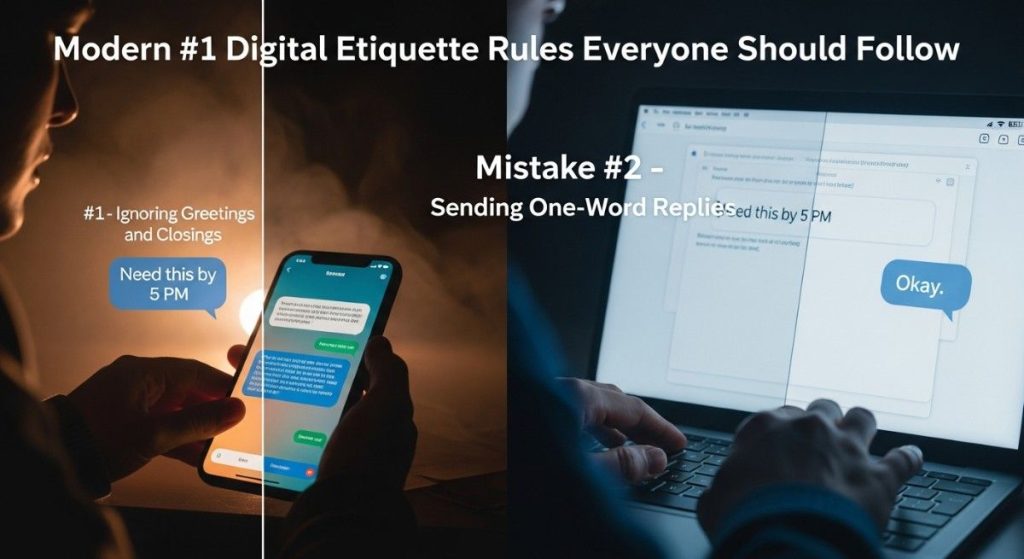
Mistake #1 – Ignoring Greetings and Closings
It makes people feel like tools instead of people when you jump into requests without saying hello. Imagine opening an email that says, “Need this by 5 PM.” No greeting. It’s anonymous. Thanks, but no thanks. I feel robotic and dismissive.
Millennials are increasingly texting into emails, which has weakened traditional etiquette norms. Emails that skip greetings or signatures are a common complaint on the internet. Even though casual communication is fine sometimes, it can damage professional relationships if you completely remove basic courtesy.
Greetings make you feel warm. Respect comes from closings. A simple “Hi,” “Good morning,” “Best regards,” or “Thank you” softens communication. It’s like a digital handshake. Despite your best intentions, your message may seem abrupt without them.
Email doesn’t have to sound like a legal document from 1997. There’s no need for excessive formality. You just need to acknowledge that another human is in the conversation.
Mistake #2 – Sending One-Word Replies
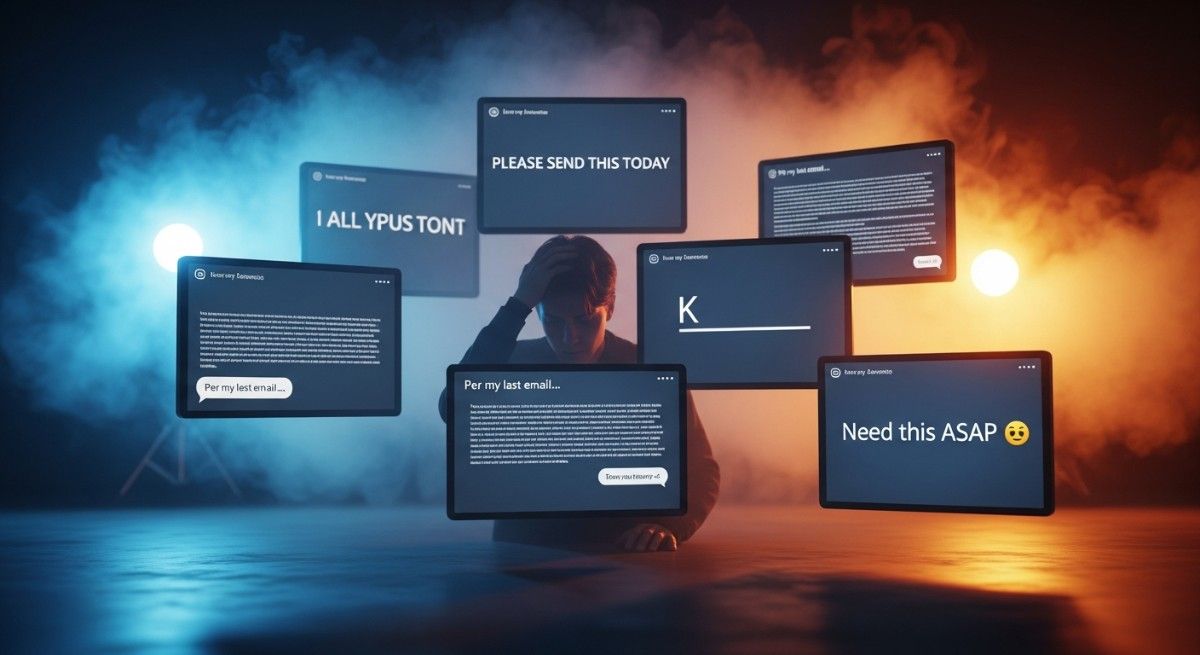
There’s nothing that kills a conversation faster than a one-word response. Responses like “Okay,” “Sure,” “Fine,” or “K” come across as emotionally unavailable. These replies can make people feel dismissed, even if you’re busy.
Communication is psychologically driven by reassurance. When someone sends a thoughtful message and gets a dry response, tension builds. Talking enthusiastically to someone face-to-face while they barely nod feels like that.
In professional environments, short replies are especially dangerous because coworkers can’t hear you. When a manager replies “Fine,” employees might interpret it as annoyance or disappointment.
It’s amazing how just a few extra words can make a huge difference. What’s the difference?
- It’s all good.
- “That sounds good to me.” Thanks, dude! ”
The second version feels cooperative and warm without requiring any extra effort.
Mistake #3 – Using ALL CAPS
The digital equivalent of shouting across a crowded room is typing in all caps. Readers get defensive before they even process the message because it instantly raises emotional intensity.
Our online culture has trained us to interpret caps as anger when people use them for emphasis. Here’s an example:
- I’d appreciate it if you sent this today.”
No matter how genuine the urgency is, it feels aggressive. Capitalization can make you seem impatient, controlling, or emotional.
You can use better alternatives if you need to emphasize:
- Formatted in bold
- Here are some bullet points
- Deadlines are clear
- Wording that’s short and sweet
You should feel calm and easy to read when you’re communicating professionally. Caps lock destroys that balance right away.
Mistake #4 – Taking Too Long to Respond
One of the biggest frustrations of modern communication is delayed replies. Nobody expects instant replies 24/7, but ignoring messages for days can signal disrespect, disinterest, or disorganization.
It’s been proven that unclear or delayed communication hurts collaboration and productivity at work. Delay replies cause anxiety in personal relationships because people start making up excuses.
Speed isn’t everything. That’s acknowledgment. It’s okay to say “I saw this – I’ll respond later,” even if it’s a quick message.
When delayed replies become disrespectful
There’s a big difference between being busy and being careless. It’s okay to have emergencies. The workload piles up. Things get messy in life. That’s pretty much understood by everyone. Responding instantly to some people and ignoring others without explanation feels rude.
Communicators who manage expectations are respectful. Instead of disappearing silently, they communicate availability.
Mistake #5 – Overusing Passive-Aggressive Phrases
People avoid direct confrontation, so passive-aggressive digital communication is common. They hide frustration behind “professional” language instead of expressing it honestly.
Here are some classics:
- I just emailed you…”
- I’ve mentioned it before…”
- “Just checking to see if you saw this.”
- “I’d appreciate your advice.”
According to researchers studying email incivility, “per my last email” is strongly associated with passive aggression.
While they may sound polite, they often have an emotional undertone that screams annoyance. There’s an instant sense of frustration among readers.
It’s better to be clear without being sarcastic:
- “I wanted to make sure this didn’t get lost.”
- “Here it is again for your convenience.”
- Please let me know if you need anything clarified.”
Kindness works better than polished hostility.
Mistake #6 – Sending Huge Text Walls
There’s nothing worse than opening a message that looks like a novel. A giant block of text overwhelms readers and makes communication tough.
The digital reader scans before it reads. It’s easy for people to skip important information in an email if there’s no spacing, structure, or clarity. There’s more confusion and frustration on both sides.
The reader’s attention span is respected when you send a respectful message. Break up ideas into smaller paragraphs. Don’t use long sentences. Make sure you highlight the important stuff. Don’t forget to breathe life into your message.
Formatting is like interior design. Clutter makes even beautiful furniture look stressful. You’ll feel calm, organized, and professional with a clear structure.
Mistake #7 – Texting or Emailing Too Late at Night
People can unintentionally feel pressured to be “always available” when they get messages late at night.
Because work communication never stops, many professionals are suffering from digital burnout. Excessive notifications and constant messaging make it hard to focus at work.
Schedules vary, of course. It’s natural for some people to work late. Here’s what you need to do:
- Make sure your emails go out in the morning
- After hours, don’t expect instant responses
- Decide how urgent it is
Being respectful of someone’s privacyersonal time is one of the strongest forms of modern digital etiquette.
Mistake #8 – Forgetting to “Please” and “Thank You”
These two phrases are tiny, but they have a big emotional impact. It’s easy to feel transactional and cold in messages without courtesy words.
Check out:
- I’ll send you the file.
- Would you mind sending the file? I appreciate it.”
Second version feels more human. There’s something orderly about the first.
Authority doesn’t suffer from politeness. Professionalism and kindness can coexist when you’re a good communicator. Usually, respectful wording increases cooperation because people respond better to appreciation than commands.
Mistake #9 – Misusing emojis in Professional Communication
When used carelessly, emojis can add warmth, but they can also make people feel awkward. Emojis that make you laugh during serious discussions might seem insensitive. Professional communication can look immature with too many emojis.
It’s all about balance. Emojis work best when they reinforce friendliness, not replace it.
Here’s an example:
- “Thanks for your help 😊” feels warm.
- “Need this ASAP 😂🔥🙌” feels chaotic and confusing.
You have to be emotionally aware when it comes to digital etiquette. Before you hit send, think about how the other person might interpret your tone.
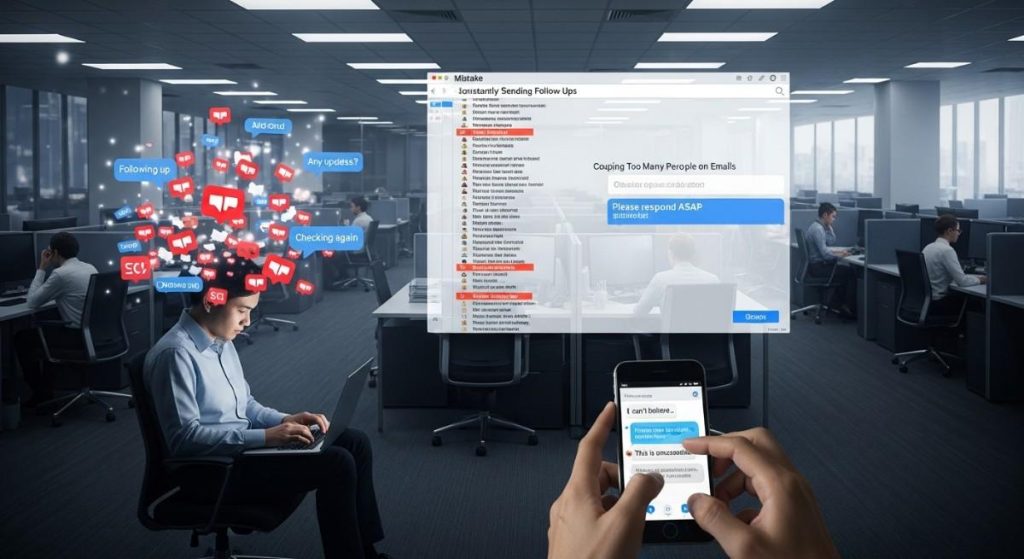
Mistake #10 – Constantly Sending Follow-Ups
It’s normal to follow up. Digitally harassing someone isn’t.
Digital platforms make it easy to send repeated reminders quickly, which makes people pushy. Here’s what happens when you don’t answer an email:
- “I’m following up.”
- “Are there any updates? ”
- “Check again.”
- “Please respond ASAP.”
At that point, the recipient feels pressured instead of respected.
The Fine Line Between Persistent and Pushy
Patience and timing are part of professional persistence. Follow-ups that are respectful:
- Give me a reasonable time to respond
- Be polite
- Don’t use guilt-tripping language
- Make it clear what’s urgent
Collaboration is the goal, not pressure.
Mistake #11 – Copying Too Many People’s Emails
There’s a risk of CC culture becoming toxic. Emails with unnecessary people can feel performative or manipulative, especially when you’re arguing.
There are people who copy managers just to put pressure on them. Others include entire departments unnecessarily, causing notification overload.
When communication gets repetitive or irrelevant, employees get disengaged. Fatigue is directly linked to massive email chains.
Don’t copy someone without asking:
- Is this information really needed?
- Do you think this will help?
- Is this making me look bad?
Communication that’s respectful values relevance over volume.
Mistake #12 – Sending Emotional Messages While Angry
It’s like throwing gasoline on a fire when you’re angry. Words sent digitally become permanent evidence.
Screens create psychological distance, so people send emotionally charged emails. Often, you feel brave in the moment, but later regret sets in.
If you feel your heartbeat racing while typing, stop. Make a draft. Don’t look back. I’ll revisit it later.
Those who are emotionally intelligent know that temporary anger shouldn’t last.
Mistake #13 – Poor Grammar and Careless Typos
It’s okay not to be perfect, but extremely careless writing will make you look lazy or disrespectful.
There’s a slight shift in modern communication trends. In the age of AI-generated text, some people leave minor typos for a more human feel. However, natural imperfection isn’t the same as unreadable carelessness.
Grammar mistakes are especially dangerous when:
- I don’t understand the instructions
- It gets confusing
- Credibility is important
Writing clearly shows effort. Respect comes from effort.
Mistake #14 – Recording Voices Without Permission
Sending voice notes is convenient for the sender, but not always for the receiver. It’s best to listen with headphones, in a quiet place, and give yourself extra time. There are some people who can’t play audio in public.
It can feel self-centered when you send long voice messages because the other person has to adapt to your style.
Asking first is a respectable habit:
- “Can I send you a quick voice note? ”
That tiny question changes the interaction completely because it gives the other person a choice.
Mistake #15 – Treating Emails Like Text Messages
Today, one of the biggest etiquette mistakes is forgetting context. There’s a difference between an email and a text.
We text casually, immediately, and in conversation. Usually, emails are more structured, detailed, and professional.
Sending ultra-casual messages in formal situations can damage your credibility. Here’s an example:
- “You’ve got to get this ASAP.”
It might work with close friends, but not with clients, professors, or executives.
Understanding the Context and Professional Boundaries
Strong communicators adapt their tone to the situation. Flexibility is emotional intelligence.
You don’t have to sound robotic in your email. The only thing it needs is clarity, respect, and an appropriate structure.
Modern Digital Etiquette Rules Everyone Should Follow
The best digital communicators are not necessarily the smartest or most charismatic people. They are usually the most thoughtful.
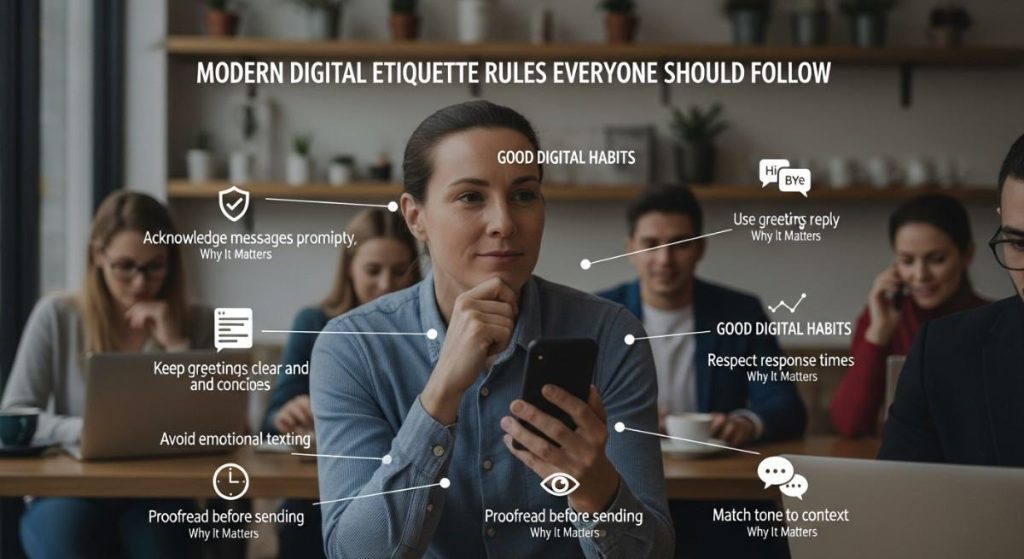
Here are simple habits that instantly improve communication:
| Good Digital Habit | Why It Matters |
|---|---|
| Acknowledge messages promptly | Shows respect and reliability |
| Use greetings and closings | Creates warmth |
| Keep messages clear and concise | Reduces confusion |
| Avoid emotional texting | Prevents conflict |
| Respect response times | Reduces pressure |
| Proofread before sending | Improves professionalism |
| Match tone to context | Builds trust |
Simple Habits That Make You Instantly More Respectful
Digital etiquette is like traffic rules. Nobody notices when everything goes smoothly, but everyone notices when someone acts recklessly.
Being respectful doesn’t mean being fake or overly formal. We’re trying to reduce friction in human interactions. Clarity mixed with empathy is the goal.
It’s easier to have a conversation, relationships become stronger, and misunderstandings disappear when people feel respected online.
Conclusion
Digital etiquette may seem small, but it shapes nearly every modern relationship. One message at a time, your texts and emails build your reputation. It tells people if you’re thoughtful, impatient, emotionally intelligent, careless, warm, professional, or dismissive.
It’s more likely that rude digital behavior is accidental than intentional. It’s a busy world. There’s a lot of stress. Things move fast in communication. Awareness changes everything. You’ll naturally start communicating more intentionally once you realize how certain habits affect others.
Small tweaks make a big difference:
- Greets
- Tone it down
- Being on time
- Passive aggression is bad
- Appreciation
People perceive you better when you have these habits.
In the world of screens, kindness has become a competitive advantage. Communicators with clarity, empathy, and respect will always stand out.
FAQs
1. Why do texts and emails sound ruder than intended?
Body language, tone of voice, and facial expressions aren’t part of digital communication. Readers often fill in the blanks themselves and interpret neutral messages negatively because those emotional cues disappear.
2. Is it rude to leave messages on “read”?
No, not always. Busy people. People get into trouble when they ignore messages without explaining why, especially in professional or personal conversations.
3. Are emojis unprofessional in emails?
No, not always. It’s easy to make communication a little friendlier with a few well-placed emojis. Moderation and understanding context are key.
4. How quickly should I reply to emails?
Professional communication is generally considered respectful if you respond within 24 hours. An acknowledgement is better than nothing.
5. What is the biggest digital etiquette mistake people make?
It’s one of the worst habits because it creates tension while pretending to be polite. Honesty that’s clear and respectful works better.