



What Does Generation Gap Mean?
Simple Definition of Generation Gap
A generation gap is the difference in opinions, beliefs, values, and behaviors between people of different ages. Age isn’t everything, it’s about how people were shaped by their upbringing. The Collins Dictionary says generation gap is when older and younger people act differently, causing misunderstandings or conflict. Imagine two people using the same words but speaking different emotional languages.

Face-to-face conversations and long-term job stability may be important to grandparents, while younger people may prefer texting and flexible remote work. It’s not that one side is wrong; it’s just that they grew up in different worlds. Someone who grew up before the internet sees life differently than someone who grew up with smartphones. Relationships, careers, and even personal identity are all shaped by that difference.
This is why the generation gap shows up everywhere-in homes, schools, offices, and even social media. Perspective is more important than conflict. Often, the bigger the difference in life experiences, the wider the gap. When we understand that truth, we can stop blaming and start listening.
Why It Is Called “Gap Years” Between Generations
In terms of generation gap years, it’s how many years separate one generation from the next. The average generation lasts about 15 to 20 years, but it varies depending on cultural and social changes. A generation is also called “the period of time between one generation and the one that precedes or follows it” in Collins Dictionary.
Like floors in a building, generations are like floors. Floors are stacked on top of one another, but people live on different floors. They’re important because history changes so fast. Even though people born in 1985 and 2005 are only twenty years apart, their childhoods, technologies, and social norms are all completely different.
In 2026, Millennials will reach major life milestones, Gen Z will move deeper into adulthood, and Generation Beta will join the world. This overlap makes the “gap” feel even bigger since multiple generations are crossing major life stages at the same time. Years aren’t just numbers, they’re reflections of changing times.
Common Generational Categories
Baby Boomers
People born between 1946 and 1964 are known as Baby Boomers. Many of them will be in their 60s and 80s by 2026. Post-war economic growth, traditional family roles, and slow technological change shaped their upbringing. Many people dreamed of stability: one career, one home, one retirement plan.
Long-term commitment, loyalty, and discipline are values this generation values. Boomers believe success comes from patience and hard work. Sometimes that mindset clashes with younger generations who value flexibility and fast adaptation. Gen Z may think changing jobs every two years is smart; Boomers may think it’s risky.
Additionally, their communication style tends to be more formal. In-person meetings, detailed discussions, and phone calls feel more trustworthy to them. There can be tension when younger people want quick text messages or voice notes. There’s nothing stubborn about it, it’s just familiarity. It’s hard to trust systems that helped you survive.
Generation X
Generation X, usually born between 1965 and 1980, sits between Boomers and Millennials like a bridge connecting two worlds. They experienced both analog and digital lives. They remember landline phones and handwritten letters, but they also adapted to email, smartphones, and social media.
Often, this generation is known for its independence and practicality. As Gen Xers grew up, they learned to solve problems on their own, which shaped their self-reliance. In the workplace, they balance traditional leadership styles with modern flexibility. Both sides understand each other.
They’re often the translators between older and younger generations because they’re in the middle. You might be able to explain Boomers to Gen Z and Gen Z to Boomers. The role is valuable, especially in families and businesses where misunderstandings grow fast.
Millennials
It’s common for Millennials, also called Generation Y, to be born between 1981 and 1996. By 2026, the youngest Millennials will be 30. They used to be called “young adults,” but now they’re parents, managers, and decision-makers.
Millennials grew up during the internet boom, social media explosion, and rapid globalization. They’re digital, but they also remember life before smartphones. They’re unique because they understand transition. They tend to value work-life balance, purpose-driven work, and emotional intelligence.
Millennials feel pressure because traditional adulthood milestones like home ownership and financial security are harder to reach. There’s a lot of comparison anxiety and frustration caused by that. The world says, “You should have it figured out,” but reality says, “It changed.”
Generation Z
They grew up in the digital world, usually between 1997 and 2012. To them, smartphones, streaming, online education, and social media weren’t inventions—they were just part of life. They learn, communicate, and build identities this way.
It’s common for Gen Z to value speed, authenticity, and flexibility. Many people prefer texting over calling, and remote work over rigid office culture. In a 2026 trend report, Gen Z sees efficiency and authenticity differently than older generations, especially when it comes to paperwork and phone calls.

Also, they’re shaped by global uncertainty – economic pressure, climate anxiety, and post-pandemic realities. It’s not uncommon for this generation to question old definitions of success. As opposed to asking, “How do I climb the ladder? ” he asks, “Do I even want that ladder?” That question alone creates a huge generation gap.
Generation Alpha
Generation Alpha includes children born from 2010 onwards. In 2026, the oldest generation will be teenagers, and they influence buying decisions and digital culture. They grow up in an environment where AI, voice assistants, and hyper-connectivity are normal.
This generation may create the widest future generation gap because their relationship with technology is even deeper than Gen Z’s. For them, the line between online and offline life is thinner than ever. Education, entertainment, and friendship blend perfectly together on screens.
Parents raising Gen Alpha often struggle because childhood looks different now. Screen time, digital safety, and emotional development all require updated parenting rules. The conversation is no longer just “What should children learn?” but also “How should they grow in a world that never logs off?”
How Many Years Create a Generation Gap?
Average Time Span Between Generations
According to most experts, the generation span ranges between 15 and 20 years.
It should be noted that this is not a strict law, but rather a useful estimate.
The average age at which people became parents has historically been associated with it.
However, today’s technological and social changes can create the illusion that generations are shorter or longer than they actually are.

Here is a simple comparison table:
| Generation | Approximate Birth Years |
|---|---|
| Baby Boomers | 1946–1964 |
| Generation X | 1965–1980 |
| Millennials | 1981–1996 |
| Generation Z | 1997–2012 |
| Generation Alpha | 2013–2024 |
| Generation Beta | 2025 onward |
These ranges are not perfect, but they help explain broad social behavior. They are like weather forecasts—not exact for every person, but useful for understanding patterns. Someone born at the edge of a generation may feel connected to both sides.
Why Experts Disagree on Exact Years
There’s no scientific formula for generational labels. They’re tools for socializing. This is why people debate whether Gen Z started in 1995, 1997, or another year. There’s no change at midnight on January 1. It takes time for cultures to shift.
According to experts like Alastair Greener, people are shaped by three things at once: their generation, their stage in life, and the speed of change around them. It’s important to remember that two people from the same generation can feel completely different.
A rural teen and an urban teen born the same year may have different life experiences. Millennial parents and Millennial entrepreneurs may be the same age, but they don’t have the same worldview. We should never replace individual understanding with generation labels, even if they help us understand trends.
Main Causes of Generation Gap
Technology Differences
The biggest reason behind today’s generation gap is probably technology. Generations before us adapted to technology; Generations after us were born into it. Everything changes with that difference, from communication to trust.
Phone calls may be seen as respectful and responsible by Boomers. An unexpected call can be stressful and unnecessary for Gen Z. There’s nothing wrong with either side—they just learned different rules. There are even different writing styles. The difference between formal emails and quick messages can cause misunderstandings.
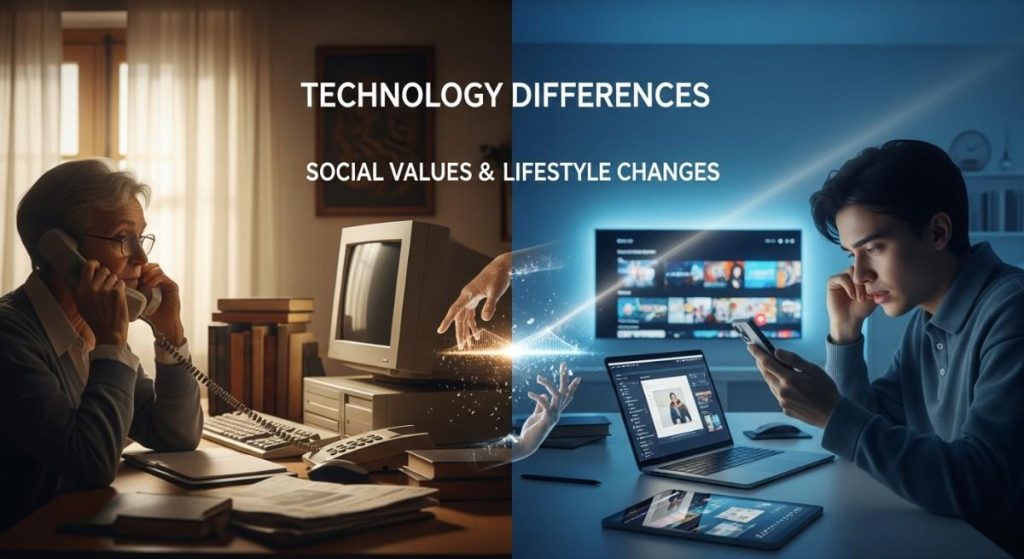
Attention spans and learning styles are also shaped by technology. The younger generations like fast information and visuals, while the older generations like deeper, slower communication. It’s like comparing a streaming platform to a library — they both offer knowledge, but the experience is totally different.
Social Values and Lifestyle Changes
Every generation defines success differently. Older generations often connect success with ownership-of-a house, a stable job, marriage, and retirement. Younger generations increasingly connect success with freedom, mental peace, and meaningful work.
There’s conflict in families because of this. Parents might ask, “Why don’t you settle down? ” But young adults ask, “Why should I rush into a life that doesn’t fit me?” These are not lazy questions—they are survival questions in a changing economy.
Social values around gender roles, mental health, and identity have also shifted. Younger generations speak more openly about emotional wellbeing and personal boundaries. Older generations may interpret that as weakness, while younger people see it as honesty. The real issue is not values—it is translation.
Generation Gap in Family Life
Parent and child communication problems
When it comes to generation gaps, families are the most personal. It’s easy to ignore workplace trends, but it’s hard to ignore dinner table arguments. It’s common for parents and kids to love each other deeply but have trouble understanding each other.
Discipline may mean strict rules to a parent, while respect may mean being heard. The two of them are trying to protect their relationship, but they’re using different tools. That’s why arguments can feel bigger than the topic. Often, it’s about who you are, not just clothes, career choices, or phone usage.
It’s easier to communicate when both sides stop trying to win and just try to understand. You can ask “Why do you feel that way? ” works better than saying “You are wrong.” Empathy is not agreement; it is curiosity. And curiosity is the shortest bridge across any generational gap.
Generation Gap in the Workplace
Leadership vs Flexibility the Debate
Modern workplaces are like family reunions with deadlines. Many Boomers, Gen Xers, Millennials, and Gen Zers work together, but they have very different expectations. There are people who want structure and people who want freedom. Hierarchy is valued by one side, collaboration is valued by the other.
Millennials are demanding more flexibility and less tolerance for vague career paths, according to a 2026 workplace report. A paycheck isn’t enough for young workers; they want purpose, autonomy, and growth. Some older managers might see that as impatience, but often it’s just a sign of the times.
Workplaces that work best don’t force everyone into one style. Systematize different strengths so they can work together. The experience matters. The future depends on innovation. It’s important to be stable. Adaptability is key. You don’t build a strong team by picking one generation over another. You build it by learning how each generation solves problems.
How to Reduce the Generation Gap
Better listening and empathy
You can’t erase the generation gap, but you can reduce friction. Listening without preparing a counterattack is the first step. Conflicts continue because people listen to reply, not to understand.
People trust older people more when they ask questions instead of giving immediate advice. Respect grows when younger people explain context instead of assuming judgment. Simple sounds easy, but easy doesn’t mean simple.
The same way Wi-Fi works, empathy does too. It’s not always there, but when it disappears, everything stops working. Strong emotional connections are more important than perfect agreement for relationships across generations.
Adapting Without Losing Identity
It doesn’t mean abandoning your values to bridge the gap. Staying flexible means understanding new ones. Older generations don’t have to become Gen Z. Younger generations don’t have to reject tradition. You need balance.
There’s a way to respect tradition and allow independence in a family. It’s possible to keep standards and embrace flexibility at the same time. Wisdom and innovation move society forward best when they’re combined.
The goal isn’t to erase differences, but to manage them maturely. Every young person grows up, and every old person was once a young voice nobody understood.
Conclusion
The generation gap isn’t just about birth dates—it’s about changing expectations, changing worlds, and changing definitions of success. It shapes how people connect and conflict, from family conversations to office meetings. Only when understanding disappears does the gap become painful.
Millennials are entering new life stages, Gen Z is redefining adulthood, and Generation Alpha is growing up in an AI-driven world. The real challenge isn’t figuring out which generation is right. Learning how to help each other grow is what it’s all about.
Generation gaps aren’t walls. We need to build it.
FAQs
1. What is the average generation gap in years?
Most generation gaps are around 15 to 20 years, but it can vary depending on social, cultural, and economic factors.
2. Why is the generation gap wider today?
Age groups have different communication, values, and expectations because technology changes faster than ever.
3. Which generation faces the biggest workplace gap?
Because of Millennials and Gen Z’s differing expectations around flexibility and career growth, they often face a big workplace gap with older leaders.
4. Can the generation gap be eliminated?
Definitely not completely, but it can be reduced through empathy, communication, and understanding.
5. Is the generation gap always negative?
I don’t. While it can cause conflict, it also fosters diversity of thought, stronger problem-solving, and learning opportunities for everyone.









Good news it is
Yes it is gap
Love the content