

Introduction to Google Digital Marketing
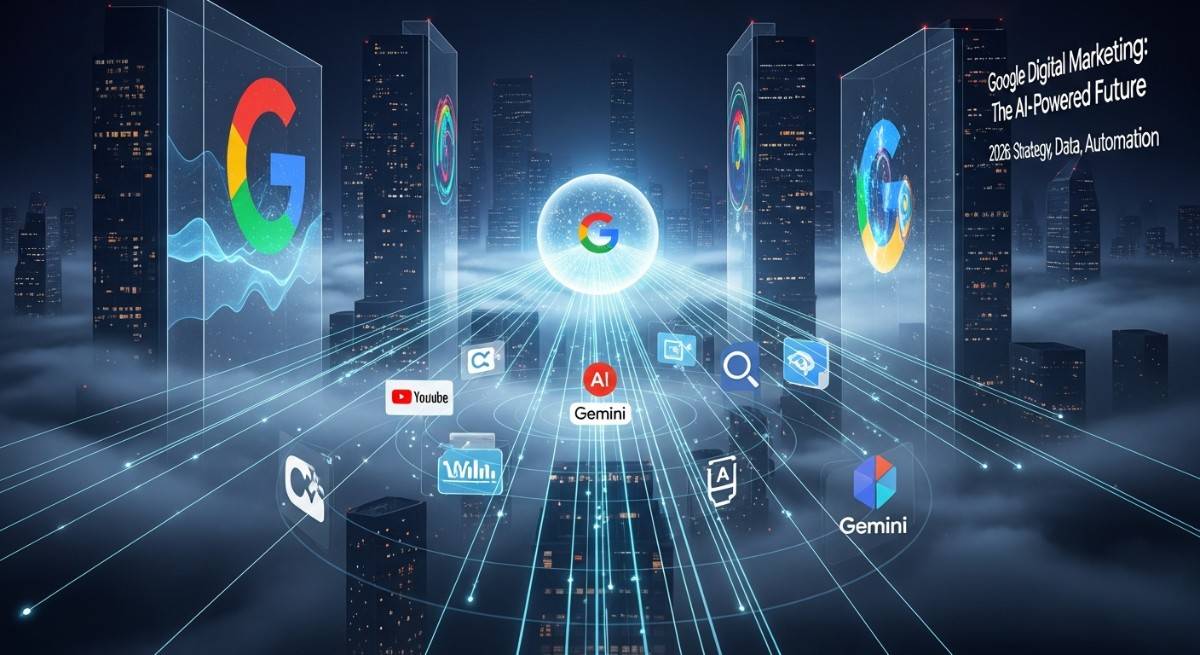
Google digital marketing isn’t just a buzzword anymore—it’s the backbone of modern online businesses.
When you search something, watch a YouTube ad, or get a product recommendation, you’re already inside Google’s marketing ecosystem.
AI-driven tools like Gemini and automated ad systems that learn user behavior faster make it even more powerful in 2026.
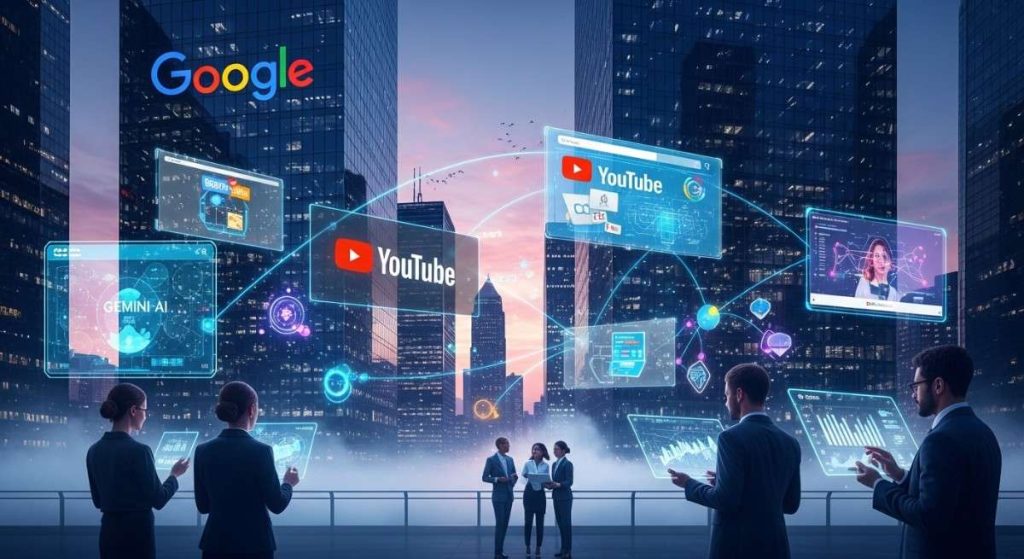
Today, businesses don’t compete manually for attention. Instead, they compete with AI-powered systems that decide what ads, content, and products show up. It’s a huge shift because it means marketing is now more about strategy, data, and automation.
The reason Google dominates digital marketing is because it controls search, video (YouTube), ad platforms, and analytics tools all in one place. You can generate traffic, leads, and sales on autopilot when you understand how these pieces work together.
What is Google Digital Marketing?
In Google digital marketing, you use Google’s platforms and tools to promote your business, product, or service. There’s Google Search, YouTube ads, Google Display Network, Google Analytics, and SEO strategies.
It’s all about connecting businesses with users at the exact moment they’re looking for something. As opposed to traditional marketing, where ads are shown randomly, Google marketing is intent-based. It means users are already interested before they see an ad.
Precision is the biggest difference between traditional marketing and Google marketing. Traditional marketing interrupts users, while Google marketing responds to their intent. Google campaigns usually have higher conversion rates because of that.
Key Components of Google Digital Marketing
Google Ads Overview
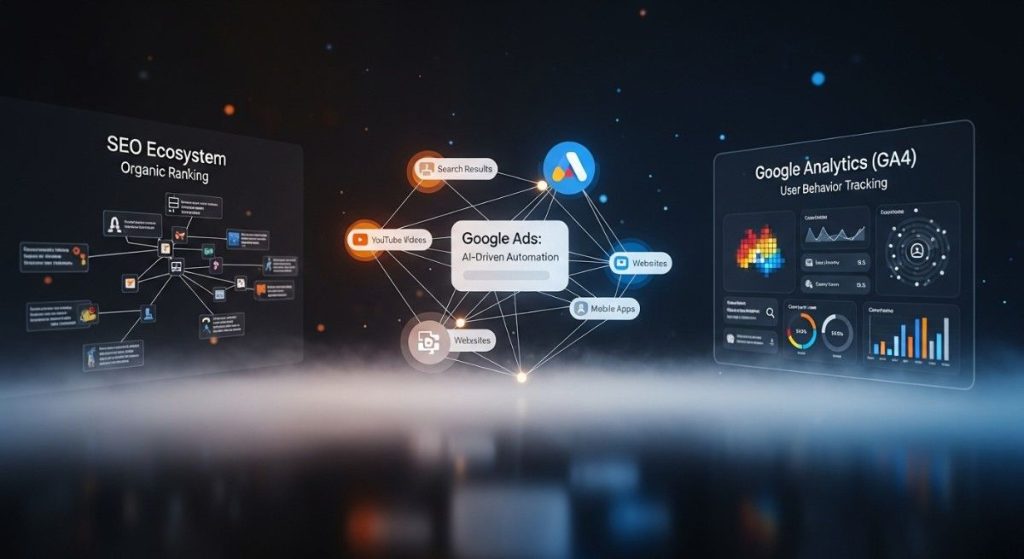
The most powerful paid advertising platform in the world is Google Ads. It lets businesses advertise on search results, YouTube videos, websites, and apps. By 2026, Google Ads will be heavily AI-driven, meaning advertisers will rely on automation for targeting, bidding, and ad creation.
Google SEO Ecosystem
The organic side of Google marketing is search engine optimization. The goal is to rank websites in unpaid search results. Paid ads and SEO go hand in hand because they both depend on keywords, user intent, and great content.
Google Analytics (GA4)
The tracking system that helps marketers understand user behavior is Google Analytics 4. It shows you where users come from, what they click on, and how they convert.
How Google Ads Works in 2026
Ads on Google have completely evolved into AI-powered systems. Google now uses “agentic AI” that optimizes campaigns without constant human input.
Instead of manually adjusting keywords and bids, advertisers set goals, and AI decides how to achieve them. Included are:
- Bidding strategies that work
- Copy generated by AI
- Audience targeting automated
- Optimizing cross-platform campaigns
As AI systems learn from millions of advertisers at once, advertising gets faster but also more competitive.
Google AI in Digital Marketing
Google marketing is changing a lot thanks to artificial intelligence. Google’s Gemini AI model is now integrated across ads, search, and analytics.
Artificial intelligence is generating millions of ad creatives automatically and optimizing performance in real time.
Marketers can now use AI for:
- Writing ad copy
- Designing creatives
- Predicting user behavior
- Improve conversion rates
In other words, marketers are using artificial intelligence to replace “manual workers.”
Google Analytics GA4 Features
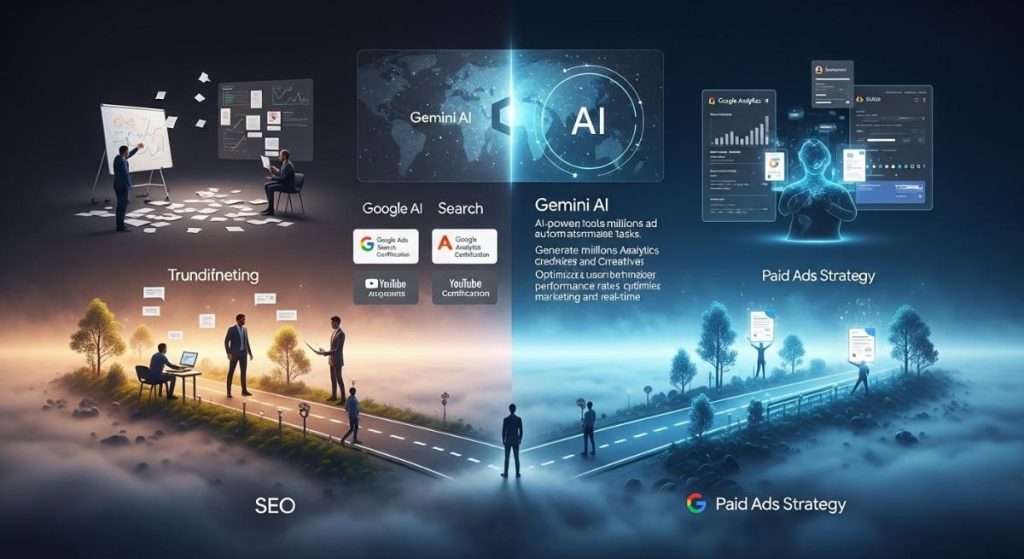
GA4 isn’t just a tracking tool anymore, it’s a decision-making tool. Cross-channel reporting allows marketers to track user journeys across multiple platforms like social media, websites, and apps.
GA4 also uses AI insights to predict future actions, like which users will convert or leave.
Businesses can optimize marketing budgets and reduce wasted ads.
Google Skillshop & Certifications
Through Skillshop, Google offers free learning platforms where users can learn advertising, analytics, and SEO. Certifications like these are globally recognized and widely used in digital marketing.
Some of the most popular courses are the following:
- Certification for Google Ads Search
- Certification in Google Analytics
- Certification for YouTube advertising
Certifications help beginners break into the industry and professionals upgrade their skills.
Google SEO vs Paid Ads Strategy
There’s a lot of comparison between SEO and Google Ads, but they’re best used together.
Google Ads provides instant visibility, while SEO focuses on long-term organic traffic. Although SEO takes time, it’s cost-effective, while ads deliver results instantly but cost money.
Smart marketers balance both strategies based on their business goals.
Latest Trends in Google Digital Marketing (2026)
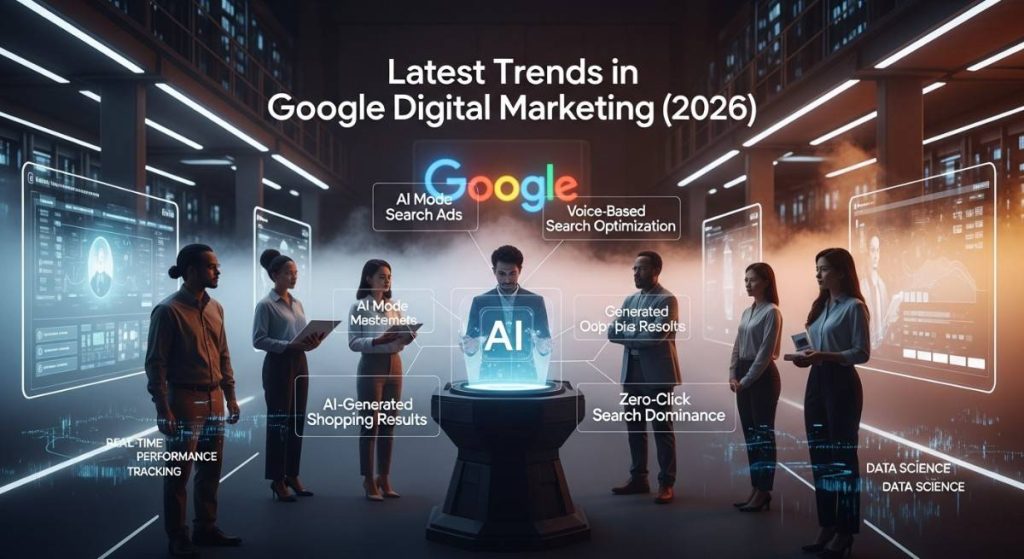
Now Google’s search experiences are AI-first. Ads are being integrated into conversational search, where users talk to AI instead of typing keywords.
Here are some key trends:
- Search ads with AI Mode
- Search optimization based on voice
- Shopping results generated by AI
- Search dominance with zero clicks
As a result, users get answers without even going to websites, changing the way marketers think about traffic.
Benefits of Google Digital Marketing
There are several benefits to Google marketing:
- Reaching millions of people worldwide
- Advertising that’s highly targeted
- Performance tracking in real time
- Return on investment is high
Small businesses can now compete with big ones thanks to AI automation.
Challenges in Google Marketing
Google marketing has some challenges despite its power:
- Cost per click (CPC) is up
- Competition is fierce
- Algorithm updates all the time
- AI dependency
To stay competitive, marketers have to adapt constantly.
Step-by-Step Guide to Start Google Marketing
- Create a Google Ads account
- Define your marketing goal
- Choose target keywords
- Create ad campaigns
- Set budget and bidding strategy
- Monitor performance using GA4
Success depends on testing and optimization.
Expert Tips for Success
Here’s how to succeed in Google digital marketing:
- Don’t just focus on keywords; focus on user intent
- Make your life easier with AI
- Make landing pages better
- Multiple ad creatives tested
- Analyze data regularly
We’re in the era of data science when marketing is no longer guesswork.
The future of Google Digital Marketing
AI is clearly driving the future. Google’s moving toward conversational search and automated decisions.
AI-driven search and ads are taking over traditional keyword-based systems, according to industry insights.
As a result, marketers need to become strategists instead of controlling everything manually.
Conclusion
Digital marketing at Google is evolving faster than ever. With AI, automation, and data-driven systems, businesses can reach more customers than ever. Success depends on understanding how these systems work and adapting fast.
Digital economy tomorrow will be dominated by those who learn and apply Google marketing strategies.
FAQs
1. What is Google digital marketing?
It is the use of Google platforms like Ads, SEO, and Analytics to promote businesses online.
2. Is Google Ads good for beginners?
Yes, but beginners should start with small budgets and learning campaigns.
3. What is GA4 used for?
GA4 tracks user behavior across websites and apps.
4. Is SEO better than Google Ads?
Both are important; SEO is long-term, and ads are short-term.
5. Can I learn Google digital marketing for free?
Yes, through Google Skillshop and other free Google resources.








Good luck