


Understanding Full Stack Development
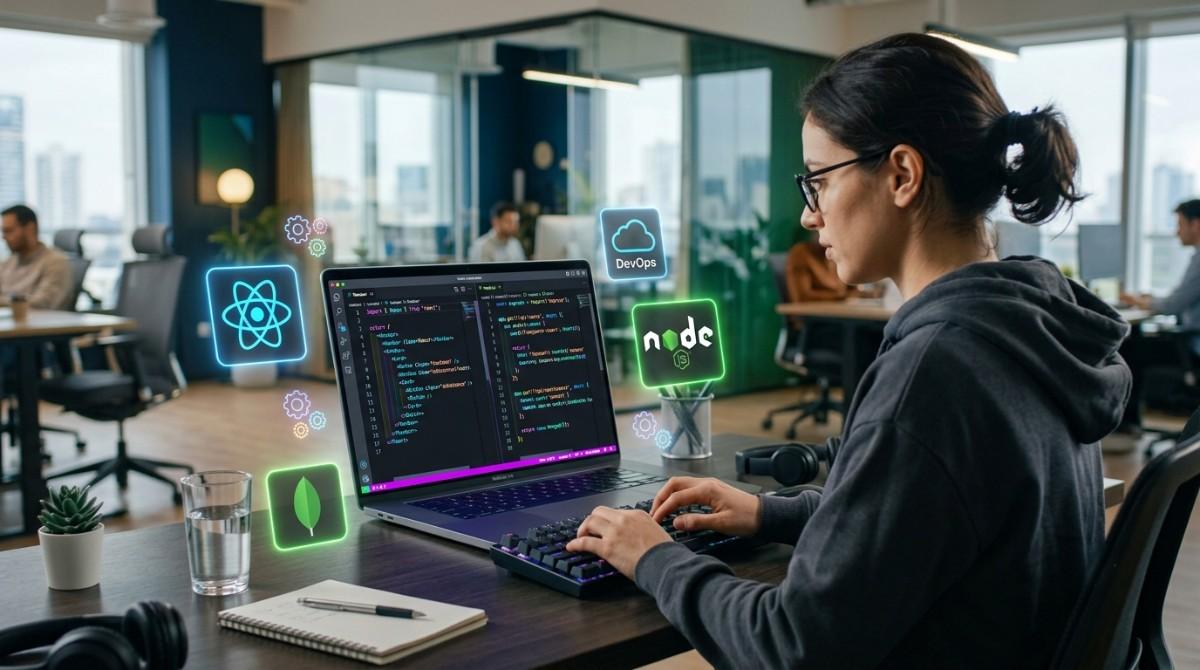
Full stack development means you build both the frontend and backend of your website or app. Basically, the frontend is what users see, while the backend is what controls the logic, servers, databases, and security. A full stack developer knows both areas and can work across the entire software development process. Rather than focusing on just one layer, these professionals understand how they work together.
There are no more simple pages in modern applications. Users can create accounts, make payments, communicate in real time, use artificial intelligence, and process data. These systems require knowledge of multiple programming languages, frameworks, databases, and development practices. A full stack developer combines these pieces to make the user experience smooth and reliable.
Full stack developers are popular because they can contribute to all stages of a project. Small startups need one developer who can build the user interface, build the server, connect databases, and deploy the product. It’s common for full stack developers to work with specialized teams, but they still provide valuable knowledge that helps different departments work together.
What Does a Full-Stack Developer Do?
Full stack developers work on both client-side and server-side projects. Different companies, projects, and technology stacks have different responsibilities. Sometimes they create interactive web pages, sometimes they design database structures, sometimes they fix server issues.
The typical full stack developer writes frontend code, creates APIs, manages databases, tests apps, improves security, and deploys software. Understanding how users interact with applications and how information moves between systems is key.
It’s not just about knowing a lot of languages that makes a great full stack developer. Someone who understands how technology works. In addition to speed and usability, they think about scalability and reliability. They’re not just trying to make something work, they’re trying to make something that works well.
What’s the difference between frontend and backend skills?
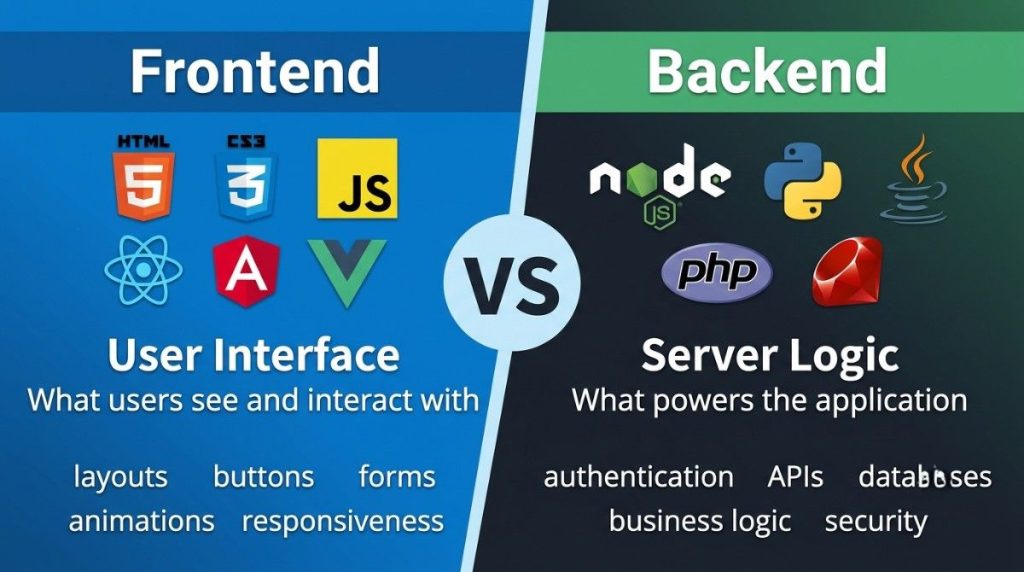
Full stack development is all about frontend and backend skills. All the stuff users can see and interact with is on the frontend. It includes layouts, buttons, forms, animations, menus, and responsive designs that work on any device.
Behind the scenes, there’s a lot going on that users don’t see. Authentication, business logic, data processing, server communication, and application security are all handled by it. No matter how pretty the website is, it won’t work if the backend isn’t strong.
Full stack developers connect these two worlds. On a website, a button click triggers backend operations and retrieves information from a database. It’s this ability to see the big picture that makes full stack developers so useful in modern software teams.
The Main Components of Full Stack Development

The full stack is made up of several layers that work together. By understanding these layers, beginners can see how websites and apps are built. The components of a digital experience need to communicate smoothly to deliver a complete experience.
The major components are frontend development, backend development, database management, APIs, security, testing, and deployment. Instead of treating these pieces like separate things, a developer learns how they work together.
HTML provides the structure, CSS controls the look, and JavaScript adds behavior and interactivity. The foundation of modern web experiences is built on these technologies.
To build complex applications faster, frontend developers use frameworks and libraries. It’s easier for developers to organize code and create reusable components thanks to tools like React, Angular, and Vue. By using these technologies, applications can become more dynamic and efficient.
Frontend developers need to think about more than just design. They need to think about accessibility, performance, mobile responsiveness, and user experience. You might lose visitors quickly if your website loads slowly. It’s for this reason that frontend development requires creative thinking and technical skills.
Backend Development Explained
A backend is what powers an application. Backends handle complicated processes behind the scenes while users interact with the frontend.
Server-side applications are created by backend developers. They handle requests, process information, and communicate with databases. Programming languages they use include JavaScript with Node.js, Python, Java, PHP, and more.
Users are authenticated, emails are sent, payments are processed, information is stored, and sensitive data is protected. Also, it provides APIs so the frontend and backend can talk to each other.
A good backend system should be secure, fast, and scalable. Backends need to handle traffic from thousands or millions of users at once. Strong programming skills and careful planning are required.
Database Management and Storage
There’s always a need to store and manage information in a modern application. It’s easy to save user profiles, messages, product information, transactions, and other stuff in a database.
Often, full stack developers work with databases like MySQL, PostgreSQL, and MongoDB. Understanding how data is organized, retrieved, updated, and protected is key.
Databases come in different types. Non-relational databases store data in more flexible ways, while relational databases store information in structured tables. The right database depends on your project’s needs.
Poor data management can lead to slow applications, security problems, and unreliable systems. Full stack developers need to design efficient data structures to support their applications.
Popular Technologies Used in Full Stack Development
There’s always something new in the technology landscape for full stack development. Developers have more options for building apps because new tools and frameworks are coming out all the time. The fundamentals are still important, and understanding core concepts makes it easier to adapt to new tech.
A full stack developer learns frontend frameworks, backend languages, databases, version control systems, and deployment platforms. Stacks of technologies are often used to describe the exact combination.
Frontend Frameworks and Libraries
It’s easier to build large and complex user interfaces with frontend frameworks. Developers can create applications faster with their organized structures.
There are a lot of frontend technologies out there, like React, Angular, and Vue. With these tools, developers can create reusable components and manage application behavior better.
Also, developers use styling tools and design systems to make their interfaces look good. Frontend development combines programming knowledge with psychology and design principles.
Backend programming languages
There are a lot of programming languages you can use for backend development. Using Node.js environments like JavaScript, developers can use JavaScript on both frontend and backend.
Python is another popular language because it’s simple, powerful, and supported by lots of frameworks. Other languages like Java, C#, PHP, and others are also important.
It’s not always the newest language that’s best. Project requirements, team experience, performance needs, and long-term maintenance determine the right choice.
Cloud, DevOps, and Deployment Tools
There’s more to it than just creating an application. It’s also important for developers to know how to publish and maintain online software.
With cloud platforms, companies don’t need to manage physical hardware to run applications. It’s easier and safer to release updates with deployment tools.
DevOps concepts like automated testing, continuous integration, and monitoring are becoming more common among full stack developers. They help teams deliver better software faster.
Essential Skills Every Full-Stack Developer Needs

The key to becoming a successful full stack developer isn’t just learning programming syntax. You need a mix of technical ability, creativity, communication skills, and continuous learning habits to be a developer.
There’s always something new in technology, so developers have to stay on top of it. Skills that are valuable today might be outdated tomorrow. A key skill in this field is the ability to learn and adapt.
Technical Skills and Programming Knowledge
It’s important for a full stack developer to understand programming fundamentals, data structures, algorithms, databases, APIs, and software architecture.
A developer should also be able to use development tools like code editors, version control systems, and testing frameworks.
It’s important for developers to have strong technical skills so they can build reliable and maintainable apps. Learning advanced technologies becomes much harder without a solid foundation.
Problem solving and communication skills
It’s often about solving problems in programming. Finding errors, improving performance, and creating better solutions are all things developers do.
It’s also important to communicate because software development is usually a team effort. Designers, managers, clients, and other engineers work with developers.
It’s often more valuable to hire someone who can explain ideas clearly and collaborate effectively than one who just writes code.
How To Become a Full-Stack Developer –

There are a lot of technologies involved in full stack development, so it can seem overwhelming. It’s much easier to learn with a structured approach.
It’s better for beginners to learn the fundamentals first rather than everything at once. Confidence and long-term success come from building strong foundations.
Learning Roadmap for Beginners
HTML, CSS, and JavaScript are usually the first things you learn on a practical learning path. When beginners master frontend basics, they can move on to frontend frameworks.
After that, they can learn backend programming, databases, APIs, and deployment techniques. All these concepts come together when you practice through projects.
Building Real-World Projects
The best way to improve as a developer is to do projects. The problem-solving skills you learn from creating real apps can’t be taught by tutorials.
Starter projects include task managers, blogs, online stores, booking systems, and social networks.
A completed project proves your abilities and builds your portfolio.
Career Opportunities in Full-Stack Development
Software is in almost every industry, so full stack development offers lots of job opportunities. It’s important for companies to hire developers who can build and maintain digital products.
You can work as a full stack developer in tech companies, financial institutions, healthcare, education, and entertainment.
Job Role and Industry Demand
Career paths include full stack engineers, web developers, software engineers, application developers, and technical consultants.
Businesses are constantly creating new digital services and improving existing ones, so developers are always needed.
The Future of Full Stack Development
Artificial intelligence, cloud computing, automation, and advanced web applications are the future of full stack development.
There will be a lot of opportunities for developers who understand both traditional programming and modern tools. People who build complete solutions will always be needed, even if the role changes.
Conclusion
The full stack development area is one of the most exciting in the tech world because it allows developers to create complete digital experiences. To build powerful applications, a full stack developer combines frontend creativity with backend logic, database management, and deployment knowledge. You’ll need dedication, curiosity, and practice to learn, but the rewards are worth it. The skills you need to enter this field can be developed with consistent learning and real-world experience.
Starting with the basics and gradually expanding your knowledge is the key. Developers with strong problem-solving skills and a deep understanding of development principles will always have a leg up.
Frequently Asked Questions About Full-Stack Development
1. What is full-stack development?
Creating a website or app from the frontend to the backend is called full stack development. Full stack developers work on user interfaces, server systems, databases, and deployments.
2. How long does it take to become a full-stack developer?
It depends on how fast you learn, how much practice you do, and how much experience you have. It usually takes a long time for beginners to become job-ready, but they can build basic full stack projects within several months.
3. Is full-stack development difficult?
Full stack development covers a lot of technology. It’s manageable though if you learn step by step and practice regularly.
4. Which programming language is most suitable for full-Stack development?
There’s no one best language. There are a lot of languages out there, like JavaScript, Python, and Java. What’s best depends on your career goals and the project.
5. Can I become a full-stack developer without a computer science degree?
Yes, definitely. Many developers learn by reading online resources, practicing, and working on their own projects. Practical skills and a strong portfolio can often matter more than formal education.