Introduction
There’s a strong comeback for business travel. Since the pandemic, companies are sending their employees back on the road with more confidence than ever. Global business travel spending is projected to reach US$1.69 trillion in 2026∗∗ [citation: 4]. Asia Pacific will be the world’s biggest business travel market in 2026, with spending projected to reach US$1.69 trillion [citation: 3]. US $701 billion will be spent on business travel in Asia Pacific, just over 40% of global spending and a 10.9% increase over last year.
There are, however, new challenges with this resurgence. The travel industry has to deal with rising costs, policy compliance, traveler well-being, sustainability mandates, and artificial intelligence. About 61% of corporate travel managers, up from 50% in 2025, are “very optimistic” or “somewhat optimistic” about the 2026 outlook.
Whether you’re looking for cost-saving strategies or emerging trends, this comprehensive guide has everything you need to know about business travel in 2026.
What is Business Travel?
Travel for business is when employees or professionals travel away from home on behalf of their company. Here are a few examples:
| Type of Business Travel | Description |
|---|---|
| Conferences & Trade Shows | Attending industry events, conventions, or exhibitions |
| Client Meetings | In-person meetings with existing or potential clients |
| Supplier Visits | Meeting with vendors or supply chain partners |
| Internal Collaboration | Meeting with remote colleagues or regional offices |
| Training & Development | Job-specific training, workshops, or seminars |
| Site Evaluations | Assessing project locations or expansion opportunities |
| Negotiations | Finalizing deals or contracts in person |
As far as business travel is concerned, it does not include daily commutes or personal leisure trips.
In the case of employees traveling for business and for pleasure at the same time (known as ‘bleisure’ travel), only the portion of the trip for business qualifies as business travel.
Global Business Travel Outlook for 2026
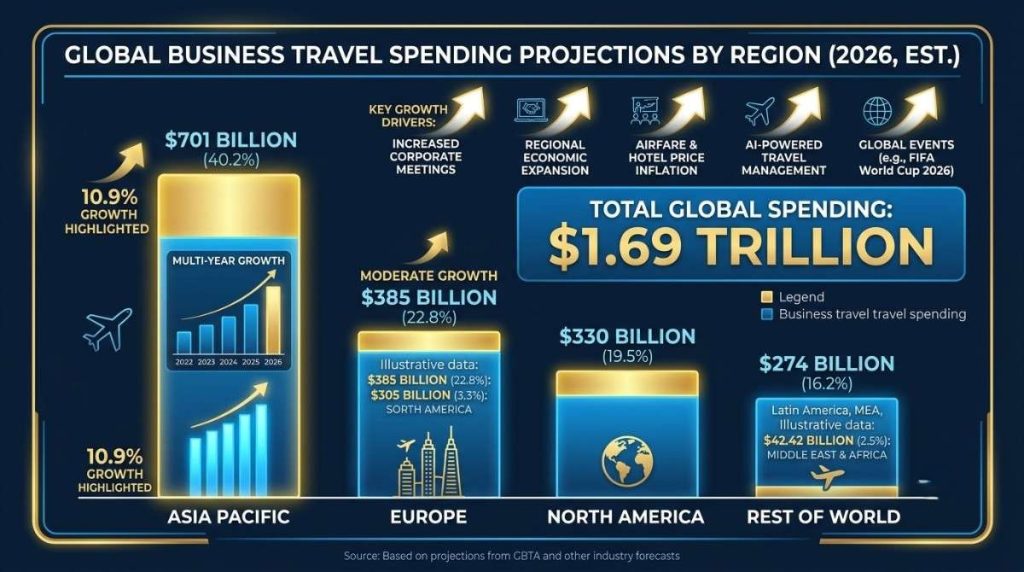
Spending Projections by Region
| Region | Projected 2026 Spending | Year-over-Year Change |
|---|---|---|
| Asia Pacific | $701 billion | +10.9% |
| Europe | Second-largest market | Moderate growth |
| North America | Third-largest market | Moderate growth |
| Global Total | ~$1.69 trillion | Positive growth |
In terms of manufacturing and trade activity, Asia Pacific is the leader in demand for goods, with Japan, Korea, and India driving the market.
As China’s domestic business travel market continues to grow, and its green-technology sector is expected to grow even further, travel demand in the country is expected to increase further.
Key Drivers of Growth
| Driver | Impact |
|---|---|
| Manufacturing Sector | Largest business-travel sector; drives cross-border trips |
| Trade Expansion | New and reacquired trading partnerships |
| Green Technology | China’s growing green sector fueling demand |
| In-Person Meetings | Virtual meeting impact diminishing |
Key Business Travel Trends Shaping 2026
1. Cost Management Remains Top Priority
Three out of ten corporate travel managers (33%) have a particular concern about ensuring that they are gaining a better value from their suppliers. A cost control strategy is imperative when it comes to a market where airfares are expected to rise 3.7% in 2026 and hotel rates to rise 3.9%.
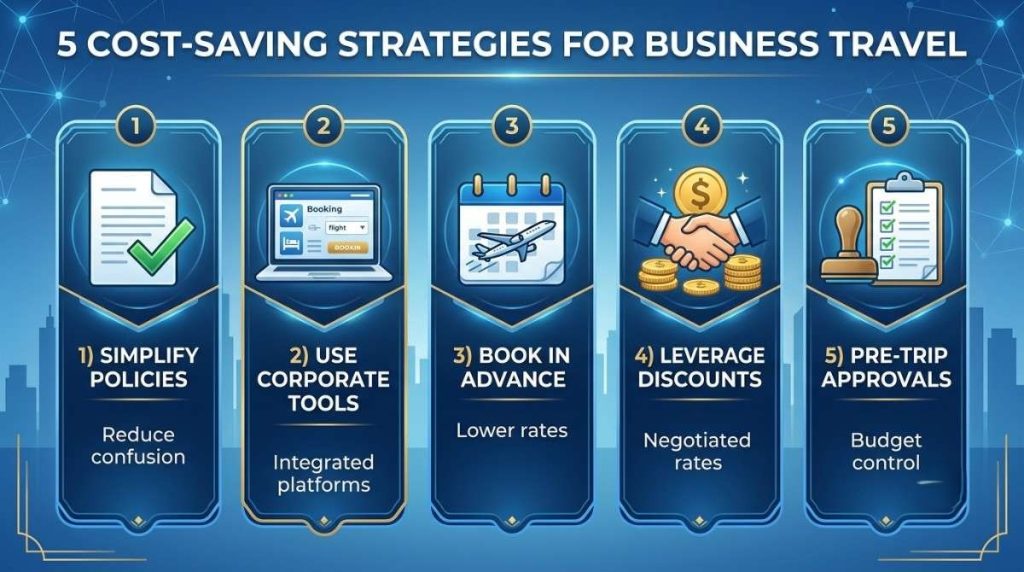
Key strategies for cost optimization:
- It is important to simplify travel policies in order to reduce confusion and non-compliance
- It is important to use corporate travel management tools that integrate bookings and expense reports
- It is advisable to book in advance in order to secure a lower rate
- Taking advantage of corporate discounts by negotiating with suppliers is a great way to save money
- Implement a pre-trip approval process for all trips
As contained in:
In a real-world example, Corporate Travel Management helped a national electronics retailer reduce travel expenditure by 21% (saving over $100,000 in just three months). This reduction was achieved by implementing a formal travel policy, reducing reliance on flexible fares by 40%, and implementing an open-skies policy that balanced market shares between two airlines.
2. Policy Compliance and Traveler Expectations
In the survey, 29 percent of respondents identified reducing “leakage” (unapproved expenditures) and managing traveler expectations against budgets as the most significant challenges they face. There must be a balance between enforcing policies and maintaining employee satisfaction in the travel industry.
Best practices for policy compliance:
- The travel policies should be clear and concise, and the booking process and expense guidelines should be clearly defined
- The use of automated approval workflows as well as budget caps is highly recommended
- Training on the reporting of expenses should be provided
- Encourage employees to provide feedback on policies on a regular basis in order to improve them
Source:
3. AI Gets Practical in Travel Management
Artificial intelligence is going from hype to necessity in 2026. It’s estimated that 80% of travelers use generative AI to plan, research, or book trips. There are a lot of AI applications, including:
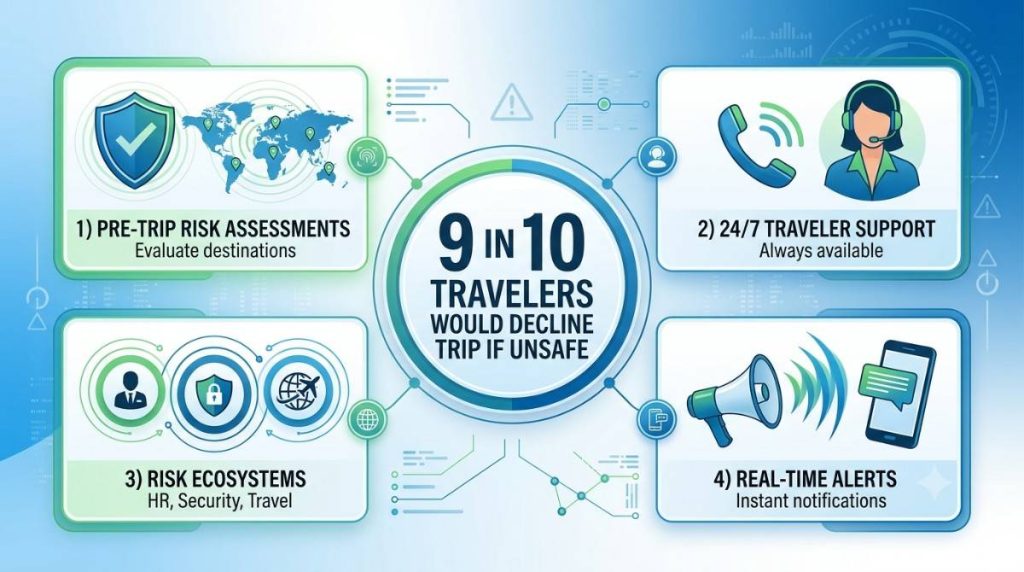
| AI Application | Benefit |
|---|---|
| Predictive AI | Analyzes flight disruptions and rebooks travelers before cancellations |
| Automated Expense Tracking | Reduces administrative burden |
| Policy Compliance | Flags non-compliant bookings automatically |
| Real-Time Itinerary Adjustments | Provides instant support and policy guidance |
Sam, FCM’s intelligence engine, provides instant support, policy guidance, and personalized experiences.
According to one expert, artificial intelligence (AI) is capable of automating a tremendous amount of work, but it is the collaboration between human agents and intelligent systems that has the most impact on travelers.
4. Duty of Care and Traveler Safety
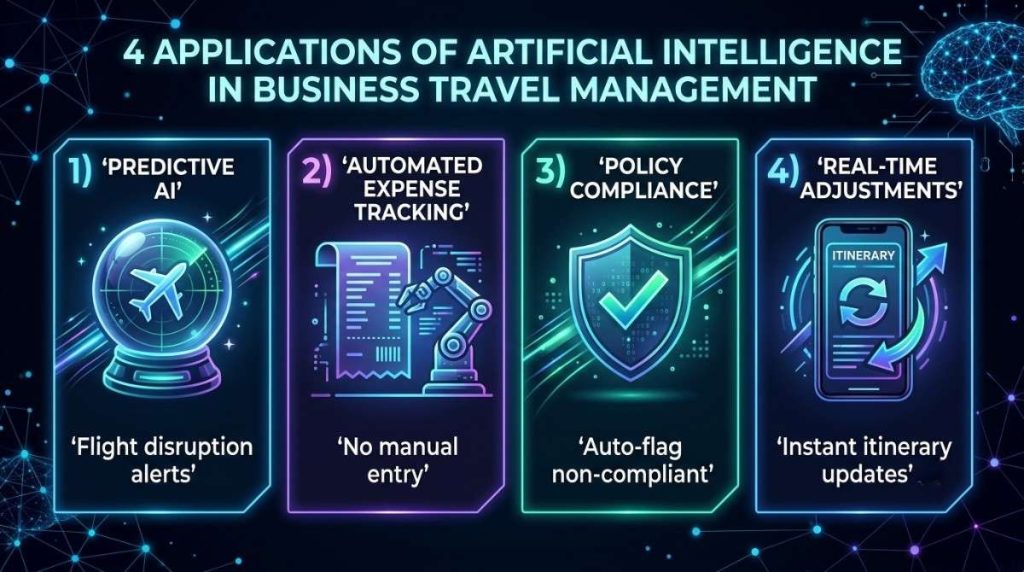
The growing geopolitical tensions, cyber threats, health risks, and extreme weather events have intensified in recent years, which means duty of care remains a major concern. The SAP Concur survey showed that nine out of ten travelers would decline a trip if they felt unsafe during the trip.
In order to fulfill our duty of care, the following practices are essential:
- Make sure that you conduct risk assessments prior to your trip
- Ensure traveler support is available 24 hours a day, 7 days a week
- A multi-departmental risk ecosystem should be implemented (HR, security, travel)
- Communication protocols and real-time alerts should be provided
- The location of travelers should be visible at all times
- https://smallusetools.com/tools/qr-code-generator
5. Sustainability Becomes a Mandate
A new regulation requiring companies to disclose Scope 3 emissions has come into effect, putting flights, accommodations, and ground transportation under the spotlight. The carbon-reduction targets of business travelers have been tied to the specific carbon-reduction targets of twenty percent of travel buyers.
Sustainable travel strategies:
- Creating a carbon budget and a supplier scorecard in order to reduce carbon emissions
- It is preferable to travel by rail rather than by air where possible
- Air travel for day trips should be minimized
- Make the right choice when it comes to transportation and lodging in order to reduce emissions
- Make use of corporate online booking platforms by integrating sustainability information into them
6. Traveller Wellbeing Becomes a KPI
As corporate traveler wellness gains traction, it is becoming more and more of a performance metric rather than a mere talking point. Business travelers are looking for more control in their travels: flexible flights, balanced itineraries, health-conscious hotels, and downtime between commitments.
Employee preferences:
- Travelers are estimated to eat healthier while they are traveling, with 59% of them doing so
- In the United States, 48% of people are habitually traveling while exercising as part of their daily routine
- Nearly half of vacationers put a high priority on staying in touch with their loved ones while on vacation, which is a great example of staying connected
A number of companies are responding by implementing policies that allow blended travel, remote work, and buffer days as a means to avoid burnout.
7. Leisure Travel Gainstraction
In recent years, “bleisure” travel-combining business with leisure-has become a much more common perk. There are times when employees extend business trips so that they can enjoy their time at the destination while they are off work. It is possible to increase flexibility and reduce total travel costs when this is structured in the right way.
8. Hotels Double Down on Experience
Hotel chains are reinventing themselves by giving their guests swanky in-room technology, curated business amenities, wellness centers, and personalized service. As a result, boutique and mid-scale brands are leading the way in this trend. In order to accommodate longer stays in a region, alternatives like Airbnb and serviced apartments are gaining popularity.
9. Meetings and Events Take a Larger Slice
It is expected that more than half of the travel budget will go towards conferences and gatherings. Face-to-face meetings are gaining ground over virtual conferences as companies invest in internal collaborations and opportunities for client interaction as face-to-face time reclaims its edge against virtual meetings.
Effective Corporate Travel Management Strategies
Building a Strategic Travel Program
| Strategy | Description |
|---|---|
| Centralize Bookings | Consolidate through a single platform to gain spend visibility |
| Leverage Negotiated Rates | Build vendor relationships for competitive prices |
| Automate Approvals | Reduce delays with automated workflows |
| Use Data Analytics | Identify trends, savings opportunities, and compliance gaps |
| Implement Traveler Communication | Provide instant support and emergency alerts |
For Small & Mid-Sized Enterprises (SMEs)
- In order to get the best results, it is important to improve efficiency and control costs at the same time
- By using an easy-to-use booking tool, you can make bookings for your event simple and easy
- A flexible policy should be maintained to ensure that small teams are not burdened with unnecessary restrictions in terms of their work
- If you are looking for a travel management platform that is designed for a smaller volume of travelers, you may want to consider
For large enterprises
- Maintain a complex set of policies that meet the needs of the region
- Be able to handle large volumes of daily bookings on a daily basis
- Coordinate multiple vendors and negotiate rate agreements with multiple vendors
- Maintain a global duty of care and compliance program as a priority
Technology Integration Priorities for 2026
Travel buyers are prioritizing the following tech investments:
| Technology | Purpose |
|---|---|
| Real-time itinerary adjustments | Respond to disruptions instantly |
| Policy compliance tools | Automatically flag non-compliant bookings |
| Fare reshopping | Capture lower fares after booking |
| Predictive analytics | Forecast demand and pricing trends |
| Automated expense tracking | Reduce administrative burden |
Business Travel Expenses and Tax Deductions
Common Deductible Business Travel Expenses
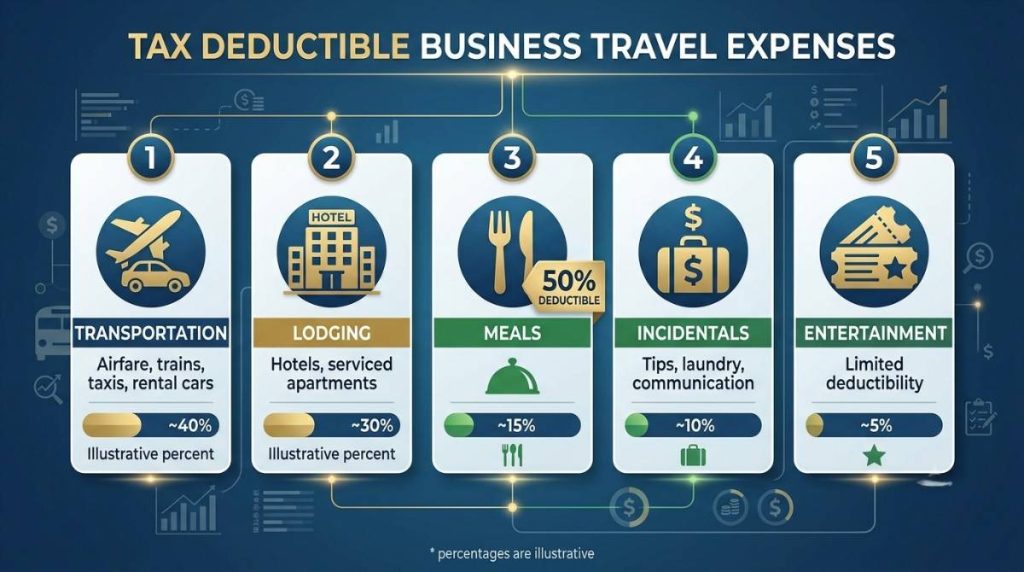
The IRS guidelines state that business travel expenses are deductible if they are “ordinary and necessary” expenses incurred for the purposes of the company:
| Expense Category | Details |
|---|---|
| Transportation | Airfare, trains, taxis, ride-share, rental cars |
| Lodging | Hotels, serviced apartments, Airbnb |
| Meals | 50% deductible (subject to limitations) |
| Incidentals | Tips, laundry, business communication |
| Entertainment | Limited deductibility (client meals under certain conditions) |
Expenses cannot be lavish, extravagant, or primarily personal in nature.
Best practices for expense management
- Automating the expense reporting process will reduce errors and save you time and money
- Use digital copies of receipts and mobile capture of receipts to standardise receipt submissions
- Establish a clear categorization of expenses so that you can analyze your spend and track your tax deductions
- Training should be provided on expense reporting so that common mistakes can be avoided
- Make sure expenses are reviewed and approved quickly so that employee reimbursements can be processed on time
Tracking Key Metrics
Monitor these KPIs to optimize travel spend:
| Metric | Purpose |
|---|---|
| Average cost per trip | Benchmark against industry standards |
| Policy compliance rates | Identify leakage and training needs |
| Total travel spend | Track overall budget performance |
| Advance booking percentage | Measure policy adherence |
| Supplier performance | Evaluate negotiated rate utilization |
Conclusion
In the year 2026, business travel is expected to grow significantly, as global spending on business travel will reach pre-pandemic levels, while Asia Pacific will lead the recovery. It should be noted, however, that this growth comes with new complexities, such as rising costs, stricter policy compliance requirements, mandates regarding sustainability, and heightened obligations when it comes to duty of care.
There are a few things that will make corporate travel programs more successful:
- Utilise technology to your advantage – Including AI-powered tools for booking, expense tracking, and customer support for travelers
- Utilize analytics to identify savings opportunities and compliance gaps in order to prioritize your data
- A balance must be struck between control and flexibility – Clear policies that still accommodate the preferences of travelers
- We need to invest in traveler wellbeing – health, safety, and work-life balance as key performance indicators
- Integrate sustainability into all aspects of your business – Carbon budgets, supplier scorecards, and a greener approach
- https://smallusetools.com/tools/qr-code-generator
If companies get these elements right, they will not only be able to control costs, but also improve employee satisfaction, reduce risk, and gain competitive advantage through more effective face-to-face interactions with customers, business partners, and other stakeholders.
Frequently Asked Questions (FAQs)
Q1: What is business travel?
It is understood that business travel is any travel that is carried out on behalf of an organization for work-related purposes, such as attending conferences, meeting clients, visiting suppliers, or collaborating remotely with remote colleagues.
Q2: How much will global business travel spending reach in 2026?
In 2026, it is projected that the global business travel spending will reach approximately US1.69 trillion, with Asia Pacific leading at US1.69 trillion in 2026, with Asia Pacific leading at US701 billion in 2026.
Q3: What are the top challenges for corporate travel managers in 2026?
There are a number of challenges that companies face today, including cost management (33% of managers are concerned about supplier value), policy compliance (29%), finding the right technology solutions (27%), and geopolitical uncertainty (20%).
Q4: How can companies reduce business travel costs?
As a result, companies are able to reduce costs by centralizing bookings, negotiating supplier contracts, booking in advance, implementing pre-trip approval processes, reducing the reliance on flexible fares, and utilizing data analytics to identify savings opportunities.
Q5: What is leisure travel?
Traveling on business and enjoying leisure time at the same time is known as business leisure travel. This refers to employees combining business trips with their own leisure time. If it is structured in the right way, and if there are clear policies in place, it can become a no-cost employee benefit.