


What Is Home Insurance and Why Does It Matter?
Imagine trying to rebuild your whole house tomorrow with only your savings. It’s just too hard for most people. It’s for that reason that home insurance exists. It protects homeowners from unexpected disasters that damage property, destroy belongings, or create legal liabilities. You’d lose decades of hard work in an hour if you didn’t have it.
A home insurance policy is a contract between you and an insurance company. You pay a monthly or yearly premium, and the insurer covers losses caused by events listed in your policy. There are a lot of things that can cause damage, like fire, theft, hailstorms, wind damage, vandalism, and certain types of water damage. Also, some policies cover homeowners if someone gets hurt on their property and sues.
As homes have become more expensive to repair and rebuild, home insurance has become more important. Natural disasters, high construction material prices, and labor shortages are driving up insurance claims. The cost of replacing a home has gone up more than 40% over the past five years, according to recent studies. In the event of a disaster, homeowners without enough insurance might have to pay a lot out of pocket.
The emotional side of home insurance is also important. There’s more to a house than bricks and drywall. The home holds memories, family traditions, valuable possessions, and personal security. While insurance can’t replace sentimental value, it can give you a little breathing room when tragedy strikes. Like a safety net beneath a tightrope walker. I hope you never need it, but you’ll be glad it’s there if something goes wrong.
How Home Insurance Actually Works
It’s common for homeowners to pay insurance premiums for years without understanding how it works. Suddenly, panic turns into confusion after a disaster. If you know how home insurance works before filing a claim, the whole thing will be a lot less stressful.
Each home insurance policy revolves around three key concepts: premiums, deductibles, and coverage limits. The premium is how much you pay. Deductibles are the things you have to pay before your insurance kicks in. Insurance coverage limits are the maximum amount the insurer will pay.
Imagine your roof gets damaged by a storm and costs $15,000. If you have a $1,000 deductible, you’d pay $1,000 and your insurer would cover the rest, assuming the damage falls within the policy. The entire insurance system runs on this simple structure.
Claims are another big part of the puzzle. The insurance company gets documentation, photos, receipts, and repair estimates after damage happens. Once the loss has been evaluated, an adjuster determines how much compensation is needed. Some claims go fast, but others get complicated if there’s a dispute over coverage.
Smart technology and artificial intelligence will be used more during inspections and claims in 2026. Some insurers use drones, satellite images, and automated risk analysis to evaluate homes faster. Using this technology can speed up claims approvals, but it also means insurers are getting much stricter about property maintenance.
It’s important to understand these details because home insurance doesn’t cover everything. A policy is a highly specific legal contract. It’s easier to deal with unpleasant surprises after a loss if you understand them.
Types of Home Insurance Coverage
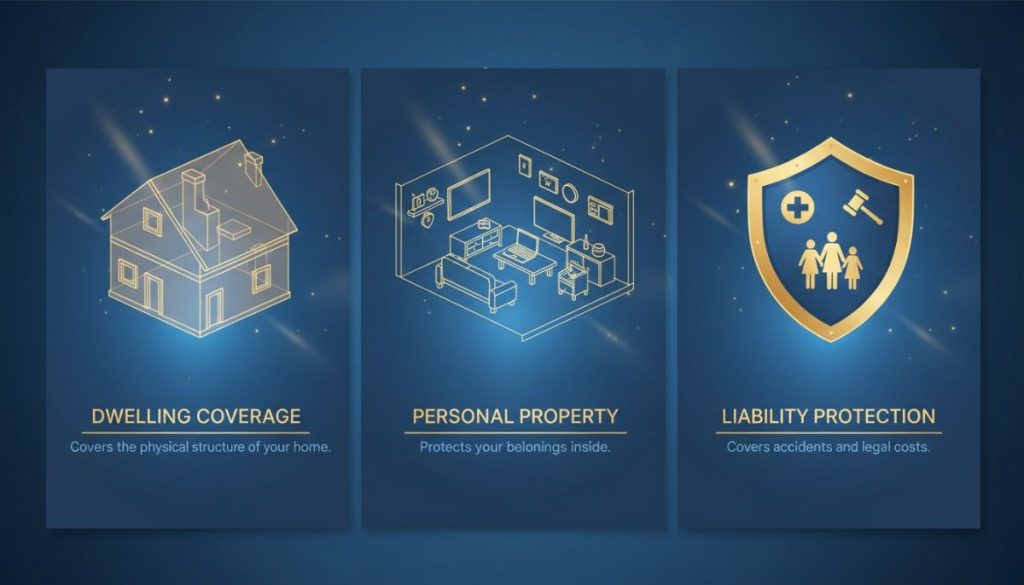
Dwelling Coverage
The most important part of any home insurance policy is the dwelling coverage. It protects your house’s physical structure, including walls, roofs, floors, garages, and attached structures. In the event of a fire or a tornado tearing off part of your roof, dwelling coverage helps pay for repairs.
Underestimating replacement costs is one of the biggest mistakes homeowners make. Many people assume their home’s market value is the same as its rebuilding cost, but that’s not always true. It might cost $450,000 to rebuild a house that sells for $300,000 in one neighborhood. The gap has widened dramatically in recent years as construction costs keep rising.
Personal property coverage?
You should take care of your stuff, too. In addition to furniture, electronics, clothing, appliances, jewelry, and other possessions inside your house, personal property coverage protects them. Think about how much it would cost to replace everything you own tomorrow. The number is usually underestimated by tens of thousands.
For expensive items like artwork, luxury watches, or jewelry, insurance companies set limits. Because of this, many homeowners buy extra riders or endorsements. It’s also easy to make claims if you keep a home inventory with photos and receipts.
Liability protection,
One of the most crucial parts of a policy is liability protection. If someone gets hurt on your property, liability coverage can help pay for medical expenses, legal fees, and settlements. Imagine a guest slipping on ice or a dog biting incident leading to a lawsuit. It’s easy to get overwhelmed by financial consequences without liability coverage.
Additional Living Expenses Coverage
Additional living expenses coverage helps pay for hotels, meals, and temporary housing if your home is temporarily unlivable after a covered disaster. If you’ve been damaged in a fire, hurricane, or flood, this coverage can be a lifesaver.
Think of it like insurance for your lifestyle while your house is being repaired. This keeps families from draining their savings for a temporary place to live.
What Home Insurance Usually Does Not Cover
One of the biggest misconceptions about home insurance is that it covers everything. That’s not true. The most expensive risks homeowners face today require separate policies or special endorsements.
One of the most common types of damage is flooding. Flood-related losses are usually not covered by standard home insurance. Water entering your home from heavy rain, storm surges, or overflowing rivers probably won’t be covered. Flood insurance is often needed by homeowners in flood-prone areas, either through government programs or privately.
In many regions, earthquake damage is also excluded. A separate earthquake coverage may be a must if you live in a seismic area. A lot of mold damage comes from landslides, sinkholes, and other natural disasters.
Also, insurance companies won’t cover normal wear and tear. When a roof deteriorates after 25 years, it’s maintenance, not an accident. Plumbing, HVAC, and old appliances fall into this category too. The purpose of home insurance is to cover unexpected events, not to cover predictable aging.
Many homeowners get frustrated with this distinction during claims disputes. The insurer might deny a claim for a small leak that damages walls over time because it’s preventable maintenance, not sudden damage. When it comes to policy exclusions, reading them carefully is crucial because assumptions can turn into big, expensive mistakes.
Why Home Insurance Costs Are Rising in 2026
You’re not the only one whose insurance premiums jumped. Many people don’t realize why insurance costs are going up for homeowners around the world.
Climate Change and Severe Weather
Extreme weather is one of the biggest drivers of insurance costs. Hurricanes, wildfires, floods, hailstorms, and severe storms are causing insurers to lose record amounts. US weather disasters cost billions of dollars in 2024 alone, according to industry data.
When insurance companies see high-risk regions, they raise premiums, tighten underwriting standards, or withdraw. Over the last few years, some homeowners in coastal or wildfire-prone areas have seen their insurance premiums double or triple.
Inflation and construction costs
There’s a lot to consider when it comes to inflation and insurance. As construction materials get more expensive, insurers have to pay more to fix damaged houses. Adding to the cost pressure are labor shortages.
There’s been a 40% rise in replacement costs in five years, according to recent reports. Almost everything costs more now than it did before the inflation surge during the pandemic.
Regional Risk Assessments
In today’s world, insurance pricing relies heavily on data analysis. When insurance companies calculate premiums, they look at neighborhood crime rates, weather history, wildfire zones, flood maps, and even roof age.
Despite never filing a claim, some homeowners get shocked when their premiums go up. It’s because insurers are looking at entire regions instead of individual properties. Across consumer communities, there’s growing frustration over regional “risk reevaluations” affecting thousands of homeowners simultaneously.
It’s resulted in a rapidly changing insurance market where location is more important than ever.
How to Choose the Right Home Insurance Policy
It can be overwhelming shopping for home insurance because policies often look the same. A tiny difference in coverage details can make a huge difference during a claim.
Compare multiple insurers first. You don’t have to go with the cheapest premium. You may get a low-cost policy with higher deductibles, lower coverage limits, or stricter exclusions. It’s also important to read customer reviews about claims handling, since fast claim support matters when disaster strikes.
Replacement cost coverage is more important than actual cash value coverage. Actual cash value policies subtract depreciation from the cost of rebuilding or replacing damaged property. After a loss, that difference can mean thousands less.
We should pay attention to policy endorsements too. Add-ons like these cover specific risks like sewer backups, expensive jewelry, identity theft, and home businesses. An insurance policy tailored to your lifestyle makes more sense than one that’s generic.
Also, make sure you review your policy every year. Everything changes so fast. Renovations, rising property values, expensive purchases, and remote work can all change your insurance needs. Homeowners often discover too late that their coverage limits don’t match their actual risks.
You can think of your insurance policy like a parachute. Falling through the air won’t be fun if you find missing pieces.
Smart Ways to Lower Your Home Insurance Premium
It’s frustrating to have to pay more for insurance, but there are still ways to save money without sacrificing coverage.
Bundling policies.
The best way to save money is to get your home and auto insurance from the same company. According to recent surveys, bundling discounts can save policyholders around 13%. Customers who buy multiple products are rewarded by insurers because they’re more likely to stick around.
Installing smart home technology
There’s a gold rush for smart home devices in the insurance industry. You can reduce risk and premiums by installing leak detectors, monitored security systems, and smart smoke alarms. According to industry forecasts, homes with qualifying technology will get discounts of 5%-20%.
When you think about it, it makes sense. You could save $50,000 in water damage with a $100 water sensor.
Raising Your Deductible Strategically
You can lower your monthly premiums by increasing your deductible. It only works if you’ve got enough emergency savings to cover the deductible comfortably after a loss.
You might notice a drop in premiums if you raise your deductible from $500 to $2,000. If an emergency happens tomorrow, you’d better be ready to pay that amount right away.
Other ways to save include:
| Strategy | Potential Benefit |
|---|---|
| Improving roof quality | Lower storm-risk premiums |
| Maintaining good credit | Better insurance scoring |
| Avoiding small claims | Reduced long-term rate hikes |
| Shopping annually | Better competitive pricing |
| Updating wiring/plumbing | Lower fire and water risk |
The key is balancing affordability with adequate protection. Saving money today means little if coverage gaps create financial disaster later.
Common Home Insurance Mistakes Homeowners Make
One of the biggest mistakes homeowners make is assuming they’re covered without checking their policy. Most people just trust the default coverage recommendations because insurance documents are long, technical, and boring. The problem with assumptions is that they can be expensive.
It’s incredibly common to underinsure your home. Many older policies don’t reflect current rebuilding costs because of rising construction costs. It’s possible for a homeowner to think they have enough coverage, then find out that rebuilding costs exceed policy limits by $100,000.
Another mistake is ignoring exclusions. There are usually separate endorsements for flooding, mold, sewer backups, and earthquake damage. It’s sometimes only after a catastrophic loss that homeowners find these gaps.
Too many small claims can also backfire. Even minor claims can cause higher future premiums or nonrenewal risks. There are times when paying out of pocket for smaller repairs makes more sense long-term.
Last but not least, not documenting possessions causes big problems during claims. Homeowners often have trouble remembering everything they own after major disasters. You can improve reimbursement accuracy by keeping digital photos, receipts, and inventory lists.
The best way to handle insurance is proactively, not reactively. Buying an umbrella after the storm starts is like waiting until disaster strikes.
The Future of Home Insurance

Home insurance is evolving faster than most homeowners realize. How insurers assess risk and process claims is changing thanks to technology, climate science, AI, and predictive analytics.
We’re going to see a lot more smart homes in the future. The devices that monitor leaks, detect smoke, track temperature changes, and prevent theft might become standard requirements. Since prevention is cheaper than paying large claims later, insurers want real-time data.
Climate risk mapping is also getting better. Insurance costs could have a big impact on housing markets in high-risk areas, according to some experts. Rising premiums are already affecting property values in vulnerable areas, according to analysts and homeowners.
A new trend is parametric insurance, which pays out when certain events happen, like hurricanes reaching certain wind speeds or rain crossing defined thresholds. By relying on measurable triggers instead of lengthy damage inspections, this approach speeds up claims.
The use of artificial intelligence will likely continue to transform underwriting and claims handling. In some high-risk areas, stricter data analysis could make getting insurance harder.
While home insurance’s future may seem uncertain, one thing is clear: homeowners who stay informed, proactive, and adaptable will be in the best position.
Conclusion
Lenders no longer just require home insurance as a checkbox. As climate risks, inflation, and unpredictable disasters rise, it’s become essential for financial survival. Not only will a strong policy protect your property, but it’ll also give you peace of mind.
There’s a lot of change in the insurance market in 2026. There’s been a sharp rise in premiums in recent years due to extreme weather, rebuilding expenses, and regional risk factors. Meanwhile, technology is changing how policies are priced and how claims are handled.
Rather than a passive monthly bill, smart homeowners treat insurance as an active financial strategy. Review policies regularly, compare providers carefully, invest in home safety improvements, and know what’s covered.
Your home may be your biggest investment, but it’s also your safe place. One of the most important financial decisions you can make is protecting it.
FAQs
1. What does home insurance cover?
Most home insurance policies cover fire, theft, vandalism, storms, and water damage. Personal belongings and liability coverage are also usually included.
2. Why are home insurance premiums increasing?
Due to severe weather events, climate risks, inflation, higher rebuilding costs, and more insurance claims, premiums are going up. Regional risk analysis systems are also getting better.
3. Is flood damage covered by standard home insurance?
I don’t. Flood damage is usually excluded from standard home insurance policies. It’s often a good idea to get separate flood insurance for your home.
4. How can I reduce my home insurance costs?
Bundling policies, improving home security, installing smart devices, raising deductibles, maintaining good credit, and shopping around can lower your costs.
5. How much home insurance coverage do I need?
It’s a good idea to have enough coverage to rebuild your house at current construction costs, replace your belongings, and cover liability. Annually reviewing your coverage is a good idea.