
Why Traditional Career Advice No Longer Works
The Economy Changed Faster Than Education
The economy they experienced personally influenced most parents’ career advice. You got rewarded for being routine, consistent, and patient in that economy. If you join a company at 22, you can retire with a pension and a gold watch at 60. Things moved slowly in industries. As technology evolved, it got better. There was no national competition. They trained employees internally because they expected them to stay loyal for a long time.
Take a look at the world in 2026. In a matter of months, entire industries change. It’s possible to automate tasks that used to require entire departments with AI tools. Companies can hire talent from anywhere on Earth thanks to remote work. Before they’re 35, workers switch careers multiple times. There’s a huge speed difference. Despite the fact that the labor market moves like a speedboat, universities still operate like giant cargo ships.
Adaptability, AI fluency, and critical thinking are more important to employers than static academic knowledge, according to research from major workforce reports. That means someone with a strong portfolio and real-world projects might do better than a traditional graduate with no experience. Imagine learning photography from a textbook without ever picking up a camera. Those are the feelings many education systems have now.
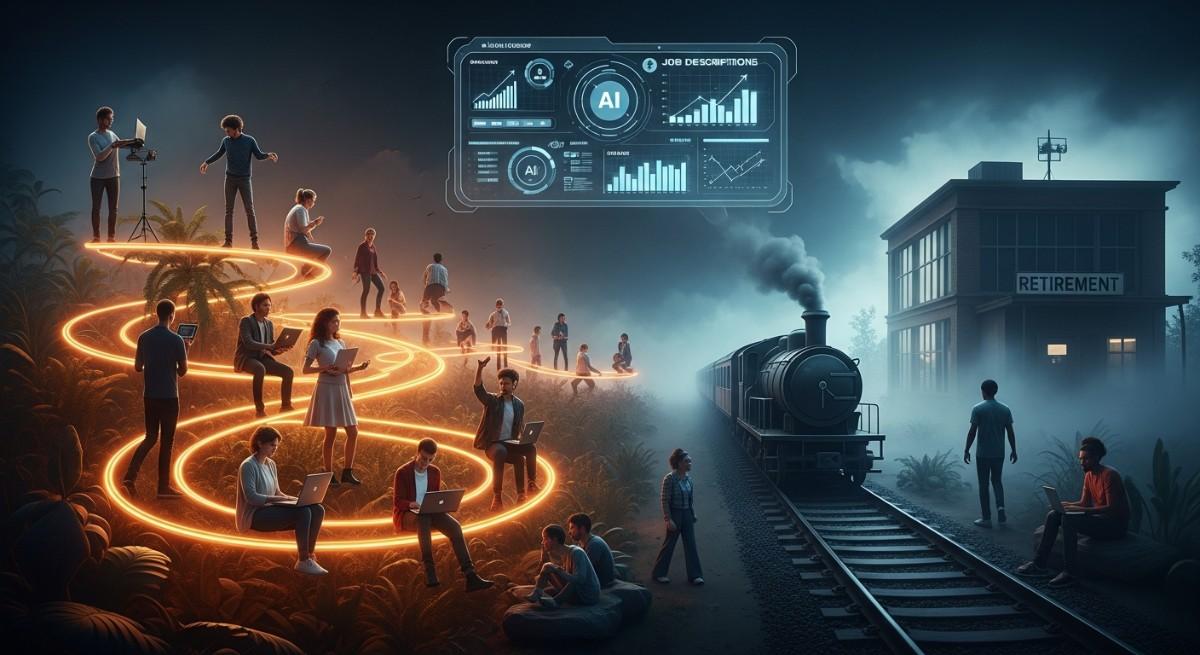
Parents still say things like “pick one career and stick with it.” But careers aren’t linear ladders anymore. I’d compare them to jungle gyms. Jobs jump between industries, freelance projects, startups, remote jobs, and creator economies. Survival is becoming more flexible. People who adapt quickly do well. Waiting for stability often feels like watching the world move without them.
Most people grew up hearing career advice that sounded comforting. Make sure you study hard. Earn your degree. Get a steady job. Make sure you stick with one company. I’ve been working for 40 years. Have a peaceful retirement. Predictability worked well for previous generations because the economy rewarded it. The world of work will look completely different in 2026. The AI is rewriting job descriptions overnight, remote work is erasing geographical boundaries, and employers care more about practical skills than certificates.
Today’s young professionals are realizing that the “safe path” isn’t safe anymore. Recent workforce studies show companies prioritize AI literacy, adaptability, and hybrid human-machine skills over traditional credentials. As a result, millions of workers are finding that jobs they once thought were secure are being automated, outsourced, or restructured faster than their universities can keep up.
What’s strange about it? It wasn’t your parents’ intention to mislead you. It was just a way to prepare you for a world that didn’t exist anymore. In 2026, careers will look less like train tracks and more like waves. The key to stability is adaptability, not permanence. It’s not loyalty that makes you money, it’s leverage. Visibility and skills matter more than degrees. In today’s world, the smartest and most educated people don’t always win. It’s because they’re the fastest learners, the best communicators, and the most flexible thinkers.
AI Has Redefined Job Security
In the past, job security meant finding a job machines couldn’t easily replace. There seemed to be more protection for white-collar jobs than for factory work. This assumption was turned upside down by AI. There will be a lot of automated desk jobs in 2026. AI systems are increasingly handling data entry, customer service, scheduling, basic coding, and repetitive content.
It doesn’t mean humans are going extinct. Work that’s predictable is going away. Rather than competing against AI, employers are looking for people who can collaborate with it. It’s a huge advantage to know how to automate, prompt, design workflows, communicate, and solve problems creatively. A lot of AI-related programs and enrollments have exploded worldwide, according to workforce studies.
Children used to be taught to avoid risk and seek certainty from their parents. It’s just that certainty itself has become risky. It’s inevitable that AI will challenge your position if you rely only on repetitive tasks. When your value comes from judgment, creativity, emotional intelligence, strategy, or leadership, your opportunities grow.
Think of AI like electricity in the industrial revolution. Workers won’t be replaced, but they’ll work differently. It’s kind of like factory owners who ignored electricity because steam engines felt “safe.” History rarely rewards those who resist change.
The death of the “Stable Job”
Why loyalty is No Longer Rewarded?
Older generations thought loyalty automatically led to career advancement. Don’t leave early. Put in the work. Don’t rush. Promotions would come eventually. Loyalty without leverage can actually reduce earning potential in today’s economy. Switching companies is a faster way to raise your salary than sticking with the same company for years.
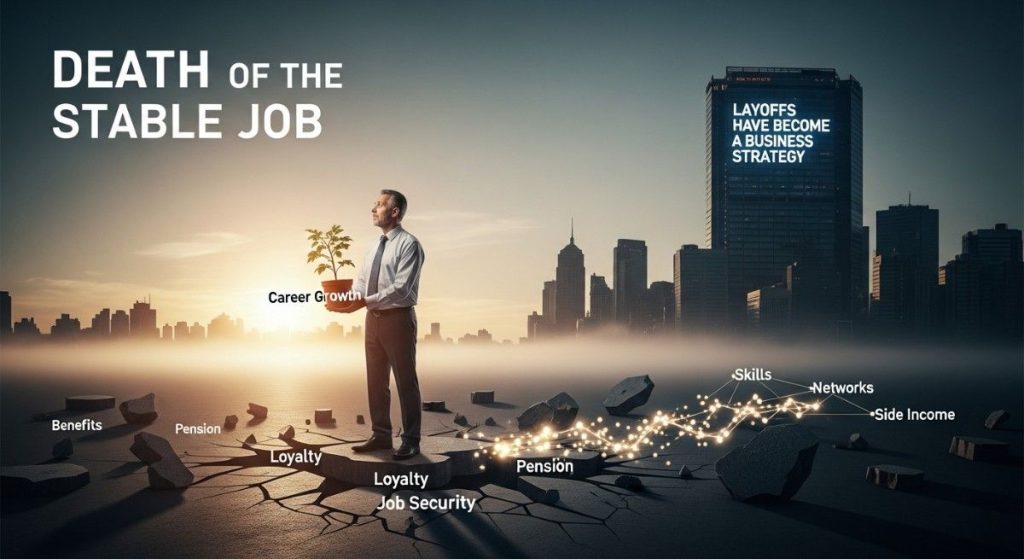
The companies changed the rules first. The reason mass layoffs happen in profitable companies is because cutting labor costs boosts shareholder confidence. There was a time when employees thought of corporations as families. It’s becoming more common for companies to treat their employees like flexible expenses. Workplace culture completely changed because of the emotional disconnect.
Because skills expire faster than ever, workers demand AI training and continuous learning from employers. Now workers don’t ask, “Can I stay here forever?” Instead, they ask, “Are they going to be valuable here?”
There’s emotional conflict for a lot of families because of this shift. Because those values worked during their time, parents teach sacrifice and loyalty. Blind loyalty can feel like staying on a sinking ship just because you painted the deck in 2026. Despite their hard work, smart professionals prioritize growth over attachment. Careers are like investments to them, and they constantly evaluate whether a role will increase their market value.
Layoffs Have Become a Business Strategy
Having layoffs no longer be a rare emergency is one of the biggest shocks for young workers. These are normal business operations. As a company grows, it downsizes during recessions, restructures during booms, automates departments during growth phases, and outsources tasks globally. It’s possible to lose a job you thought was secure even if you’re highly educated.
Globally, entry-level hiring has declined significantly in several sectors as automation and remote restructuring reshape the workplace. So many young workers feel anxious despite doing “everything right.” They followed traditional advice, earned degrees, but still found themselves in a chaotic job market.
There’s no longer an emotional contract between employer and employee. It’s becoming more and more obvious to workers that companies prioritize efficiency. Initially, that realization might sound depressing, but it can actually be empowering. When you stop expecting corporations to protect your future, you start building your own safety net with skills, networks, side income, and adaptability.
You don’t get career resilience from one employer. It comes from being employable everywhere.
Degrees Lose Their Monopoly
Skills Matter More Than Credentials
It’s still valuable to have a university degree, but it doesn’t guarantee you a job. Employers are increasingly looking at what you can actually do instead of where you went to school. It can sometimes be more important to have a portfolio, an audience online, a GitHub repository, or a successful freelance project than formal credentials.
Technology changes faster than traditional education systems, so businesses are moving toward skills-based hiring. It’s important for employers to hire people who can solve problems quickly, use modern tools, and adapt to changing workflows.
Self-taught developers, content creators, marketers, and AI specialists are making highly successful careers without elite academic backgrounds. The knowledge became abundant. There was a shortage of execution. Education has become an open marketplace where anyone can learn world-class skills.
Let’s say two people apply for the same job. There’s one with a prestigious degree but no experience. Another built real projects, grew an audience, and showed measurable results. It’s becoming more common for employers to pick the second person because evidence beats theory.
Education isn’t useless, though. You can’t just rely on education. The degree is becoming a starting point instead of a destination.
Employers Want Proof, Not Promises
Hiring psychology has changed completely since the internet. Now companies can verify whether someone knows a skill instantly. Designers show their portfolios. Published work by writers. Developers show their code repositories. Advertisers show campaign results. Case studies are shown by consultants.
That’s why personal proof matters more than resume language. It’s easy to claim you’re “creative” or “strategic,” but it’s harder to prove it. You get permanent social proof when you’re online. If you have a good LinkedIn profile, YouTube channel, blog, newsletter, or project archive, you can get jobs before you even apply.
Some workers overstate their AI skills because they feel pressure to appear tech savvy. Nearly two-thirds of workers overstate their AI abilities to stay competitive. It shows how much workplace expectations have changed in just a few years.
It’s all about visible competence in the new career game. It’s more important for employers to see results than to hear about polished promises.
AI is creating Winners and Losers
Entry-level jobs are shrinking.
Many traditional beginner jobs are going away in 2026. AI performs repetitive entry-level tasks cheaply and efficiently, so companies automate them more and more. Employers want experienced workers, but there are fewer traditional ways to get experience.
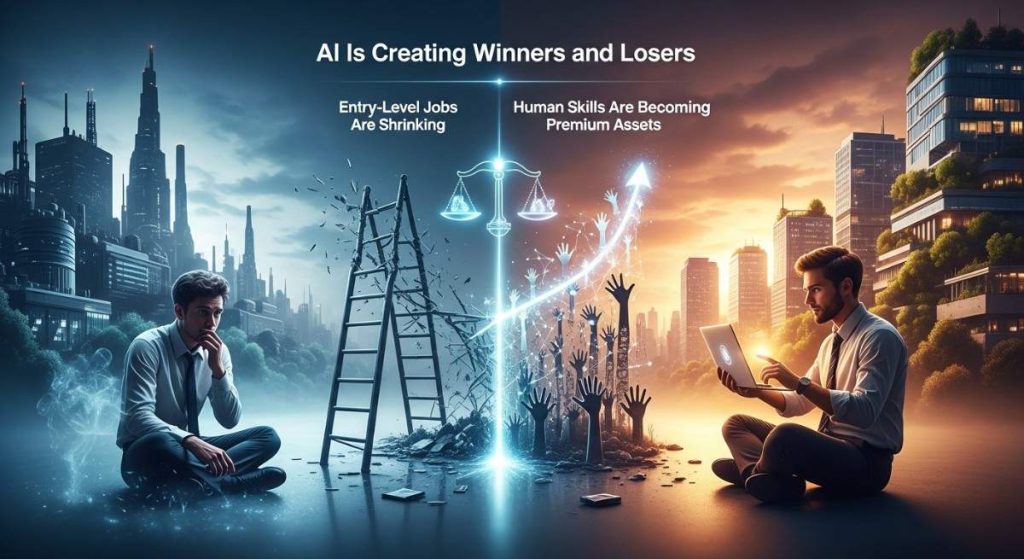
According to research across multiple countries, AI is reducing demand for routine junior roles while increasing demand for hybrid human-AI collaboration skills. There’s a major disruption coming for customer service, admin work, and basic digital tasks.
Now that young professionals are entering the job market, being average feels risky. Almost immediately, employers expect their workers to know productivity software, AI systems, automation tools, and remote collaboration platforms. Reddit workers describe entry-level jobs as “mid-level expectations with beginner pay.”
It sounds harsh, but it also opens up opportunities. It’s not hard to outperform peers if you learn modern tools early. An employee using AI effectively can produce what used to take an entire small team. As a result, careers scale differently. As productivity increases, leverage increases.
The future belongs to workers who combine technical fluency with deeply human skills like empathy, storytelling, leadership, and negotiation.
Human Skills Are Premium Assets
As AI improves, human abilities become more valuable. Because they require nuance and human relationships, emotional intelligence, trust-building, communication, leadership, and strategic judgment are hard to automate.
While automation grows, human-centered skills remain essential. Despite its ability to generate instant information, AI can’t replace emotional connection or human credibility.
Think about the jobs that aren’t threatened by AI. There are therapists. Teachers are awesome. They’re elite salespeople. Those who lead. Building communities. The negotiating team. They’re coaches. Authentic audiences for creators. It’s not raw information that makes them valuable, it’s human trust.
Career success in 2026 will depend on becoming more human, not less. It’s not just about technical intelligence in the future. It’s about combining emotional depth with technical leverage.
Remote Work Changed Everything
Geography Is No Longer Destiny
Children used to be encouraged to move near economic centers because opportunity depended on location. By 2026, remote work broke down a lot of geographic barriers. You can work for a company in London if you’re a talented designer from Bangladesh. You can collaborate with startups in California if you’re a developer in Brazil. Globalization accelerated the interconnectedness of the workforce.
Multiple industries are expanding remote work, especially high-skilled knowledge workers. Having access to international clients and salaries opens up a world of opportunities for ambitious workers in emerging economies.
There’s another side to this transformation. Globalization also made competition global. Workers don’t just compete with people in their city anymore. They compete with talented professionals all over the world. As a result, standards go up a lot.
Often, remote workers are excellent communicators, disciplined self-managers, and highly visible online contributors. The best way to open doors is with technical skills, but the best way to keep them open is with communication.
Competition is now global.
The remote-first economy is changing careers. In today’s workplace, output is more important than office politics. Looks don’t matter as much as results. Regardless of nationality or location, workers who consistently deliver value become incredibly attractive.
This shift benefits proactive learners, but challenges workers who rely on traditional credentials. The global economy makes it easier to replace average performance. Career defenses include specialized skills and personal branding.
AI and remote work markets also show explosive growth in demand for specialized AI workflow skills like prompt engineering, automation systems, and AI operations. Those who master these emerging areas can get ahead of slower-moving competitors.
Career battlefields aren’t local anymore. There’s a digital revolution, it’s global, and it’s always changing.
The Rise of Portfolio Careers
One Income Stream Is Risky
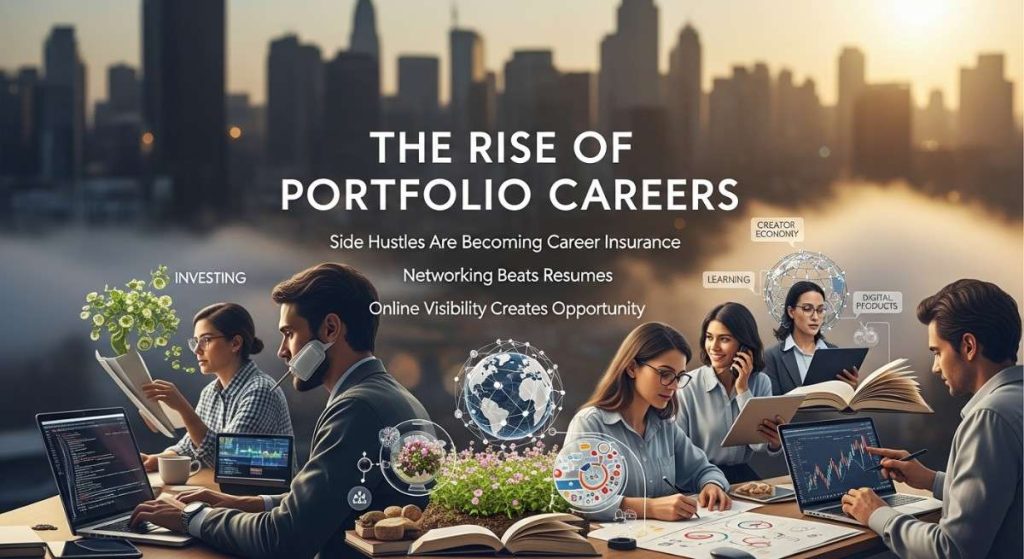
People were told to rely on one employer for income security in traditional career advice. Depending on one paycheck feels risky in 2026. Professionals now build portfolio careers that combine full-time jobs, freelancing, consulting, digital products, investing, or content creation.
More than ambition, this trend reflects economic reality. There was a sudden wave of layoffs across industries. They realized diversification is important in careers, too. Having multiple income streams makes you less vulnerable.
Creator economies accelerated this mindset shift. Newsletters, courses, communities, videos, coaching, and digital products can all be monetized. Attention became economic opportunity thanks to the internet.
Side projects are becoming less like hobbies and more like career insurance for younger generations. There are some that eventually replace traditional jobs.
Side hustles Are Career Insurance
There was a time when side hustles were seen as desperate extra work. These days, they’re often about strategic freedom. You can find stability during an economy that’s uncertain if you have a freelance client base, an online audience, or a skill you can monetize.
Gen Z workers are already changing career plans due to AI disruption and pursuing multiple skills or entrepreneurship. Employability matters more than employment, they understand.
You’ll also develop valuable skills if you build side income. Entrepreneurship improves marketing, sales, communication, branding, negotiation, customer psychology, and content creation. Real-world education comes from even failed side projects.
Taking calculated risks instead of being blindly dependent might be the safest career path in 2026.
Networking Beats Resumes
Personal Brands Matter More Than Ever
You tell employers what you’re all about in a resume. People can tell who you are by your personal brand. Modern hiring relies heavily on this distinction.
Recruiters are searching online more and more before contacting candidates. They look at LinkedIn profiles, portfolios, social presence, published work, and professional reputations. Opportunity comes from visibility. Invisibility is created by silence.
Branding sounds superficial until you realize reputation has always mattered. It just got global thanks to the internet. People who share insights, document projects, and contribute publicly often get opportunities on their own.
Modern hiring is like dating apps. Discoverability is determined by visibility. If no one knows you exist, talent isn’t enough.
Online Visibility Creates Opportunity
The internet rewards consistency over perfection. Weekly career insights can gradually build a powerful professional network. There’s always room for opportunity.
That’s why so many professionals are investing in content creation, community building, and networking online. Increasingly, relationships drive opportunity more than cold applications.
Even for employees, the career future looks less corporate and more entrepreneurial. It’s important for workers to market themselves, communicate their value clearly, and adapt constantly.
What Builds Wealth in 2026?
Owning a beats employment
One of the biggest career lessons parents never learned is that salaries alone rarely create huge wealth. It’s ownership. Beyond hourly labor, equity, investments, businesses, intellectual property, audiences, and digital assets generate leverage.
Time is traded for money. Owners build systems that scale without their direct involvement. Online ownership has expanded massively. Online businesses, audiences, software tools, and educational products can be built almost anywhere.
You don’t have to quit your job right away. Skills, stability, and experience can come from employment. However, modern workers are starting to realize the benefits of owning a business.
Learning Speed is the Ultimate Career Skill
In 2026, learning quickly might be the most important skill. There’s always something new in tech. Within a few years, entire industries change. It’s hugely beneficial for workers who adapt quickly.
There’s been a dramatic increase in AI education, critical thinking programs, and professional upskilling worldwide. It’s less about what you learned five years ago and more about how fast you can evolve.
Career resilience has become like athletic conditioning. There’s no such thing as permanently “arrived.” You keep training, adapting, and improving. The power of curiosity turned into economic power.
In 2026, the workers who thrive won’t necessarily be fearless. It was just a matter of learning how to move forward in the face of uncertainty.
Conclusion
Your parents’ career world doesn’t exist anymore. There’s no guarantee of stability with degrees, loyalty, or traditional office jobs. The rules have changed completely because of AI, remote work, automation, and global competition.
That sounds scary until you realize how much freedom you have in modern careers. Online learning, global work, building audiences, launching businesses, monetizing skills, and reinventing yourself are easier than ever.
Survival rules for an industrial economy were taught to you by your parents. You live in a digital economy shaped by AI and constant change. Predictability was the old formula. A new formula rewards adaptability, visibility, creativity, and continuous learning.
People who can combine human intelligence with technology will rule the future. The people who learn to dance with change, not the ones who resist it.
FAQs
- Are college degrees useless in 2026?
Degrees still matter, especially in specialized fields like medicine, law, and engineering. There’s a difference now: degrees don’t guarantee employment anymore. Practical skills, portfolios, and adaptability are becoming increasingly important to employers.
- Which careers are safe from AI disruption?
Emotional intelligence, leadership, strategy, creativity, relationship-building, and hands-on human interaction are generally safer careers. A few examples are therapy, healthcare, consulting, skilled trades, sales, and leadership.
- Is remote work still growing in 2026?
Yes. There’s still a big demand for remote and hybrid work, especially for skilled digital jobs. It’s becoming more common for companies to hire talent globally instead of just locally.
- What skill is most valuable in the modern economy?
There’s no doubt that adaptability is a valuable skill. Those who can learn AI tools quickly, communicate well, and adapt to changing industries are going to be the most successful in the long run.
- Should anyone start a side hustle now?
You don’t have to have multiple income sources to be financially resilient. You can also build skills, networks, and opportunities through side projects.