


Understanding Marketing Strategy
What Is a Marketing Strategy?
Marketing strategies help businesses attract, engage, and convert customers. You can think of it like a GPS for your business. You might still move without it, but you’ll waste fuel, time, and money driving in circles. A strategy helps businesses decide who they’re going to serve, how to communicate value, and what channels to use. Marketing isn’t just about posting on social media or running ads, it’s about aligning every marketing action with your business goals.

In 2026, marketing strategy is more about precision than guesswork. Businesses aren’t asking whether to market online; they’re asking how to create sustainable visibility across search engines, AI platforms, social channels, and customer communities. 48.57% of marketers prioritize AI-powered personalized content, while 40.6% update SEO for search changes like AI overviews, according to HubSpot’s 2026 State of Marketing report. Now, strategy isn’t just an option, it’s a necessity.
Marketing strategies include customer research, competitor analysis, brand positioning, content planning, budget allocation, and performance measurement. You can use it to connect short-term campaigns with long-term growth. When you don’t have a strategy, marketing becomes random. It becomes predictable when you have a strategy.
You know what’s cool? You don’t need a huge budget to build one. It’s possible for small businesses to create powerful marketing strategies if they understand their audience and focus on consistency. When it comes to strategy, size usually doesn’t matter.
Why Marketing Strategy Matters More Than Ever in 2026
During rush hour, the marketing world in 2026 feels like a highway-crowded, loud, and crowded with people. Ads, videos, emails, AI-generated content, and influence promotions bombard your customers every day. Without a clear strategy, your brand becomes invisible. You don’t get visibility by shouting louder; you get visibility by speaking smarter.
HubSpot reports that 79.2% of marketing teams expect increased budgets in 2026, but at the same time, 73% say budgets face more scrutiny than ever before . That means every dollar has to prove its worth. There’s no such thing as “random marketing.” Companies need systems that generate measurable ROI. That accountability comes from strategy.
According to Gartner, brands are shifting to agentic AI, where AI tools help deliver tailored customer experiences. It changes everything. Marketers have to create highly relevant experiences for smaller, targeted groups instead of blasting one message to everyone. It’s time to say goodbye to spray-and-pray.
There’s also trust to consider when it comes to strategy. Fake reviews, fake influencers, and low-quality AI content are making consumers wary. Now conversions are driven by authenticity. It’s not just about brands they notice, it’s about brands they trust. Maintaining brand identity, consistency, and transparency across all touchpoints requires a clear strategy.
You can think of marketing strategy as your business armor. Even against bigger players, it protects your budget, sharpens your message, and helps you compete.
Core Elements of a Strong Marketing Strategy
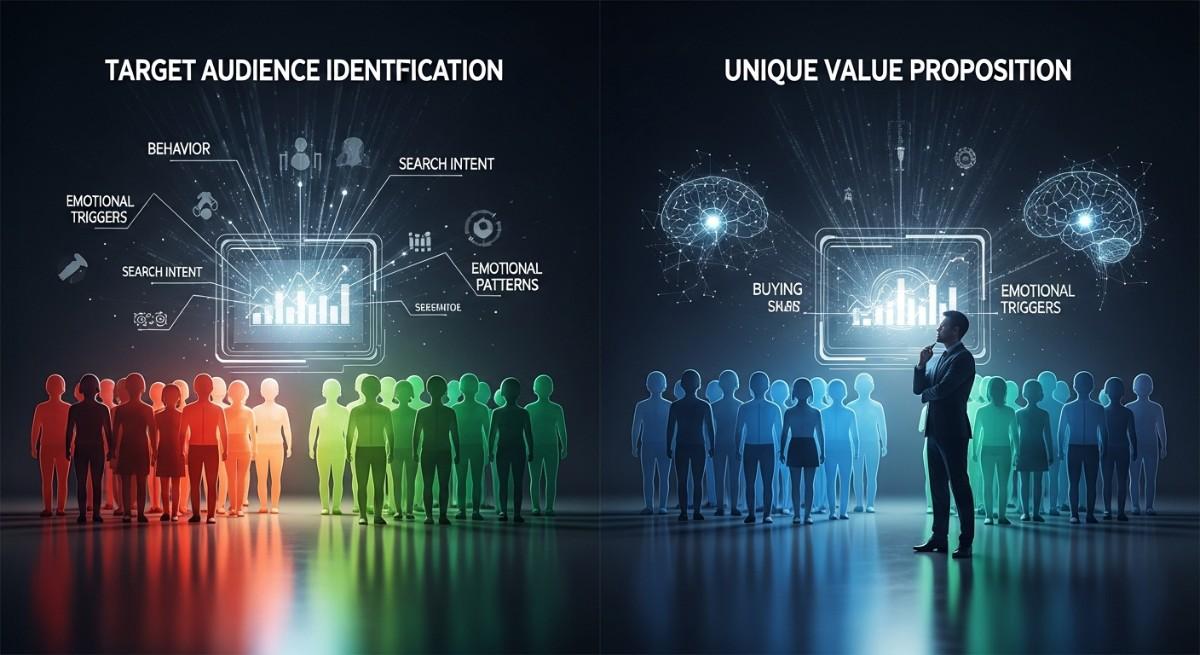
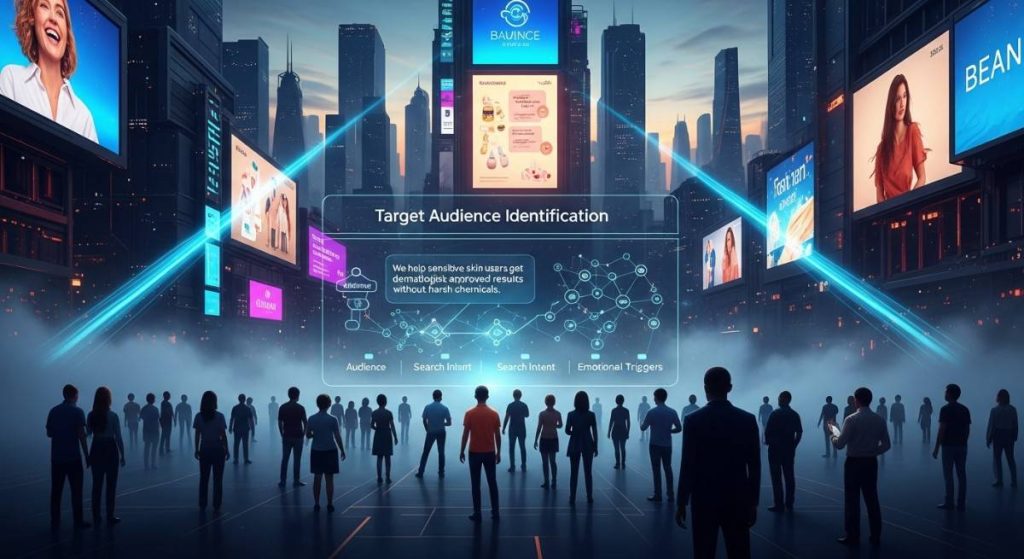
Target Audience Identification
Marketing to everyone is like trying to cook for every taste with one recipe-it just doesn’t work. The most important part of any marketing strategy is identifying your target audience. Before you say anything, you have to know who you’re talking to.
You want your target audience to be people who need, want, and buy what you’re selling. There’s more to it than age and gender. A smart marketer in 2026 looks at behavior, search intent, buying patterns, and emotional triggers. When customers buy, why do they do it? Can you tell me what problem they’re trying to solve? Is there anything that frustrates them? You’ve got gold there.
Audience segmentation is a lot more powerful thanks to AI. In place of old-school buyer personas like “Marketing Mary,” businesses now use real-time behavioral clusters. Users are tracked by what they search for, what pages they visit, and where they drop off. As a result, conversion rates are better and personalization is better. Because of that, AI-driven segmentation is becoming a major competitive advantage.
An exercise brand shouldn’t just target “people who like exercise.” That’s too broad. People like busy professionals looking for home workouts, new moms returning to fitness, or beginners looking for affordable plans should be the target audience. Different messages are needed for different segments.
The more you know your audience, the more personal your content will feel. Boost the effectiveness of your ads. It’s easy to open your emails. You get more conversions from your website. You can’t be great at marketing without listening.
Unique Value Proposition
What’s your Unique Value Proposition (UVP)? Why should customers choose you over your competition? It’s easy to answer that question for your competitors if you can’t.
It’s not just a slogan to have a strong UVP. You should pay attention to your business because of it. If you’re faster, cheaper, more reliable, specialized, or more innovative, you’re the best. Compared to your competitors’ waiting rooms, maybe your customer service feels like a five-star hotel. Whatever it is, it needs to be believable, relevant, and clear.
When there’s a lot of competition, clarity wins. Let’s say there are two skincare businesses. “We sell premium skincare products.” “We help sensitive skin users get dermatologist-approved results without harsh chemicals.” Which one feels stronger? The second one speaks directly to a problem and makes a promise.
There are so many choices for modern customers. Their time is limited, so they don’t have time to decode vague branding. Make sure your UVP is on your homepage headline, in your ads, in your social media, and even in your sales conversations. Your name needs to be associated with that benefit consistently until people get used to it.
Price wars often happen when businesses don’t have a UVP. People will always go cheaper, so that’s dangerous. But if your value is clear, customers stop comparing only price—they compare trust, results, and experience. That is where profitable growth lives.
Competitive Positioning
Competitive positioning is where strategy becomes battlefield planning. It’s not just about being good, but about being the obvious choice. You’ve got to know what competitors do well, what they fail at, and how your brand can stand out.
Take a look at your competitors honestly. Take a look at their pricing, content, reviews, ads, customer complaints, and customer praise. It’s often customer frustration that hides the biggest opportunity. Make sure you’re faster than your competition. Be specialized if they’re generic. Make sure you’re getting value for your money if they’re expensive.
You can’t copy what works for others when it comes to positioning. Creating strategic contrast is what it’s all about. Compare Apple phones with budget Android phones. There’s a world of difference between the two companies when it comes to smartphones. The other sells simplicity and premium identity. Affordability and flexibility are the other selling points.
Positioning includes visibility across AI search and answer engines in 2026. Your brand needs a clear digital footprint that supports your positioning when customers ask ChatGPT or Google AI Overview. This is why Answer Engine Optimization (AEO) is rising fast alongside traditional SEO.
A strong positioning makes it easier for customers to make decisions. Instead of thinking, “Which one should I pick? ” They think, “This brand is clearly for me.” That is powerful.
Setting Clear Marketing Goals
SMART Goals for Business Growth
A strategy without goals is just wishful thinking wearing a business suit. Clear goals transform ideas into measurable progress. The best marketers use the SMART framework: Specific, Measurable, Achievable, Relevant, and Time-bound.
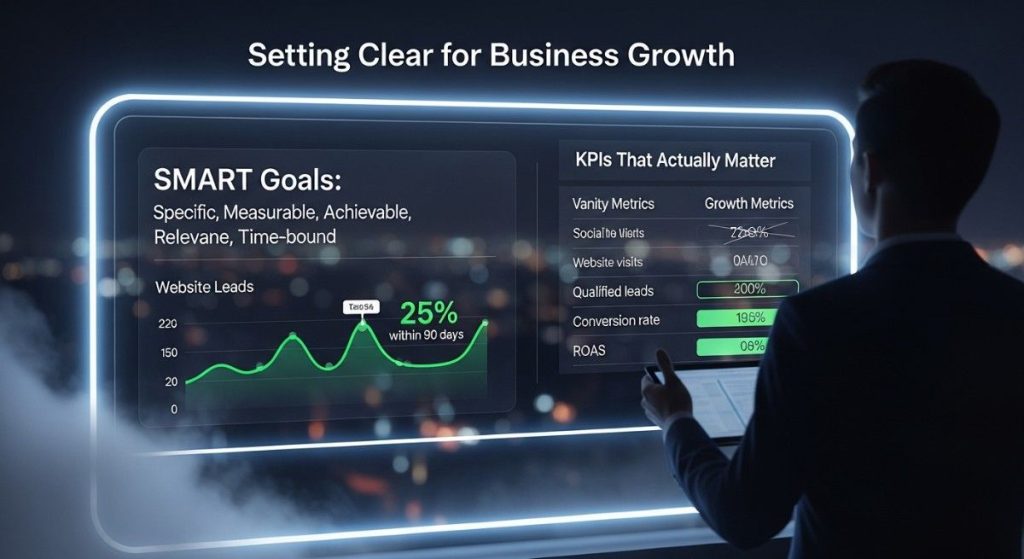
Instead of saying, “We want more sales,” a SMART goal sounds like this: “Increase monthly website leads by 25% within the next 90 days through SEO and paid social campaigns.” That goal is clear, trackable, and connected to action.
Many businesses fail because they confuse activity with achievement. Posting daily on Instagram is activity. Generating qualified leads from Instagram is achievement. Goals force you to focus on outcomes, not just effort. They also help teams stay aligned. Everyone knows what success looks like.
In 2026, marketing teams are under intense ROI pressure. That means vague goals are dangerous. If leadership asks, “What did marketing actually deliver?” you need answers backed by numbers. HubSpot’s report shows that marketers are increasing investments in AI chatbots (37.7%), paid social (37.4%), and video marketing (37.1%) because these areas offer clearer performance measurement .
SMART goals also improve decision-making. When a new trend appears, you can ask: does this help our goal? If yes, test it. If no, ignore it. Goals protect you from distraction, and in marketing, distraction is expensive.
KPIs That Actually Matter
If goals are your destination, KPIs (Key Performance Indicators) are your dashboard. They tell you whether your marketing engine is actually moving or just making noise. Too many businesses drown in vanity metrics—likes, impressions, random traffic spikes—without understanding whether any of it creates revenue. A smart marketing strategy focuses on KPIs that connect directly to growth.
Here’s a simple comparison:
| Vanity Metrics | Growth Metrics |
|---|---|
| Social media likes | Qualified leads |
| Website visits | Conversion rate |
| Email open rate alone | Revenue per email campaign |
| Follower count | Customer retention rate |
| Impressions | Return on ad spend (ROAS) |
Businesses will also measure visibility inside AI platforms in 2026. Ranking on Google alone isn’t enough anymore. Now brands want to know if they show up in ChatGPT answers, Google AI Overviews, and voice search results. It’s changing how KPIs are tracked since visibility has spread beyond search engines.
There’s one thing you should know: if a metric doesn’t help you make a decision, it’s probably just decoration. KPIs should guide your actions. They’ll tell you what you need to improve, what you need to stop, and where you need to double down. You don’t want numbers to impress you, you want them to inform you.
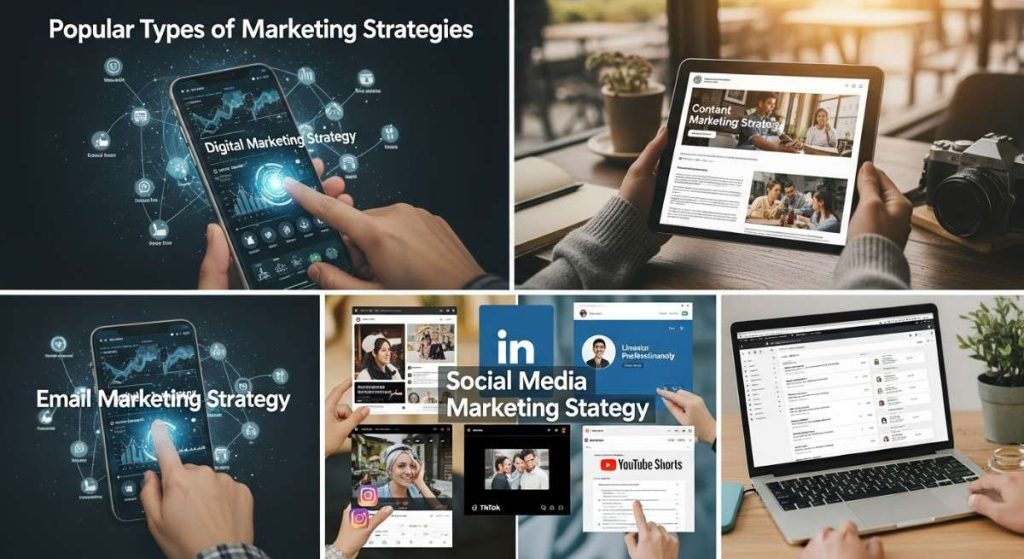
Popular Types of Marketing Strategies
Digital Marketing Strategy
You need a digital marketing strategy to get customers, engage them, and convert them. SEO, paid advertising, email, websites, social media, video, and even AI-powered search visibility are all part of it. Digital marketing won’t just be a department in 2026, it’ll be the front door for most companies.
Take a look at customer behavior today. Search is the first thing people do before buying anything. They read reviews, compare prices, watch videos, and ask AI assistants for recommendations. You’re invisible where it matters most if you aren’t visible during that journey. This is why digital strategy starts with customer intent, not content.
The full customer journey should be mapped out in a digital strategy. You can get awareness from blog posts or YouTube videos. Comparison pages and email nurturing might get you some consideration. Landing pages, retargeting ads, and trust-building reviews are all crucial to conversions. Different messages are needed for each stage.
Despite its evolution, search engine optimization remains a major pillar. In addition to keyword ranking, AEO (Answer Engine Optimization) optimizes content so AI tools cite and recommend you. Businesses that understand this shift are ahead of the game. Rather than just ranking for clicks, they become the answer.
Testing is also a big part of digital marketing. All your landing pages, headlines, ad creatives, and call-to-actions should be experiments. The best marketers aren’t guessing—they’re measuring. Putting evidence before opinions is strategy.
Content Marketing Strategy
Content marketing is often misunderstood as “just writing blogs.” It’s about building trust before selling. Content marketing attracts the right audience and guides them to action with valuable, relevant content.
There’s nothing exciting about your advertisement. The first thing they want when they wake up is a solution. You need to give them answers, clarity, shortcuts, and confidence. Here’s where content comes in. Building trust in a blog, a case study, a tutorial, or a video takes more than ten aggressive sales messages.
It’s going to be tough to compete with AI-generated noise in 2026. As a result, shallow, generic articles are losing power. Expertise, originality, and perspective are key now. It’s all about helpful, trustworthy content, whether it’s from Google, users, or AI platforms. This is where human insight counts. Personal experience, expert quotes, unique examples, and real opinions make the difference between great content and forgettable filler.
It’s also important to align your content strategy with your business goals. Content that raises awareness attracts traffic. It’s comparison content that makes buyers decide. Decision-stage content like testimonials and product demos boost conversions. The kind of content that only teaches but doesn’t guide action is entertainment, not marketing.
Content strategy works like planting trees. It takes time, consistency, and patience to grow, but once it does, it gets long-term traffic and authority. The budget ends when the ads stop. The best content works while you sleep.
Social Media Marketing Strategy
It’s not just about posting pretty pics and hoping for engagement on social media. It’s all about relationships now. Social media marketing connects brand identity with audience behavior across platforms like Instagram, LinkedIn, Facebook, TikTok, and YouTube Shorts.
Each platform has its own language. On LinkedIn, you get rewarded for expertise and credibility. You get rewarded for being entertaining and relatable on TikTok. Instagram combines aesthetics with storytelling. Wearing the same outfit to a wedding, a job interview, and the gym is like wearing the same outfit everywhere.
It’s more important to be authentic than perfect in 2026. A lot of overproduced content doesn’t perform as well as simple, honest communication. It’s more trustworthy to trust faces than logos. Customer stories, behind-the-scenes videos, and founder content boost engagement.
Influencer marketing has also changed. A shift in trust is happening from mega influencers to niche authority creators. It’s important for customers to feel like their recommendations are genuine. Micro-influencers have loyal communities instead of massive but disconnected audiences, so brands work with them.
Being on top of all the trends isn’t a good strategy for social media. We should answer one question: what kind of relationship do we want with our audience? It’s community over virality. It’s better to be consistent than to have random attention bursts. When you use social media as a growth channel, it turns into a content treadmill.
Email Marketing Strategy
Email marketing is like owning a house, while social media is like renting an apartment. You’ll always have your email list. Algorithms change, platforms go away, but you’ll always have your direct line to your audience. In modern marketing, email marketing still delivers some of the best ROI.
You can do a lot with email if you give it permission. You’ve been invited to their inbox. Thanks for letting me know. You get access, but you also get a lot of responsibility. Promo blasts that are generic rarely work. Relevance, timing, and usefulness are what people expect. Personalization isn’t a bonus anymore—it’s a requirement.
Email strategy is all about segmentation. Educating new subscribers is important. It might be a good idea to upsell returning customers. Reminding abandoned cart users is important. Giving loyal customers exclusive access is fair. Everybody getting the same message is bad for performance and trust.
The key to scalability is automation. With welcome sequences, lead nurturing, re-engagement flows, and post-purchase follow-ups, you’ll get consistent communication without constant manual work. Send times, subject lines, and message personalization can now be optimized using AI tools.
Aside from email, there are lots of other marketing channels. With SEO traffic, ad retargeting, and social connections, you’ll get more traffic. Think of it like a follow-up system. Marketing starts the conversation, email keeps it going. Businesses pay twice to reach people they could have reached directly when they ignore email.
Modern Marketing Trends in 2026
AI-Powered Personalization
Marketing in 2026 will be more like thousands of one-on-one conversations. That’s the power of AI-powered personalization. Instead of sending everyone the same message, brands can now customize content, offers, recommendations, and timing based on individual behavior.
Imagine walking into a store where the salesperson already knows what you like, what you bought last month, and what your problem is. That’s what customers expect online. Businesses can create that experience at scale with artificial intelligence. With browsing history, purchase patterns, customer service interactions, and engagement behavior, it predicts what someone needs next.
One of the biggest priorities for marketers in 2026 is AI-powered personalized content. It’s because personalization increases conversion rates and customer experience. Get relevant messages and you’ll feel better. Spam feels bad when it’s irrelevant.
Warning: personalization shouldn’t feel robotic. Customers can tell when robots are manipulating them. The more automated and invasive your messages are, the less trust you’ll get. You don’t want to be creepy-you want to be helpful. Personalization makes you feel like you’re getting thoughtful service.
The brands that win with AI use it to enhance human connection, not replace it. Scale is handled by AI, but meaning is decided by strategy. That balance is where you’ll find true competitive advantage.
Answer Engine Optimization (AEO).
Ranking on the first page of Google used to be SEO. In 2026, be the answer in ChatGPT, Gemini, and Google AI Overviews. Currently, search engine optimization (SEO) is one of the biggest shifts in digital marketing.
Customers are changing how they search. Instead of typing “highest-quality CRM software,” they ask, “What is the most suitable CRM for a small service business with a low budget?” AI tools respond with direct answers instead of just a list of links. If your brand is not part of those answers, you will lose visibility before the click even happens.
AEO focuses on structured, trustworthy, and relevant content. It’s rewarded when you’re clear. FAQs, expert-backed articles, case studies, strong topical authority, and consistent brand mentions all help answer visibility. It’s not separate from SEO-it’s just the next step.
Businesses that rely only on keywords risk becoming invisible. There’s a shift from discovery to recommendation in search engines. That means authority matters more than ever because people want “tell me what to choose,” not “find me options.”
With AEO, you’re not in the phone book, you’re recommended. One gets attention. The one gets action, the other doesn’t.
Creator and Influencer Authenticity
It used to be simple: find someone with a big following, pay for a post, and hope for sales. The power is going down fast in 2026. There’s been a shift in audience intelligence, skepticism, and ability to spot forced promotions. These days, it’s all about creators and influencers being authentic — with real trust, not attention.
Personal and believable recommendations are what consumers want. Creators with 20,000 deeply engaged followers usually outperform celebrities with 2 million passive viewers. What’s up? It’s different from the scale of reach when it comes to trust. Get more attention if you’re a creator who consistently shares honest opinions, shares real experiences, and stays connected to your niche.
It’s why brands are partnering with micro-influencers instead of doing one-off sponsorships. A sponsored post between unrelated promotions feels more credible than working with a beauty blogger for six months. As you do it more, you’ll become more confident and familiar.
Being authentic also means letting creators speak their own minds. A scripted, robotic brand message kills trust fast. That’s a dead giveaway to audiences. Smart brands give you direction, but let you tell your own story.
Authenticity and community building go hand in hand. When customers feel like they’re joining a trusted circle, not just buying a product, they’re more likely to buy. That’s why creators aren’t just marketers, they’re bridges between brands and people.
How to Build a Marketing Strategy Step by Step
Research your market.
Before you spend a penny on ads or write your first campaign headline, you need to understand the battlefield. Research is the foundation of every effective marketing strategy because it tells you where the opportunities are and where the dangers are.
First, let’s talk about your customers. Are they sure what they want? What’s their biggest pet peeve? Could you tell me what they’re already using? The customer reviews, support tickets, social media comments, and keyword research all reveal patterns most businesses don’t see. A complaint your competitor didn’t fix can sometimes give you the best strategy.
Make sure you check out your competition. Don’t just look at their products. Take a look at their messaging, pricing, customer reviews, ad angles, content strategy, and customer loyalty. Spying isn’t what you’re doing, it’s learning the rules. When everyone in your industry says the same thing, differentiation becomes your advantage.
Make sure you use both qualitative and quantitative data. You can tell how people feel in surveys and interviews. Analytics and search data can tell you how people behave. When they’re together, they show not just what customers do, but why. You can do a lot with that combination.
You can also avoid expensive mistakes through market research. Building a campaign without checking the ground underneath is like building a house without checking the foundation. For a while, it looks strong, but cracks will appear. Making assumptions isn’t helpful. It’s all about understanding reality.
Choose the Right Channels
There are some marketing channels you shouldn’t pay attention to. Trying to be everywhere at once is one of the biggest mistakes businesses make. It sounds ambitious, but it usually leads to weak performance everywhere. The key to a smart strategy is to pick the right channels, not the most.
Channel choice depends on where your audience spends time and how they make decisions. LinkedIn, SEO, webinars, and email nurturing can help a B2B software company. Instagram, TikTok, influencer partnerships, and visual storytelling can make a fashion brand thrive. It’s not popularity we’re after, it’s alignment.
Think about what your customers want. People who are actively searching for solutions are captured by search engines. It’s common for social media to create discovery before demand exists. Retention and loyalty are supported by email. Visibility gets better with paid ads. In the customer journey, each channel plays a different role.
It’s all about the budget. Content marketing and SEO take time to grow, so be patient. Pay-per-click ads can create faster results but stop when you stop spending. Long-term and short-term channels are usually included in a balanced strategy.
The right channel mix feels like building a sports team. You do not need eleven strikers. You need the right players in the appropriate positions. Marketing works the same way.
Budget allocation and Testing
The best strategy without a budget plan is like owning a race car without fuel. You might have potential, but you’re not going anywhere. Testing makes sure your marketing priorities match your actual spending, and budget allocation makes sure money doesn’t go to waste.
Divide your budget into three zones: proven channels, growth opportunities, and experiments. You should spend most of your budget on channels that are already working. Funding promising new opportunities should take up a smaller portion. Small budgets make innovation possible without sacrificing stability.
For example:
| Budget Area | Suggested Allocation |
|---|---|
| Proven high-ROI channels | 60% |
| Growth opportunities | 25% |
| Experimental testing | 15% |
This kind of structure protects businesses while allowing them to grow. Experimentation keeps marketing fresh.
You’ll get better results if you change one variable at a time. Learning happens randomly because of testing.
AI tools will speed up optimization in 2026, but human judgment still matters. It’s data that tells you what happened, but strategy explains why. Budget decisions need to take both evidence and context into account.
Marketing success rarely comes from one big move. It’s usually small improvements repeated consistently that lead to big things. The improvements are discovered through testing.
Common Marketing Strategy Mistakes
Ignoring Customer Data
Ignoring the very people you’re trying to serve is one of the biggest mistakes in marketing. Businesses spend thousands on internal campaigns while customer data sits untouched. That’s not strategy, that’s gambling.

Customer data includes website behavior, purchase history, reviews, support conversations, survey feedback, and search patterns. These are not just numbers; they are signals. They show what customers care about, where they hesitate, and what makes them trust or leave.
If users keep abandoning checkout on one page, the problem isn’t traffic, it’s friction. When customers keep asking the same pre-sale questions, your messaging isn’t clear. Revenue reports don’t reveal problems until data does.
Decisions are often based on emotions when data is ignored. There’s someone who says, “I think we should do more TikTok,” and suddenly budget moves. Steering a ship like that is like using a compass instead of a compass. A smart marketer tests assumptions, not defends them.
We’re not trying to collect endless reports. We’re trying to create useful insight. We should use data to answer action questions: what should we improve, stop, or scale? Marketing gets sharper, faster, and more profitable when customer behavior guides it.
Chasing Every Trend
Marketing trends are like shiny objects in a crowded market – loud, exciting, and sometimes distracting. A new platform, viral format, AI tool, or “must-try” hack pops up all the time. Not trying new things is the danger; abandoning strategy every time something shiny comes along is the danger.
It’s hard to stay consistent if you chase every trend. Podcasts one month, short-form video the next, then NFTs, then voice search, then something else entirely. What happened? There’s no long-term momentum and no clear identity for this brand.
Putting goals before trends is a good idea. One simple question: does this help our audience? Test it strategically if it works. Let it pass if it’s not for you. There are some trends that don’t deserve your attention.
There is a difference between adaptation and distraction. Adaptation means evolving your methods while protecting your message. Distraction means replacing your message every week because something new feels exciting.
Brands that stay grounded are the best. Their customers know who they serve, what they promise, and why they trust them. It’s not about mastering trends, but using them. You should have a strategy that keeps you stable even when the marketing ocean gets rough.
Conclusion
You can’t build a marketing strategy on luck, trends, or guesswork. Clarity is key. Make sure you know who your audience is, what problems you solve, where customers find you, and how every marketing action contributes to growth. Without that structure, marketing is just expensive noise.
In 2026, strategy matters even more because the rules change fast. AI-powered personalization, Answer Engine Optimization, creator authenticity, and smarter customer expectations are reshaping how businesses compete. Visibility is no longer enough—relevance is everything. Brands that understand this shift will grow faster and waste less.
The strongest strategies are simple, focused, and flexible. They are based on real customer insight, supported by the right channels, measured with meaningful KPIs, and improved through constant testing. You do not need to do everything. You need to do the right things consistently.
Marketing doesn’t work like magic. That’s what it is. Build it with intention, and when your business stops chasing growth, it will create it.
FAQs
1. What is the main purpose of a marketing strategy?
The main purpose of a marketing strategy is to create a clear plan for attracting, engaging, and converting customers. It helps businesses align marketing efforts with sales goals, improve ROI, and build long-term brand growth instead of relying on random tactics.
2. What is the difference between marketing strategy and marketing plan?
A marketing strategy defines the big-picture direction—your audience, positioning, goals, and value proposition. A marketing plan focuses on execution, including campaigns, timelines, budgets, and specific actions needed to apply that strategy.
3. Why is AEO important in 2026?
Answer Engine Optimization (AEO) is important because people increasingly use AI tools like ChatGPT and Google AI Overviews for recommendations instead of traditional search alone. Businesses need visibility inside these AI-generated answers to stay competitive.
4. Which marketing channel gives the best ROI?
There is no universal answer because ROI depends on the business type and audience. For many businesses, email marketing, SEO, and content marketing often provide strong long-term ROI, while paid ads can deliver faster short-term results.
5. How often should a marketing strategy be updated?
Marketers should review their strategies quarterly and update them whenever customer behavior changes, industries change, or platforms change.
It should be stable enough to maintain consistency, but flexible enough to adapt when needed.









Wow post it is