Introduction
Take a moment to picture this: Imagine that you wake up on a Tuesday morning with nowhere to go. We don’t have meetings, we don’t have deadlines, we don’t have commutes. It is entirely up to you how you spend your day. I am not referring to retirement as the end of my work life, but as the beginning of my freedom as a retiree.
There are millions of Americans who dream of living in this picture, yet it remains a distant dream for them. It has been reported that nearly 50% of U.S. households do not have any retirement savings at all, according to a report published in 2024. If you are one of those individuals who have a retirement account, then the median retirement account balance is just 87,000 for all households, and 87,000 for all households and 164,000 for those nearing retirement (ages 55-64).
As a result, the math is sobering: 164,000, if converted into a sustainable 4164,000, if converted into a sustainable 46,560 of annual income—about $547 a month if converted to a sustainable income system. The needs of most retirees are far greater than what they can afford.
Is there good news to report? The process of planning for retirement is not about magic. In the end, it comes down to math, time, and discipline. You can use the strategies in this guide whether you have 40 years left until retirement or 10 years left to prepare for it. Now is the time to start focusing on what matters.
The purpose of this comprehensive guide is to walk you through each step of retirement planning in 2026: setting goals, calculating needs, choosing accounts, investing wisely, and eventually withdrawing funds in a sustainable manner.
When Should You Start Retirement Planning?
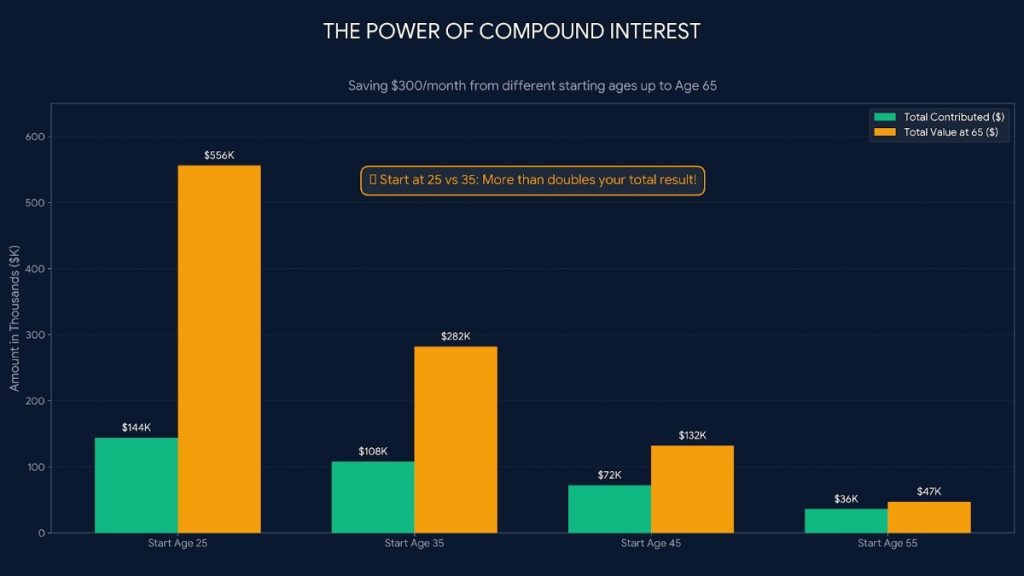
The simple answer: as early as possible.
Table: The Power of Starting Early
| Age Started | Monthly Contribution | Years Invested | Total Contributed: | Value at Age 65 (6% return) |
|---|---|---|---|---|
| 25 | $300 | 40 years | $144,000 | $556,000 |
| 35 | $300 | 30 years | $108,000 | $282,000 |
| 45 | $300 | 20 years | $72,000 | $132,000 |
| 55 | $300 | 10 years | $36,000 | $47,000 |
Even though your out-of-pocket contributions are only $36,000 more, starting at 25 more than doubles the end result. Compounding over a decade makes up for the difference.
You don’t have to despair if you’re over 40 and just getting started. There’s no going back, but you can save more aggressively now. If you make bigger contributions and shorten the timeframe, compounding still works.
Step 1: Envision Your Retirement Lifestyle
It’s not just about numbers when it comes to retirement planning. What kind of retirement do you want? Before calculating how much you need, ask yourself this: What kind of retirement do I want?
Table: Retirement Lifestyle Examples
| Lifestyle | Annual Spending | Monthly Spending | Example Activities |
|---|---|---|---|
| Basic/Sustainable | 30,000–40,000 | 2,500–3,300 | Modest home, local activities, occasional travel |
| Moderate/Comfortable | 50,000–70,000 | 4,200–5,800 | Dining out, annual vacations, hobbies |
| Affluent/Rich | $100,000+ | $8,300+ | Frequent international travel, second home, luxury expenses |
In order to determine your retirement number, you need to determine your desired lifestyle.
Compared to an affluent retirement, a modest retirement requires much less savings in order to live comfortably.
Factors to Consider
| Factor | Questions to Ask |
|---|---|
| Location | Do you stay in a high-cost city or move somewhere cheaper? |
| Housing | Downsize, keep the family home, or rent? |
| Travel | How much and how far? |
| Work | Part-time consulting, passion projects, or no work at all? |
| Family | Supporting adult children or grandchildren? |
| Healthcare | Anticipate increasing medical costs; factor into the budget. |
Step 2: Calculate Your Retirement Number

In general, 80% of your pre-retirement income will be needed to support you in retirement, according to the most common rule of thumb. How come? There may be a reduction in savings (no retirement contributions), a reduction in taxes, and a decrease in work-related expenses, if they even exist.
The problem is that income is the wrong metric to use. A better approach would be to estimate the actual amount you will need to spend on retirement.
Two Methods to Calculate Your Number
Method 1: The 4% Rule
Take your desired retirement income and divide it by 0.04 (4%). Let’s say you want 60,000 per year: 60,000 ÷ 0.04 = $1,500,000 needed.
Method 2: The 25x Rule
Take your desired income and multiply it by 25. Then 60,000 times 25 equals 1,500,000.
The rules both assume a 30-year retirement and a balanced portfolio.
Table: Retirement Savings Targets
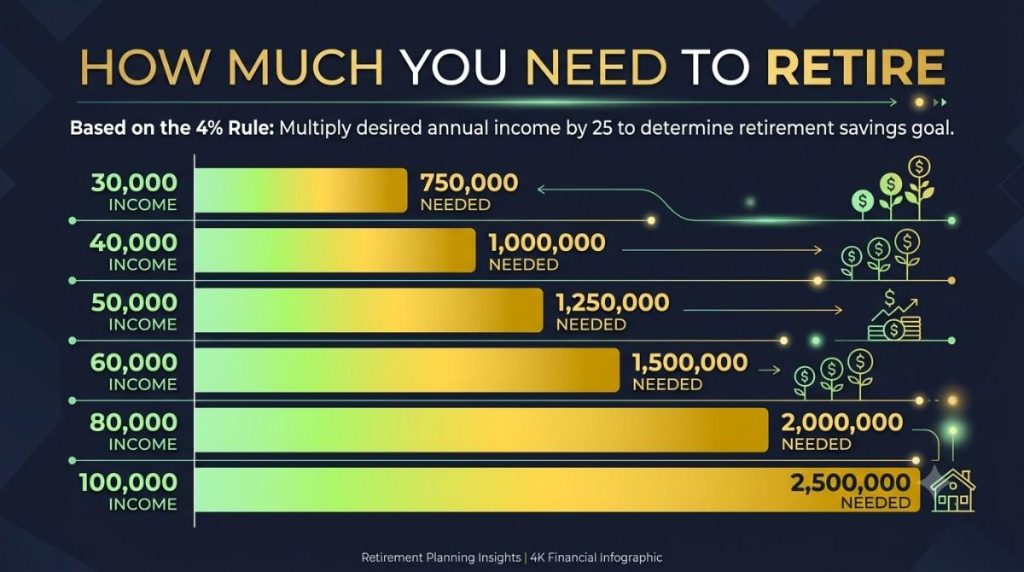
| Annual Retirement Income | Savings Needed (4% Rule) |
|---|---|
| $30,000 | $750,000 |
| $40,000 | $1,000,000 |
| $50,000 | $1,250,000 |
| $60,000 | $1,500,000 |
| $80,000 | $2,000,000 |
| $100,000 | $2,500,000 |
Subtract Other Income Sources
| Income Source | How It Helps |
|---|---|
| Social Security | Reduces the amount you need from savings |
| Pension | Reduces the amount you need from savings |
| Part-time work | Reduces the amount you need from savings |
Let’s say you want 60,000/year. Social Security gives you 60,000/year. The Social Security system pays $2,000 a month (24,000 a year). Your savings only need to provide $24,000 a year. Savings only need to provide 36,000 a year. You’ll need to save 36,000÷0.04=36,000÷0.04=900,000.
Estimated Social Security benefits.
The Social Security Administration (SSA) gives you estimates of your benefits at 62 (early retirement), 67 (full retirement), and 70 (delayed retirement). Create an account and access your statement at ssa.gov.
Step 3: Choose the Right Retirement Accounts
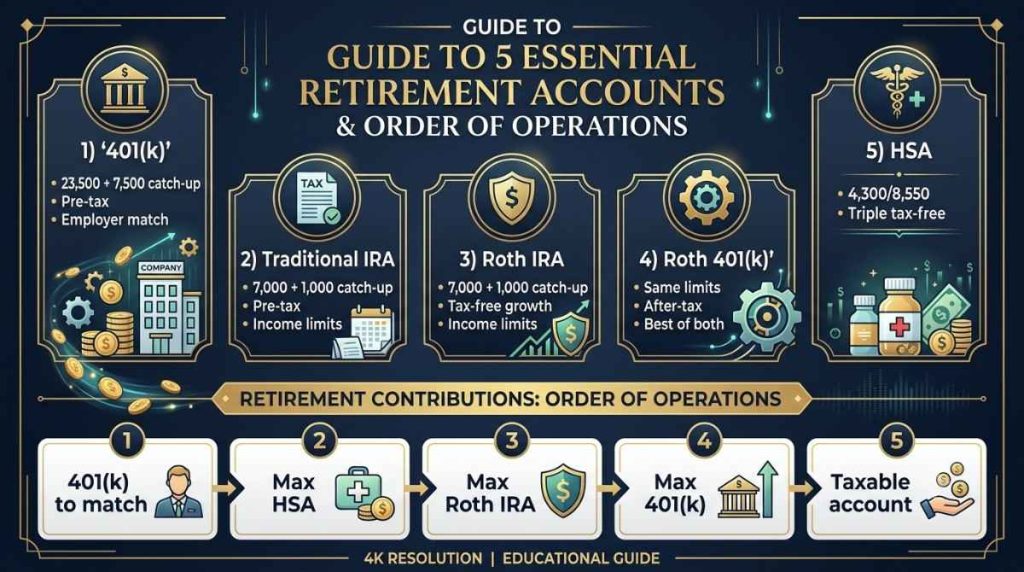
It’s just as important to know where your assets are (which accounts you use).
Table: Retirement Account Options
| Account | Contribution Limits (2026) | Tax Treatment | Key Feature |
|---|---|---|---|
| 401(k), 403(b), TSP | 23,500 + 7,500 catch-up (50+) | Pre-tax | Employer match; highest annual limit |
| Traditional IRA | 7,000 + 1,000 catch-up (50+) | Pre-tax | Income limits for deduction if covered by workplace plan |
| Roth IRA | 7,000 + 1,000 catch-up (50+) | Tax-free growth | No deduction, but tax-free withdrawals |
| Roth 401(k) | Same as 401(k) | After-tax | Best of both if available |
| HSA (Health Savings Account) | 4,300 individual/8,550 family | Triple tax-free | Powerful retirement vehicle if used for medical expenses |
| Taxable Brokerage | No limit | After-tax | No contribution limits; capital gains tax |
Order of Operations: Where to Save First
| Priority | Action | Why |
|---|---|---|
| 1 | 401(k) up to employer match | Free money (100% return) |
| 2 | Max out HSA (if eligible) | Triple tax advantage |
| 3 | Max out Roth IRA | Tax-free growth |
| 4 | Max out remaining 401(k) | Tax-deferred growth |
| 5 | Taxable brokerage account | No limits; flexible |
What to Do If You Are Behind
| Strategy | Description |
|---|---|
| Maximize catch-up contributions | If 50+, use extra contribution room |
| Increase savings rate | Save 15–25% of income instead of 10–15% |
| Extend working years | Work 2–5 years longer |
| Delay Social Security | Each year you wait (up to 70) increases benefits |
| Downsize housing | Free up equity for retirement savings |
Step 4: Build an Investment Strategy
It’s important to save.
If you’re decades away from retirement, keep your money safe, but don’t be too conservative.
Asset Allocation by Age
| Age | Stocks | Bonds | Cash |
|---|---|---|---|
| 20s–30s | 80–100% | 0–20% | 0–5% |
| 40s | 70–85% | 15–30% | 0–5% |
| 50s | 60–75% | 25–40% | 0–5% |
| 60s (pre-retirement) | 50–65% | 35–50% | 5–10% |
| 70+ (retirement) | 40–50% | 40–50% | 10–15% |
Why this works.
- There is no doubt that stocks provide long-term growth that is necessary to beat inflation in the long run.
- In addition to reducing volatility, bonds provide an income stream as well.
- By having cash on hand, you ensure that you are able to access funds without selling assets at a loss.
Implementation Options
| Option | Best For | Cost |
|---|---|---|
| Target-date fund | Hands-off simplicity | Low (0.05–0.15%) |
| Three-fund portfolio (total US stock, international stock, total bond) | DIY control | Very low (0.03–0.10%) |
| Robo-advisor | Automated low-cost management | 0.25% plus fund fees |
| Financial advisor | Personalized advice | 0.50–1.50% AUM |
Step 5: Track Progress and Adjust
Make sure that you review your retirement plan at least once a year, as well as after any major life changes (marriage, divorce, birth of a child, inheritance, job change).Review your retirement plan at least annually and after major life events (marriage, divorce, birth of a child, inheritance, job change).
Key Metrics to Track
| Metric | Target |
|---|---|
| Savings rate | 10–15% of gross income (minimum); 20–25% if behind |
| Investment returns vs benchmark | Within 1–2% of appropriate index |
| Net worth trajectory | Increasing year over year |
Adjusting for Shortfalls
| If You Are Behind… | Consider These Actions |
|---|---|
| Increase savings rate | Reduce expenses or boost income |
| Work longer | Even 2–3 extra years significantly increases savings and reduces withdrawal period |
| Delay Social Security | 8% annual increase for each year you delay past full retirement age (up to 70) |
| Downsize housing | Free up equity for retirement savings |
You’re Ahead… Take These Actions
| :— | :— |
You should retire earlier. Adjust your withdrawal rate accordingly.
Make sure you don’t go over your withdrawal limits when you’re retired
Tax-efficient wealth transfer | Gift to family or charity
You can convert to a Roth | Prepay your taxes at a lower rate |
Step 6: Plan Your Withdrawal Strategy
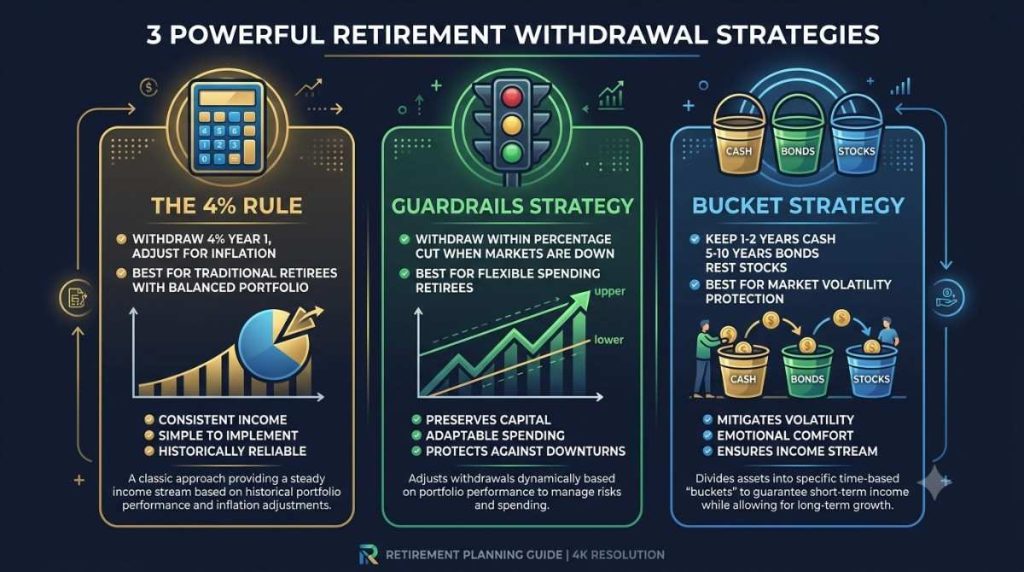
The last step in the process of turning your savings into a reliable income is the most anxiety-inducing.
As a traditional guideline for retirement withdrawals, 4% of your portfolio should be withheld the first year of retirement, and each subsequent year your withdrawal should be adjusted for inflation.
Withdrawal Strategies
| Strategy | Description | Best For |
|---|---|---|
| The 4% Rule | Withdraw 4% year 1, adjust for inflation thereafter | Traditional retirees with balanced portfolio |
| Guardrails | Withdraw within a percentage range; cut when markets are down | Flexible spending retirees |
| Bucket Strategy | Keep 1–2 years of expenses in cash, 5–10 years in bonds, and the rest in stocks | Market volatility protection |
| Required Minimum Distributions (RMDs) | Mandatory withdrawals starting at age 73 (75 if born 1960+) | Tax management |
Estate Planning and Legacy Goals
Your savings are a symbol of your hard work; estate planning ensures that those assets are transferred to the beneficiaries of your choosing.
Core Estate Documents
| Document | Purpose |
|---|---|
| Will | Directs distribution of probate assets |
| Revocable Living Trust | Avoids probate; privacy |
| Power of Attorney | Manages finances if incapacitated |
| Healthcare Power of Attorney | Medical decisions if incapacitated |
| Living Will | End-of-life care preferences |
| Beneficiary Designations | Supercedes wills for retirement accounts and insurance |
Updating Beneficiaries
The beneficiary designation on a retirement account or life insurance policy takes precedence over a will. You should review and update your beneficiaries immediately after major life events (marriage, divorce, death) have taken place.
The Psychology of Retirement
Many people find it hard to transition from saving to spending.
Even when it’s your plan, spending down your savings can feel wrong after decades of accumulation.The transition from saving to spending is psychologically difficult for many. After decades of accumulating, spending down your savings can feel wrong—even when it is the plan.
Strategies for a Smooth Transition
| Challenge | Solution |
|---|---|
| Fear of running out of money | Stress-test your plan with Monte Carlo simulations |
| Guilt about spending | Build budget for guilt-free spending |
| Loss of identity | Define who you are beyond your career |
| Social isolation | Plan activities that involve others |
When to Hire a Professional
Consider Hiring a Fee-Only Fiduciary CFP.
- The situation that you are in involves a great deal of complexity (business ownership, stock options, significant inheritance, special needs family member).
- There is a good chance that you will retire in the next 5 to 10 years
- Is there anything else you would like to know about your plan before you move forward?
- It is not easy for you to manage your investments because you don’t have enough time or confidence
Where to Find One
| Network | Focus | Website |
|---|---|---|
| NAPFA | Fee-only fiduciary CFPs | napfa.org |
| CFP Board | Certified Financial Planners | letsmakeaplan.org |
| XY Planning Network | Fee-only, hourly planners | xyplanningnetwork.com |
Conclusion
There is no need to deprive yourself today when you are planning your retirement. In the end, it all comes down to keeping the right balance between spending enough to enjoy life now and saving enough for the future.
It is best to start planning as soon as possible, which was yesterday. Today is the second-best time to schedule a meeting. Make sure you open your IRA account as soon as possible. Invest 1% more in your 401(k) by increasing your contribution. Make sure that your Social Security numbers are up to date. This week, try to take at least one action that will make a difference.
Frequently Asked Questions (FAQs)
Q1: How much do I need to retire?
You multiply your desired income by 25 according to the 4% rule. In order to live on 60,000 a year, you need 1,500,000 (not including Social Security or pensions).
Q2: What is the most appropriate age to claim Social Security?
For those born after 1960, full retirement age is 67. You can claim early (reduced benefit) or late (increased benefit). Each year you delay past FRA, your benefits go up by about 8%.
Q3: What is the 4% rule in retirement planning?
If you withdraw 4% of your portfolio in year one of retirement, adjust for inflation each year, and you shouldn’t run out of money in 30 years.
Q4: How much should I save for retirement each month?
When you are between the ages of 20 and 25, you should start saving between the ages of 10 and 15% of your gross income or between 20 and 25% if you wait until later in life. It will depend on the goals you have and how soon you want to achieve them as to how much money you will need.
Q5: How do I catch up on my retirement savings in my 50s?
Consider delaying Social Security, reducing expenses, extending working years, and maximizing catch-up contributions (7,500 extra into 401(k), 7,500 extra into 401(k), 1,000 extra into IRA).