


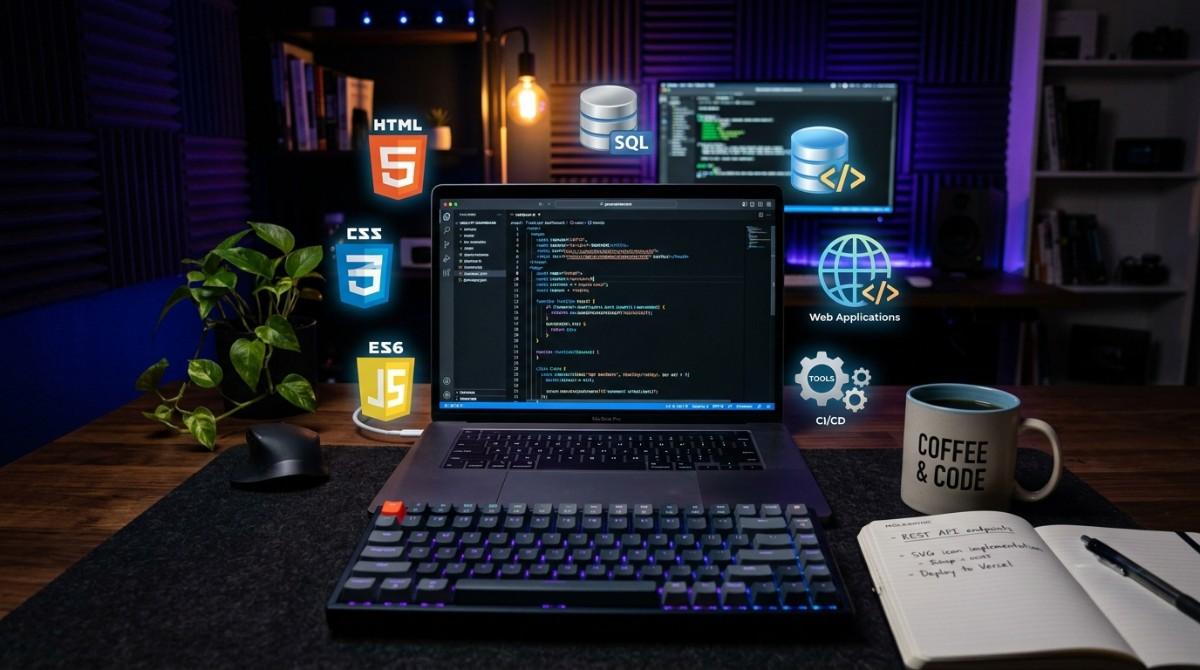
Understanding Web Programming
What Is Web Programming?
Using computer programming languages, frameworks, and a variety of development tools, it is possible to create, develop, and maintain websites and web-based applications, and this can be done using a variety of programming languages, frameworks, and tools. It’s important to remember that web programming is significantly different from simple webpage creation, because it focuses on making websites interactive, dynamic, and capable of performing tasks based on user input. As an example, a basic web page could only display information, while a programmed web application could allow users to create accounts, make purchases, communicate with others, and manage their personal information.
During the process of building an online experience, a web programmer works with different layers of technology. As a rule of thumb, the visible part of a website is created through front-end programming, while the hidden systems that manage the information and the business logic of the website are handled through back-end programming. In the same way that two halves of a machine work together, these two sides work together perfectly. A website that is properly connected is one that feels fast, reliable, and easy to use when users are experiencing it.

In today’s world of web programming, writing code is not the only thing that is involved. This includes such things as understanding the needs of the users, planning the structure of the website, improving performance, protecting data, and ensuring compatibility across various devices. It is imperative that a successful web programmer thinks both about technology and about people at the same time. An effective website is one that solves problems and provides value to its users by solving their problems.
Despite the fact that new technologies are constantly appearing in this field, it continues to evolve. With the advent of artificial intelligence, cloud computing, mobile devices, and advanced security systems, the way developers build websites is changing drastically. Because of this constant evolution, web programming offers an exciting and ever-changing field in which learning never truly stops.
Why Web Programming Matters Today
The role of web programming in shaping the digital economy has become increasingly important in recent years. As a matter of fact, almost every organization today relies on websites or web applications for interacting with customers, providing services, and managing operations of their business. The online presence of a company can make all the difference when it comes to being competitive because people are increasingly expecting to have access to information and services instantly.
It is easy to see how web programming plays an important role in our day-to-day lives. Food can be ordered online, travel can be booked, classes can be attended online, and finances can be managed all with the help of carefully designed web applications. Each time a button is clicked or a page is updated, there is a set of programming logic that is making it all happen.
There are also a number of opportunities for individuals who are interested in web programming. There are many people who learn web development skills in order to start careers, build businesses, or create digital products of their own. One developer with the right set of skills can create tools that can be used by thousands of people all over the world if they have the right skills. In the technology industry, web programming is considered to be one of the most valuable skills to have due to its accessibility.
There is a possibility that web-based solutions will become even more crucial in the future. A web programmer will continue to play a significant role in the creation of digital environments that are both secure, efficient, and easy to use as technology becomes more connected.
The Foundations of Web Development
Front-End Web Programming

It refers to everything a user sees and interacts with directly on a website, so it is called front-end web programming. The front-end technologies of a website are responsible for the layout, colors, menus, buttons, animations, and presentation of the content when someone visits that website. Front-end developers are responsible for translating ideas and designs into functional interfaces that function across computers, tablets, and mobile phones.
There is no doubt that the main goal of front-end development is to create an enjoyable user experience for the user. If a website does not have easy navigation or is slow to react, visitors may quickly leave the website, even if the information on the site is excellent. As a front-end programmer, you have to be careful to organize elements so that the user can easily find what he or she is looking for.
It is important to note that modern front-end programming involves much more than just creating static pages. The developers build interactive experiences where the content is able to be updated instantly without the need for the users to reload the page. A few examples of front-end programming in action are dashboards, shopping carts, video players, and interactive maps on websites.
In order to be a strong front-end developer, one must possess both technical and creative skills. In order for developers to be effective, they need to understand programming concepts as well as design, accessibility, and user behavior. Combining these two elements helps create websites that are not only visually appealing, but also functional and easy to use.
Essential front-end technologies
It is important to note that the foundation of front-end web programming consists of several core technologies. HTML is a coding language that creates the structure of web pages by organizing content into headings, paragraphs, images, and links. By managing layouts, colors, spacing, and visual styles, CSS is able to control the appearance of a webpage. It allows webpages to respond to user actions by allowing them to use JavaScript to add functionality to them.
There is no doubt that JavaScript has become one of the most important technologies for web developers because it allows them to create highly interactive web experiences. There are many JavaScript frameworks and libraries available today which simplify the process of developing a website and improve its performance. As a result, programmers are able to build complex applications more efficiently with the help of these tools.
As part of the front-end development process, front-end developers also focus on responsive design. In order to accommodate people who access websites on many different types of devices, websites must automatically adjust their size based on the device they are using. When a website works perfectly on a desktop, but fails to work on a smartphone, then the user experience is diminished as a result.
Front-end development also includes the consideration of accessibility as another important aspect. As a programmer, you need to ensure that a website is accessible to people with different abilities. As part of this process, we will create readable content, ensure properly navigable web pages, as well as integrate assistive technologies into our website.
Back-End Web Programming
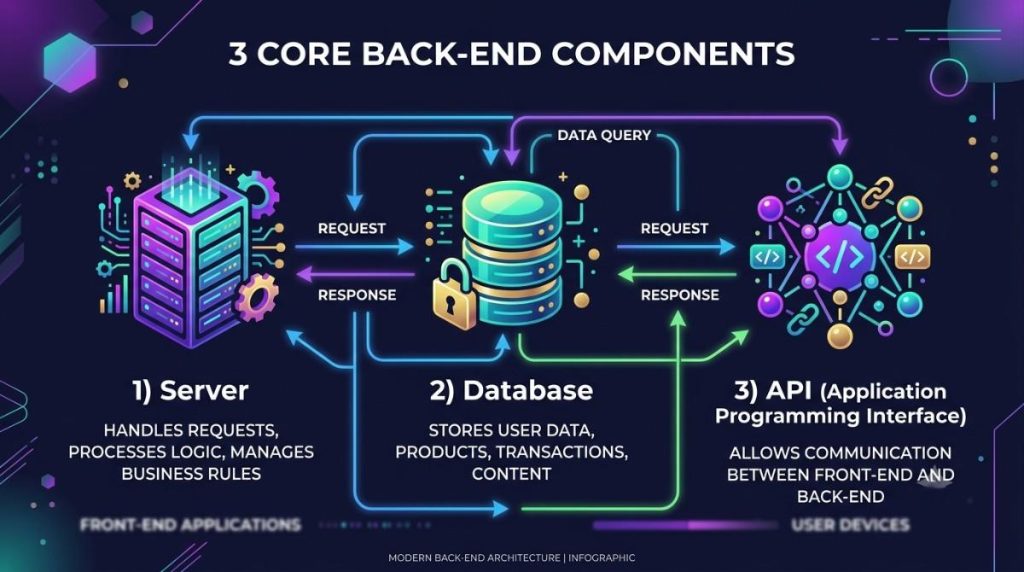
Web back-end programming is the process of developing the systems that control websites and applications on the back end. A front-end developer is focused on what the end user sees, while a back-end developer deals with the servers, databases, security, and logic of the application. This is the engine that works in the background and takes care of all the details.
Whenever a user creates an account, uploads a photo, or searches for information, the back-end of the site is responsible for processing those requests. In this program, data is received, rules are applied, communication with databases takes place, and the user receives responses in response. Many modern websites would be nothing more than simple information pages without the use of back-end programming.
Developers who work on the backend of a system are responsible for creating systems that must be reliable, secure, and scalable. There can be a lot of visitors to a small website, but a large platform may need to be able to support millions of users at the same time. In the world of web programming, one of the biggest challenges is the creation of systems that are able to cope with growth.
Another major responsibility that a company has is security. The back-end programmers protect sensitive information by implementing authentication systems, encryption methods, as well as secure communication practices in order to safeguard sensitive information. In the era of increasing online threats, having strong security skills becomes more and more important.
Server-side Development Basics
As the name suggests, server-side development involves the creation of programs that run on a web server instead of directly within a user’s browser. The purpose of these programs is to control how websites process and communicate with databases in order to process information.
In terms of back-end programming languages, Python, Java, JavaScript through server environments, PHP, and other languages have become popular. There are many different languages available for developers to create powerful web applications, but all of them have their own strengths.
An example of a server-side process would be when a user makes a request on the server. Once the server receives the request, it processes the required operations, retrieves or updates the information, and sends a response to the client. In most cases, this process is completed in fractions of a second, as it happens quickly.
There is also a great deal of work involved in back-end development when it comes to databases. The purpose of a database is to store important information such as user profiles, product details, messages, and transactions regarding users. As a developer, your job is to design systems which provide a safe and efficient way to store information and retrieve it when necessary.
Programming Languages Used in Web Development

A number of different programming languages are used in the development of web applications. In terms of purposes and advantages, each language has its own characteristics. It is important to know which language is best suited to the project requirements, performance needs, and preferences of the developers.
In contrast, front-end languages are primarily used to create user interfaces, while back-end languages are used to create logic and perform data processing. In fact, some languages can even be used for both sides of a development cycle, which is why they are one of the most popular choices for contemporary developers.
Popular front-end languages
In the front-end of a website, HTML, CSS, and JavaScript are the most commonly used technologies. The foundation of a website is HTML, the visual experience is enhanced by CSS, and the interaction is brought to life by JavaScript.
The fact that JavaScript has become one of the most widely used web programming languages is due to its flexibility. A wide range of applications can be created with it, ranging from simple animations to full web applications.
A number of programmers also make use of front-end frameworks that provide ready-made structures and tools to make their lives easier. The frameworks help developers reduce repetitive work and allow them to focus on building more useful features rather than repetitive tasks.
Powerful back-end languages
The back-end of a website is developed using a variety of programming languages, depending on the goals of the project. In the software industry, Python is known for its simplicity and readability, while Java is used more often for large enterprise applications. As a result of JavaScript-based server development, developers are able to use the same language for both front-end applications and back-end applications.
There are also other languages that remain important in the world of web development. In order to make the right choice, there are several factors to consider, such as speed, security, tools available, and long-term maintenance requirements.
How Web Applications Work
Client-Server Communication

The interaction between the device and the server is one of the most important components of every web application. In the browser, information is requested from the server through the client, which acts as a client. Upon receiving the request, the server processes it and returns the appropriate response in response to the request.
A website is constantly in communication with its users whenever they interact with it. As soon as you click a button, submit a form, or load new content, exchanges between the server and client are triggered.
Databases and Data Management
As a result of the need for modern websites to manage and store information, databases are an essential part of them. In order to keep track of users and content on social networks, online stores, and business applications, databases are a necessary component.
A website that has an effective database management system will remain fast and organized for a long time. There are a number of issues that can arise due to poor database design, such as slow performance and security risks.
Tools and Frameworks for Web Programmers
Development Frameworks and Libraries
It is the frameworks and libraries that assist developers in building applications faster because they provide reusable solutions. In addition to reducing repetitive coding, they also encourage better development practices by reducing the amount of repetitive code.
In spite of the fact that frameworks can be used to replace programming knowledge, they cannot do so. Frameworks are tools that are used to support creativity and problem-solving, therefore developers still need to understand the fundamentals of how they work.
Testing and deployment tools
During the testing process, websites are ensured to work properly before they are made available to users. For the purpose of preventing problems, developers test the performance, security, and functionality of their software.
It is important to use deployment tools to help move applications from development environments to live websites as quickly as possible. The use of these tools makes it easier to update and maintain your online projects in a timely manner.
Skills Needed to Become a Web Programmer
As a web programmer, you will be required to have both technical knowledge and practical experience in order to become successful. It is important to be able to learn programming languages, but having the ability to solve problems is more important.
In order to be a good developer, one has to understand how to analyze problems, find solutions, and continuously improve their skills. As technology changes rapidly, it is necessary for professionals to remain up to date on the latest technologies.
Communication skills are also very important when it comes to business. Developers often work with other programmers, designers, and business owners when they are developing a website. Explaining ideas clearly is one of the keys to the success of a project.
The Future of Web Programming
With the advent of new technologies, web programming will continue to evolve. With artificial intelligence, automation, advanced security systems, and an improved user experience, the industry is changing rapidly.
There is a good chance that in the future, web developers will work with smarter tools that will help them build applications faster. Despite this, the importance of creativity, logical thinking, and human understanding will remain unchanged.
There is no denying the fact that the web is becoming more connected each year, and programmers will continue to develop the systems that power the digital world.
Conclusion
It is important to understand that the modern internet is built on the foundation of web programming. By combining coding, creativity, and problem-solving skills, it is able to create websites and applications that have a significant impact on the way people live and work today. All digital experiences depend on skilled programmers, regardless of whether they are simple webpages or advanced online platforms.
The ability to learn web programming can open doors to a variety of career opportunities. It does not matter whether an individual is interested in a career in technology, a freelance business, or the ability to build their own personal projects, web development provides valuable skills that will remain relevant in a changing world for a long time to come.
There is no doubt that the journey will require a certain amount of patience and practice, but every successful website begins with just one line of code. There is no doubt that the future belongs to those who are able to use technology to create meaningful and effective digital experiences.
Frequently Asked Questions About Web Programming
1. What is web programming in simple terms?
Programming for the web is the process of creating websites and web applications with the use of a variety of programming languages and development tools. By using it, websites can display information, respond to users’ questions, process data, and perform a variety of tasks online such as responding to their queries.
2. Is web programming difficult to learn?
Although web programming can be challenging at first, beginners can easily learn the basics step by step. A strong foundation can be created by starting with basic concepts such as HTML, CSS, and JavaScript at an early stage.
3. What languages should a beginner learn?
There is no doubt that the majority of beginners will start with HTML, CSS, and JavaScript because these technologies form the foundation for developing a website. It is then that they can explore the backend languages and frameworks that are available.
4. Can web programming become a career?
The field of web programming offers many career opportunities to those who are interested in it. It is possible for developers to work for companies, to be freelancers, or even to create their own digital products and services.
5. What is the future of web programming?
As web programming moves forward, we will see smarter applications, artificial intelligence integration, improved security, and faster digital experiences that will enhance the user experience. There will continue to be an important role for web developers in the field of technology in the future.