


Introduction
It’s like having your bank in your pocket. Checks can be deposited at midnight, money can be transferred while you’re waiting for coffee, bills can be paid during your commute, and you can check your balance before you buy something.
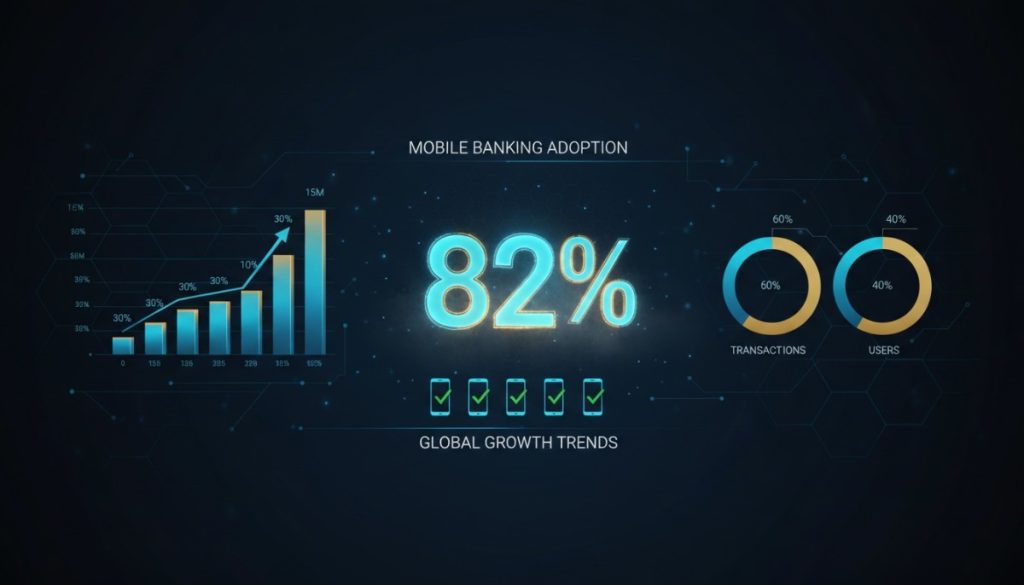
In the last few years, mobile banking has transformed from a convenient add-on to the primary way people manage their money. According to 2026 statistics, 82% of mobile banking users are active, reinforcing mobile as the primary channel for account holders to interact with their banks. At this new high, mobile activation rates have jumped past a three-year plateau of 73%.
The shift didn’t happen overnight. As more people discovered how refreshing it is when banking is streamlined, it grew quietly. It feels outdated to millions of people to walk into a branch, wait for paperwork, or dig through statements.
From adoption trends and security innovations to key features and what’s next, this guide covers everything you need to know about mobile banking in 2026.
Mobile Banking Adoption: Key Statistics for 2026
Mobile banking has become a part of our everyday lives, based on these numbers.
Table: 2026 Mobile Banking Adoption Metrics
| Metric | 2025 Value | Change |
|---|---|---|
| Checking accounts with active digital users | 87% | +10% in two years |
| Mobile banking users actively engaged | 82% | Up from 73% plateau |
| Loan applications via digital channels | 51% | First time crossing 50% |
| Average monthly digital log-ins | ~17 per user | Significantly higher than branch visits |
| eStatement recipients among active digital users | 79% | 80% opted out of paper entirely |
What These Numbers Mean
87% of checking accounts have active digital banking users. It’s no longer optional to engage digitally.
There’s an active engagement rate of 82% among mobile banking users. Mobile has officially taken over as the primary channel. People aren’t just downloading banking apps; they’re using them.
The number of loan applications submitted online has exceeded half for the first time. Digital lending has reached a milestone.
There are 1.56 new products per user on average when it comes to digital banking. You’re more likely to grow your relationship with your bank if you’re an engaged digital customer.
Chinese Mobile Banking Market (2026)
According to QuestMobile’s March 2026 data, the Chinese mobile banking market is dominated by state-owned banks:
| Rank | Bank | Monthly Active Users |
|---|---|---|
| 1 | Agricultural Bank of China | 209 million |
| 2 | China Construction Bank | 180 million |
| 3 | Industrial and Commercial Bank of China (ICBC) | 172 million |
Growth has slowed significantly as the market enters a “stock competition” phase.
Banks are seeing user growth rates drop to single digits.
Today, most banks use a dual-channel strategy (app + WeChat mini-program) to reach both core and casual customers.
The Shift to Mobile-First Banking
Rather than having physical branches, mobile-first banks are designed primarily to be used on smartphones.
A simpler, faster, and more intuitive digital environment for essential bankingt.
Why Mobile-First Banking Became Popular
| Factor | Explanation |
|---|---|
| Evolving lifestyle of younger generations | Millennials and Gen Z expect financial services to behave like their favorite apps—fast, transparent, and intuitive |
| Convenience | Everything is available inside a single app, from spending limits to transaction notifications |
| Transparency | Clear fee structures and real-time updates reduce surprises |
| Lower costs | Mobile-first banks avoid physical branch overhead, often passing savings to customers |
Key Features That Make Mobile-First Banks Stand Out
- Open an account instantly – Upload your ID and selfie, get approved in minutes
- Get real-time notifications when money moves
- Management of cards – Lock/unlock lost cards from the app
- Integrated budgeting with spending categories and savings goals
- Mobile check deposit – Deposit checks using your phone’s camera
Limitations of Mobile-Only Banks
| Limitation | Explanation |
|---|---|
| Cash deposit challenges | No branches for cash deposits |
| Less personal support | Digital customer service may feel less personal than face-to-face help |
| Psychological adjustment | People who grew up visiting branches may need time to trust digital-only systems |
Security Innovations: The End of Passwords
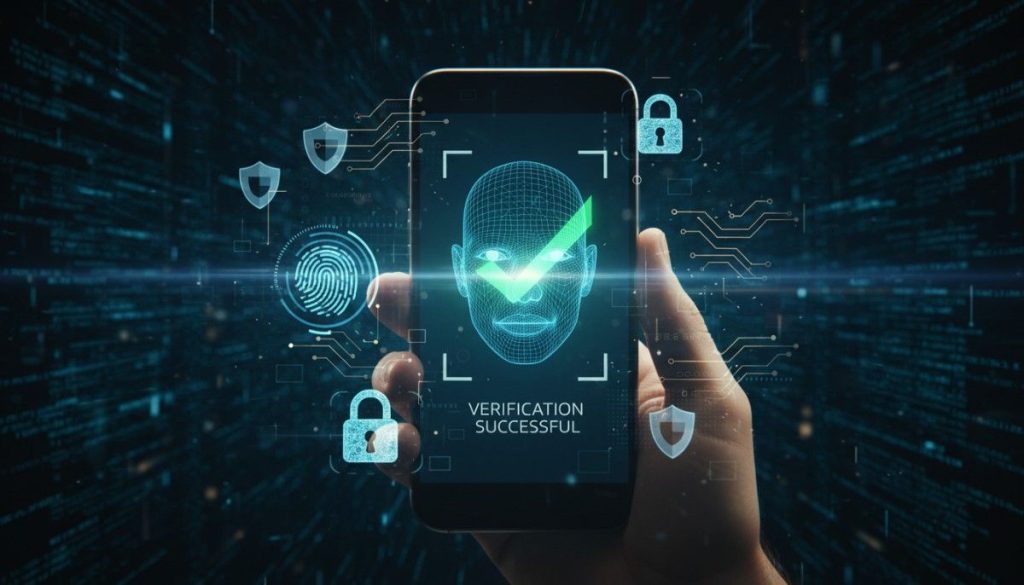
As a second factor for authentication, banks have been using one-time passcodes (OTPs) for years. Bank codes are one of the weakest-and most frustrating-parts of the experience. Their codes can be delayed, fail to arrive, or force users to switch apps. They’re vulnerable to phishing or SIM-swap scams.
The Shift to Passkeys and Biometric Authentication
“Passkey-First” security is going to be the norm for major financial institutions by 2026. Users unlock their accounts with Face ID, a fingerprint, or a PIN instead of codes. Across the US and Europe, it’s faster, phishing-resistant by design, and becoming the standard.
How Passkeys Work?
As part of the transition, the FIDO2 standard replaces the shared secret (the password) with a unique cryptographic pair. We’re going from “something you know” to “something you have” (the device) and “something you are” (biometrics).
| Feature | How It Works | Security Benefit |
|---|---|---|
| Public Key Infrastructure (PKI) | When you register, your device creates a key pair. The bank stores the public key (useless to hackers); your private key never leaves your phone | The bank never holds anything that can compromise your account |
| Phishing-resistant by design | The passkey is mathematically tied to the bank’s specific domain | A fake phishing website cannot request the passkey |
| Zero-knowledge architecture | The bank never sees your biometric data; it receives a cryptographic confirmation from your device’s secure hardware | Proof of identity without access to sensitive facial or fingerprint data |
Biometric Continuity
Setting up a new device used to feel like starting from scratch. Multi-device passkey flows make sure a user’s digital identity follows them everywhere:
- Ecosystem sync: Passkeys are synced securely with encrypted clouds (iCloud Keychain, Google Password Manager). It’s common for customers’ access to sync automatically when they get a new phone.
- Cross-device handshakes: To log into a bank on a new laptop, a user scans a QR code. Nothing is typed, nothing is shared.
- Ambient authentication: No codes to copy, no switching apps. The process feels more like unlocking a phone than logging in to a bank.
The recovery challenge
It’s the device itself that’s the key, so the first thing customers worry about is “What happens if I lose my phone?” Designing the recovery journey is the real UX challenge for 2026.
Implemented solutions:
- Instantly revoke access to lost devices with trusted device management
- Recovering from social media: Some fintechs let “Trusted Contacts” approve recoveries
- Users can scan a passport or driver’s license for government ID verification using AI. To re-issue a passkey, the app compares the selfie with the ID
Source:
Citi’s Enhanced Security Implementation
The Enhanced Security Function at Citibank Hong Kong shows how banks are implementing these technologies. Here’s what it uses:
- Binding to a device using cryptography – Each user has a device bound to their account
- 6-hour cooling off period – Additional authentication and restrictions on high-risk transactions
- Strengthened facial recognition – Cross-references live facial images with securely stored HKIDs
- Secure and simple QR Authentication for Citibank Online
Once registered, no additional authentication (such as SMS OTP) is required for transactions after login.
Mobile Banking Features That Matter
Core Features of Modern Mobile Banking Apps
| Feature | Description | User Benefit |
|---|---|---|
| Quick Balance | Check balances without full login | Saves time for routine checks |
| Mobile Check Deposit | Deposit checks using a camera. | No branch visit needed |
| Bill Pay | Schedule and pay bills digitally | One place for all payments |
| Card Controls | Lock/unlock lost cards instantly | Immediate fraud prevention |
| Zelle® / P2P Transfers | Send money to anyone | Easy person-to-person payments |
| Real-Time Notifications | Instant alerts for transactions | Stay informed of account activity |
| Budgeting Tools | Spending categories, savings goals | Better financial management |
| Credit Score Access | Free credit score monitoring | Track credit health |
AI-Powered mobile banking
AI is changing mobile banking from a transaction channel to a financial command center. By 2026, mobile will go beyond transactions and become an always-on financial command center. With AI, banks can get real-time insights and guidance based on spending data, usage patterns, and financial goals.
The chief industry innovation officer at nCino, Anthony Morris, says AI helps mobile banking form a personality around each customer, rather than just a generic one. With personalized agents, you get a profile that knows your financial life—your goals, your patterns, your worries.”
User Experience Research Findings
Researchers surveyed 103 people about mobile banking UI design in 2026 and found:
| Finding | Percentage |
|---|---|
| Respondents who regularly use mobile banking apps | 81% |
| Respondents who experienced problems with current apps | 77% |
| Respondents unhappy with current solutions (using third-party apps for daily transactions) | 44.7% |
| Respondents requesting budgeting features | 84% |
| Respondents complaining about biometric authentication | 46% |
Common problems identified: language barriers, lengthy loading times, unclear terminology, and navigational challenges.
User priorities: More personalized interfaces, improved customer service, increased security, and budgeting functionality.
User Experience Trends and Challenges
Top 5 Mobile Banking CX Trends for 2026
According to DECTA’s 2026 analysis, these trends are shaping mobile banking customer experience:
| Trend | Description |
|---|---|
| Mobile-First Communication | Communication and services are optimized for mobile devices first |
| AI-Powered Personalization | Financial institutions use AI to provide tailored product recommendations and financial advice |
| Real-Time Customer Service | AI chatbots provide instant access 24/7, with seamless escalation to human agents for complex issues |
| Hyper-Personalization | Big data and predictive analytics deliver deeply customized experiences |
| Emotional Connections | Human-centric design reduces friction and creates deeper emotional connections |
Key Challenges in Delivering Excellent Mobile Banking
| Challenge | Description |
|---|---|
| Legacy system integration | Outdated core banking systems struggle to integrate with modern digital capabilities |
| Data privacy and security | Regulations demand robust security; cybersecurity threats are increasing |
| Customer resistance | Some consumers remain hesitant about digital banking due to lack of understanding or skepticism |
| Regulatory compliance | Compliance requirements are ever-changing and resource-intensive |
| Balancing automation and human touch | Some transactions still require a humanized approach |
User-centric design recommendations
Here’s what the 2026 mobile banking UI study recommends:
- Reducing complexity in app layout and grouping – Simplify navigation
- Gestalt psychology principles like proximity and symmetry can improve visual design
- Communicate security features clearly – Make them visible and easy to understand
- Add budgeting features - 84% of users asked for it
- Address biometric authentication issues – 46% of users complain about the current implementations
Mobile-First Banks vs. Traditional Banks
| Aspect | Mobile-First Banks | Traditional Banks |
|---|---|---|
| Account Opening | Minutes via app (upload ID + selfie) | Hours or days (branch visit often required) |
| Fee Structure | Typically lower or no fees | Often higher, with minimum balance requirements |
| Cash Access | ATM networks (cash deposits challenging) | Full branch and ATM network |
| Customer Support | In-app chat, phone | In-person, phone, chat |
| Interest Rates | Often higher on savings | Often lower |
| Security | Biometric, passkeys, real-time alerts | Passwords, OTPs, in-person verification |
| Best For | Daily banking, digital natives | Complex services, cash-heavy users |
The Fintech Challenge
It’s now fintech companies that are the biggest threat to the banking industry. They ranked fintechs higher than community banks for the first time in three years.
Fintech banks that only accept mobile payments have their own challenges. They’ve had a hard time getting more customers. It looks like many of them will likely be absorbed by larger conventional banks while maintaining operational independence.
The future of mobile banking
AI as an Operational Infrastructure
The future of artificial intelligence is embedded operational logic, not interface technology. Rather than just responding to user commands, banking software takes action, adjusts parameters, and reprioritizes.
Here are a few key developments:
- Automation of routine financial stuff (payments, savings allocation, compliance checks)
- Behavioral data and financial planning: predictive modelling
- A structural necessity for algorithmic accountability
In the past, banks used one-time passcodes (OTPs) sent via SMS as a second factor. But these codes have become one of the most frustrating parts of banking. Phishing and SIM swap scams can happen, and codes can be delayed, fail to arrive, or force users to switch apps.
The Shift to Passkeys and Biometric Authentication
In 2026, major financial institutions will use “Passkey-First” security. Instead of a code, users unlock their accounts with Face ID, a fingerprint, or a PIN. In the US and Europe, it’s faster, phishing-resistant by design, and becoming the standard.
How Do Passkeys Work?
FIDO2 replaces the shared secret (the password) with a unique cryptographic pair. Security shifts from “something you know” to “something you have” (the device) and “something you are” (biometrics).
Continuous monitoring replaces Point-to-Time Banking
The traditional banking system relies on snapshots – credit checks at account openings and suspicious activity reviews. This model changes completely with continuous monitoring. There’s a need for real-time architecture that enables data to move fast.
Conversational AI as Primary Interface
Banks are no exception. People are increasingly interacting with technology using conversational AI. Experiences that are intuitive and dialog-driven are expected by customers. By surfacing information naturally, conversational AI reduces employee frustration.
Mobile Platforms as Financial Control Layers
Mobile banking is becoming the primary interface for managing your money. Suddenly, the app isn’t just a service channel – it’s a control layer connecting payments, identities, credit, savings, investments, and more.
Continuous authentication.
Here’s what the future of mobile banking authentication looks like:
- Analyzing behavior
- Patterns of location
- Reputation of the device
- Behaviour of transactions
- A machine-learning approach to anomaly detection
Banks will rely more on context instead of asking for more factors.
Conclusion
The primary way people interact with their financial institutions in 2026 will be via mobile banking. 82% of mobile banking users are active, digital loan applications have crossed 50%, and mobile activation rates have broken through a three-year plateau.
The world of security has changed dramatically. Passkeys and biometric authentication are replacing annoying OTPs, making mobile banking more convenient and secure. Cryptographic device bindings and the FIDO2 standard mean authentication is becoming invisible-something that happens in the background.
We’ve gone way beyond basic transactions. Real-time insights and tailored recommendations powered by AI. Users can manage their money more effectively with budgeting tools, spending categories, and savings goals. Notifications keep users in the loop.
It’s still a challenge. Data fragmentation continues to plague legacy systems. There are still some users who are scared about security. It takes a lot of skill to manage the balance between automation and human touch.
With mobile banking, consumers get faster service, lower fees, and more convenience. Institutions that deliver mobile experiences that feel more like effortless financial management will thrive.
There’s no doubt that the future of banking is mobile-first – it’s mobile-only for many people. That future is already here.
Frequently Asked Questions (FAQs)
Q1: What is mobile banking?
Mobile banking is the use of a smartphone or tablet to perform financial transactions. This includes checking balances, transferring funds, paying bills, depositing checks, and managing accounts through a bank’s mobile app.
Q2: What percentage of people use mobile banking?
As of 2025, 87% of checking accounts are associated with active digital banking users, and 82% of mobile banking users are actively engaged.
Q3: Is mobile banking safe?
Yes, when using legitimate banking apps. Banks use encryption, biometric authentication, passkeys, and real-time fraud detection. However, users should always enable biometric login and never share passwords.
Q4: What are mobile-first banks?
Mobile-first banks are financial institutions designed for use on smartphones rather than in physical branches. They offer instant account opening, real-time notifications, and integrated budgeting tools through their apps.
Q5: How do I deposit a check using mobile banking?
Open your bank’s mobile app, select “Deposit Checks,” take photos of the front and back of your endorsed check, enter the amount, and submit. Funds availability varies by bank.