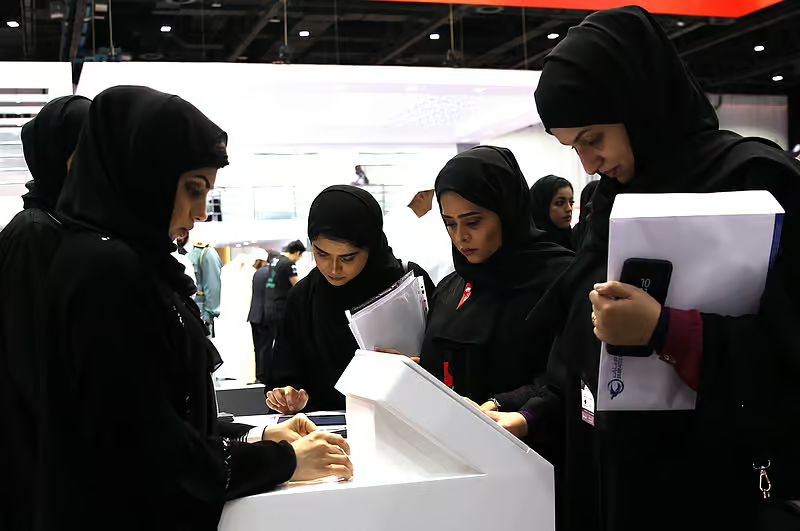
The UAE and Jordan currently face the highest share of jobs at risk of substitution by artificial intelligence within the Menaap (Middle East, North Africa, Afghanistan, and Pakistan) region, according to the World Bank’s October Economic Update. High-income nations remain the most exposed because a larger portion of their labor force is engaged in cognitive tasks that generative AI is increasingly capable of performing. AI has become central to the UAE’s economic diversification and long-term competitiveness.
Regional Economic Developments
- Tesla Roadster: Bookings are open in the UAE with pricing starting from Dh210,000, though no official delivery date has been provided.
- Infrastructure Expansion: The UAE’s fourth highway, stretching from the Dubai-Sharjah border toward Ras Al Khaimah, is designed to feature up to 16 lanes.
- Industrial Update: Emirates Global Aluminium has successfully restarted 50 percent of its smelting cells at the Al Taweelah facility.
- Holiday Planning: Employees can strategically combine annual leave around upcoming UAE National Day public holidays to secure a five-day break.
Across the broader region, the risk of AI-driven job substitution affects roughly 10 percent of the total workforce. Conversely, between 13 and 20 percent of roles present opportunities for AI to enhance productivity, although the World Bank notes that such potential benefits are far from guaranteed. The UAE stands out as having the most extensive occupational footprint for AI adoption, showing above-average implementation across nine of 22 occupation groups, including management, software, arts, media, personal care, and food preparation.
This widespread integration is attributed to the National Strategy for Artificial Intelligence 2031, which emphasizes embedding AI into energy, logistics, finance, government services, and healthcare. Which targeted hospitality, retail and logistics as well as technology, the report links this to the national AI strategy launched in 2017.
Consequently, the value of work currently performed or assisted by AI—when measured against GDP—is highest in the Gulf, with the UAE’s ratio nearing that of the UK and Germany. Stay up to date with the latest news.
These estimates stem from an analysis of one million Anthropic Claude conversations, though researchers warn that these users may represent more knowledge-intensive backgrounds than the general public, potentially inflating the projected gains.
While high-income countries face more disruption, lower-income economies show less exposure, largely due to variations in the specific tasks performed by their workers. Lower exposure reflects the mix of jobs rather than any lead in preparedness.
However, these regions are not immune; online freelancers in countries like Pakistan and Egypt, which rank among the top five global suppliers across over 2,700 skill categories, are already seeing impacts. Since the introduction of ChatGPT, jobs requiring highly substitutable skills have seen a 9.8 percent decline in value, while new entrants into these specific skill sectors have dropped by 12.1 percent. Viral video on indecent act in Makkah that led to 2 executions is ‘misleading.
Digital transformation remains uneven across the region, where only 16 percent of firms introduced new products or services in the last three years, compared to 29 percent in other emerging markets. Infrastructure barriers, such as inconsistent broadband and electricity access, persist in some areas. Meanwhile, AI talent is increasingly gravitating toward the GCC, contributing to a talent drain from middle-income nations.
The UAE and Saudi Arabia remain the region’s only representatives in the global top 25 for high-performance computing and AI model development. The UAE’s ranking in Stanford University’s Global AI Vibrancy Index climbed from 32nd in 2017 to 8th in 2024. Despite this, gender disparity remains a challenge, as women represent only 20 to 25 percent of generative AI course enrollments on Coursera in Egypt, Qatar, Saudi Arabia, and the UAE. And enrolment in generative AI courses on Coursera grew 344 per cent year on year, the UAE rose from 32nd in 2017 to 8th in 2024 in Stanford University’s Global AI Vibrancy Index.
Key Job Details
- E-911: UAE’s fourth highway from Dubai-Sharjah border to RAK to have up to 16 lanes.
- UAE National Day holidays: How to use annual leave to get 5-day break.