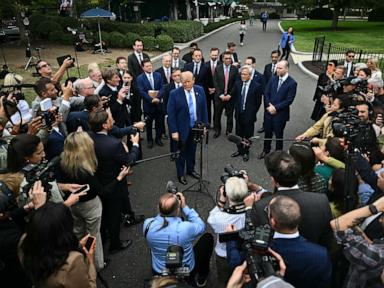
President Donald Trump announced on Tuesday that prominent technology leaders have signed a “constitution” designed to allow the industry to police itself. This agreement follows growing pressure and internal warnings within the tech sector regarding the potential risks of advanced artificial intelligence, with some advocates calling for development slowdowns to prevent systems from exceeding human capability. The meeting came as AI leaders are issuing warnings about the threat of AI and calling for steps to slow it down before it outsmarts humans. Lawmakers are weighing what — if any — action should be taken, following those warnings. But we do work with them in so many ways,” Trump said.
House Speaker Mike Johnson confirmed that the commitment is entirely voluntary. The White House gathering included several high-profile figures, such as Meta CEO Mark Zuckerberg, Elon Musk, Anthropic CEO Dario Amodei, Google CEO Sundar Pichai, Nvidia’s Jensen Huang, Palantir’s Alex Karp and Shyam Sankar, Amazon’s Jeff Bezos, and Greg Brockman from OpenAI.
Before the meeting, President Trump expressed a clear aversion to international regulatory frameworks or global cooperation on the technology. He noted that he discussed the matter with Chinese President Xi Jinping at the White House last week, stating that he does not want to do anything that might stifle American growth. The president emphasized his desire to maintain the United States’ competitive advantage, suggesting that working with China on AI could lead to the immediate loss of sensitive knowledge. And, and a lot of people said, ‘Let’s do it together with China. We’re leading now over China and everyone else and I want to keep it that way. We want people to behave honestly, at the same time.
Regarding the prospect of regulation, Trump reiterated his stance that the U.S. rejects global efforts to control AI, a position he recently voiced at the United Nations General Assembly. He stated that the government would rely on existing law enforcement mechanisms, such as the Department of Justice and the FBI, to address instances where companies might follow a dangerous path, rather than implementing proactive industry-wide regulations.
Speaker Johnson, who highlighted the meeting two weeks ago as a venue for discussing corporate safety responsibilities, has consistently argued against a moratorium on AI development. He warned that stalling progress would result in a national security disadvantage, allowing China to gain the upper hand. In comments to Fox Business on Monday, Johnson dismissed widespread warnings about AI existential threats as a “Chinese psychological operation” and politically motivated fear-mongering. But then they’re going to be able to immediately gain access to things that we know that they don’t know.
Internal industry perspectives remain divided on the approach to safety. While some leaders have pushed for collective cooling-off periods, Meta CEO Mark Zuckerberg has argued that each laboratory maintains the responsibility and incentive to advance models safely. President Trump has frequently categorized the discourse surrounding potential AI catastrophes as a “hoax,” comparing the rhetoric to his previous experiences with impeachment.
This week’s meeting is the latest in a series of high-level discussions between the administration and the private sector. Last week, multiple tech CEOs, including heads of Microsoft, Apple, AMD, and SpaceX, attended a state dinner for President Xi. Furthermore, Anthropic’s Dario Amodei reportedly met with the president on Sunday evening, reflecting the ongoing intensity of dialogue between tech executives and the White House regarding the future of the industry.