


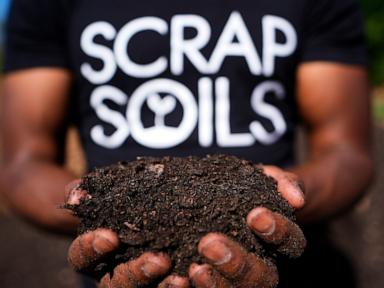
Each Monday, Ricky Blanding navigates a carefully mapped route across Detroit in his Ford Ranger, stopping at various homes and restaurants to collect buckets of kitchen scraps. As the CEO of Scrap Soils, a company he co-founded in 2020, Blanding is part of a growing movement of independent haulers addressing a significant environmental challenge: keeping organic waste out of landfills where it produces potent greenhouse gas emissions. Blanding, a 34-year-old native Detroiter, co-launched Scrap Soils in 2020 to play a local part in solving a statewide food waste problem that mirrors what’s happening around the globe.
Food waste is a major contributor to methane emissions in Michigan and across the globe. Experts at the climate solutions nonprofit Project Drawdown note that diverting items like eggshells, coffee grounds, and carrot tops from landfills provides dual benefits. By avoiding methane production, which functions like an emergency brake on climate change, the process also returns vital nutrients to the soil once decomposition is complete. It also ultimately helps create healthy soil for gardeners and urban farmers. Estimates say, and accounts for millions of metric tons of carbon dioxide equivalent emissions in the state, food waste is a huge source of methane in Michigan landfills.
“That’s a way that we can see that we’re benefiting the environment, because we’re taking food and then replenishing the ground with those nutrients,” said Emily Cassidy, a research associate at Project Drawdown. She emphasizes that while methane has a massive, short-term impact on the climate, the dual-action of composting helps improve local food production.
For urban dwellers who lack access to municipal composting or space for backyard systems, these independent services fill a crucial gap. In Detroit, Scrap Soils serves over 70 residential and commercial clients. Subscription costs are tiered, with residential pickups starting at $15 per month and business services beginning at $60, depending on the volume of waste generated.
Executive chef Lou Hammer of The Grand Porter in Detroit’s Southwest neighborhood uses the service to manage the restaurant’s daily output. According to Hammer, the process is seamless, requiring the kitchen staff to simply deposit bread scraps, tomato tops, avocado skins, and eggshells into a designated bin instead of standard trash bags. “It doesn’t take any extra effort,” she remarked. “We go through a lot of eggs, so mostly egg scraps, eggshells and the cardboard. It’s just going to go in a green bag instead.”.
After completing his weekly 100-mile circuit, Blanding delivers the collected waste to Sanctuary Farms. There, the materials are processed into high-quality soil additives. Despite the success, Blanding acknowledges that scaling the operation remains difficult. The team is currently fundraising to secure a matching state grant to purchase larger transport vehicles and dedicated composting infrastructure. Too.”, probably a few other things in there. More than 100-mile (160-kilometer) weekly route, Blanding drops off the waste at Scrap Soils’ partner, Sanctuary Farms in Detroit, after completing his nine-hour. There, everything from apple cores to rotted pumpkins to corn husks is composted into a rich soil additive that’s available for purchase.
Educational outreach remains a pillar of their business model. Blanding stresses that success depends on ensuring clients understand how to prepare scraps, such as removing produce stickers, and maintaining consistent engagement to expand the service. These hurdles are common for independent ventures in the sector, which often struggle with gaining visibility and securing long-term commitments from the community.
The broader landscape of composting is shifting as more municipal governments recognize its role in climate strategy. A 2023 report from the publication BioCycle identified 400 residential food waste collection programs supported by municipalities nationwide, with 230 offering curbside pickup. Cities are increasingly viewing these initiatives as vital tools to hit ambitious environmental targets.
Detroit’s climate strategy, which aims for a 100% reduction in municipal greenhouse gas emissions by 2050, includes a goal to divert 15% of total waste from landfills over the next three years. This year, the city launched its first municipal food scrap drop-off site, which saw hundreds of residents sign up to participate.
Tepfirah Rushdan, Detroit’s director of sustainability, views these programs as an accessible entry point for citizens. She believes that individual actions like composting are essential steps toward reaching the city’s sustainability objectives. Similar independent efforts are cropping up elsewhere in the U.S., including the Denver Compost Collective, Nashville’s Compost Co., and Compost Now, which operates across Georgia and North Carolina.
As these services expand, Blanding remains focused on the environmental impact of his work. By converting everyday waste into a valuable resource, these services aim to solve local waste issues while contributing to the global fight against climate change.