

A combination of regulatory bottlenecks in Kyiv and rigid, outdated strategic planning within Western militaries is hindering collaborative weapons production. According to defense experts and a report titled “Beyond Aid: Making Ukraine Defence Cooperation Work” by the Kyiv School of Economics, these systemic issues are weakening Ukraine’s battlefield efficiency while leaving Western forces ill-prepared for modern combat conditions. Mundane regulatory problems in Kyiv and unimaginative institutional thinking in Europe’s militaries are holding up joint weapons production.
For the past two years, Ukraine has attempted to scale up its domestic armaments sector by inviting international defense firms to establish local manufacturing hubs. Under this arrangement, Kyiv secures vital hardware, while foreign defense partners gain invaluable real-world battlefield data. However, this initiative has faced major obstacles. Out of at least 180 business-to-business partnerships launched between Ukrainian and international enterprises, 22 percent are currently stalled.
A primary example of these setbacks is a planned artillery ammunition plant announced a year ago by the German defense manufacturer Rheinmetall. Though the facility was scheduled to begin production by now, construction has not yet started. The delay stems from bureaucratic hurdles, as Ukrainian regulators slow-walked necessary permits before the government ultimately decided to relocate the facility’s designated site. Because Ukrainian authorities have delayed permits and the government then moved the factory’s site, yet ground has not been broken on the project.
Legal and intellectual property complications also create friction. Chris Pool, a visiting fellow at the Centre for Statecraft and National Security (CSNS) at King’s College London, explained that “the process of registering intellectual property is lengthy” and outpaced by rapid technological development. “Iteration cycles move so quickly, often what’s registered and protected is obsolete,” Pool observed, noting that field modifications raise difficult legal ownership issues. “What happens if the product ends up with a Ukrainian brigade and that brigade then modifies it and adapts it to new developments? Who then owns the intellectual property in the improved product? Does the Ukrainian state have a stake at that point?”
Furthermore, the absence of a structured export framework prevents these initiatives from scaling globally. The Kyiv School of Economics report noted that “while focusing exclusively on the Ukrainian market may be viable at the initial stage, the absence of a clear export mechanism may later constrain companies’ ability to … integrate Ukrainian-based facilities into wider international supply chains.”
Additional friction comes from Western militaries’ reluctance to adapt to decentralized, rapid-cycle warfare. Former CIA Director General David Petraeus recently highlighted that Ukrainian drone manufacturers “can make software changes once a week as required by what the Russians are doing to counter their systems. They can make hardware changes every three or four weeks”—an extraordinary pace compared to Western peacetime procurement schedules. That is a dizzying speed of innovation by the West’s peacetime standards.
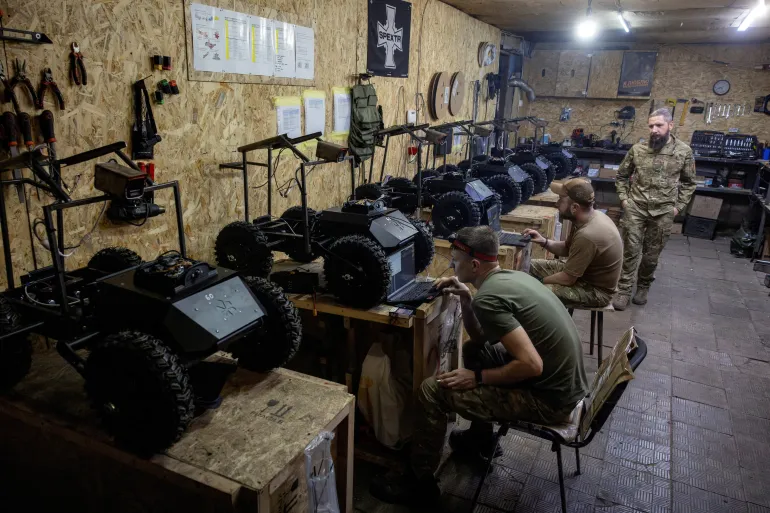
Despite this, European militaries remain wedded to conventional frameworks. In 2022, both sides fought primarily with traditional heavy armor and artillery. After struggling to match Russia’s vast industrial output during its 2023 counteroffensive, Ukraine pivoted toward low-cost innovations. Kyiv invested $1 billion into drone technology in 2023—ten times its 2022 expenditure—allowing it to destroy as many Russian armored vehicles in three months as it did during the entire first year of the war. Production skyrocketed from one million first-person view (FPV) drones in 2024 to over three million in 2025, with estimates reaching eight million this year, giving Ukraine a 16-to-10 battlefield ratio advantage over Russia. In 2025, the production was more than 3 million. Long-range drones and missiles to stanch the flow of Russian weapons and fuel to the front, and to destroy Russian refining capacity, it designed cheap.
These technological shifts have altered command structures. “The most important thing is decentralized command. Ukraine has implemented this more than anyone else,” said Konstantinos Grivas, an advanced weapons professor at the Hellenic Military Academy. He noted that Ukrainian units do not wait for top-down orders but instead harvest local intelligence and make immediate field decisions, which requires highly capable junior commanders.
Yet, Western partners often resist these lessons. Chris Pool noted a persistent institutional complacency in the United Kingdom, where some believe the British army would not fight in such a manner, rendering the Ukrainian experience irrelevant. He recalled Ukrainian developers being told to partner with traditional giants like British Aerospace or Babcock so Western officials could work with familiar intermediaries. “Faced with teams who are presenting a new technology or navigation that doesn’t rely on GPS, for example, there isn’t that curiosity to find out what’s going on and how this could be adapted to the British Army,” Pool stated.
This reluctance persists despite clear warnings in simulated exercises. During the Combined Resolve war games in August, Ukrainian drone operators successfully neutralized an entire US tank brigade by dropping armor-piercing munitions directly onto the vehicles. They achieved a similar result against a British brigade in February.
Oleksandr Danylyuk, a land warfare expert at the Royal United Services Institute (RUSI) and former adviser to Ukraine’s defense and foreign ministries, warned that Western forces have “not even started to shift all of the land forces units into drone infantry.” He argued that conventional infantry tactics are fast becoming obsolete. “If you actually don’t use drones as the main weapon of your infantry, they are obsolete. These people, you recruited and trained to fight with assault rifles, they will never see the enemy. They will be all killed with drones.”
Compounding these operational and bureaucratic hurdles is a tightening financial outlook. While the United States halted its funding rounds last year, and far-right factions in France and Germany advocate for ending support, the European Union remains Ukraine’s primary financial and military benefactor. However, Kyiv is facing severe budget constraints after overspending in the first half of this year to fund two counteroffensives that reclaimed 870 square kilometers of occupied territory. Expressing skepticism about Western adaptability, Danylyuk concluded, “I don’t see any real chance for any positive transformations in the West.”