

President Donald Trump has framed the global race for artificial intelligence supremacy in stark, existential terms. Earlier this month, he stated his intent to maintain the United States’ lead in the sector, citing the sentiment that the winner of the AI race will ultimately emerge as the global victor. This competitive stance reflects a growing realization within Washington that China, despite being the world’s second-largest economy, is making rapid, aggressive progress that could challenge American technological hegemony. With pioneering AI labs, the most advanced chips and deep-pocketed investors, trump’s comments underscore the stakes of a US-China tech competition that is increasingly being framed in existential terms. The US has an obvious edge. Leveraging that dominance, Washington is also forcing countries around the world to pick a side.
However, Beijing’s alternative approach to AI development is finding a receptive audience. While the United States promotes a strategy focused on restricted, secure innovation, Chinese leadership has championed a more open ecosystem. In July, Xi Jinping launched the World Artificial Intelligence Cooperation Organization. While over two dozen nations and the European Union have joined the American-led “Pax Silica” alliance to mitigate reliance on China, Xi has successfully recruited 29 countries, including Pakistan, Indonesia, and Russia, to his vision for open, customizable models. It’s rapidly narrowing the technology gap while championing a more open ecosystem centered on accessibility and lower cost, even as it trails the US in frontier AI models.
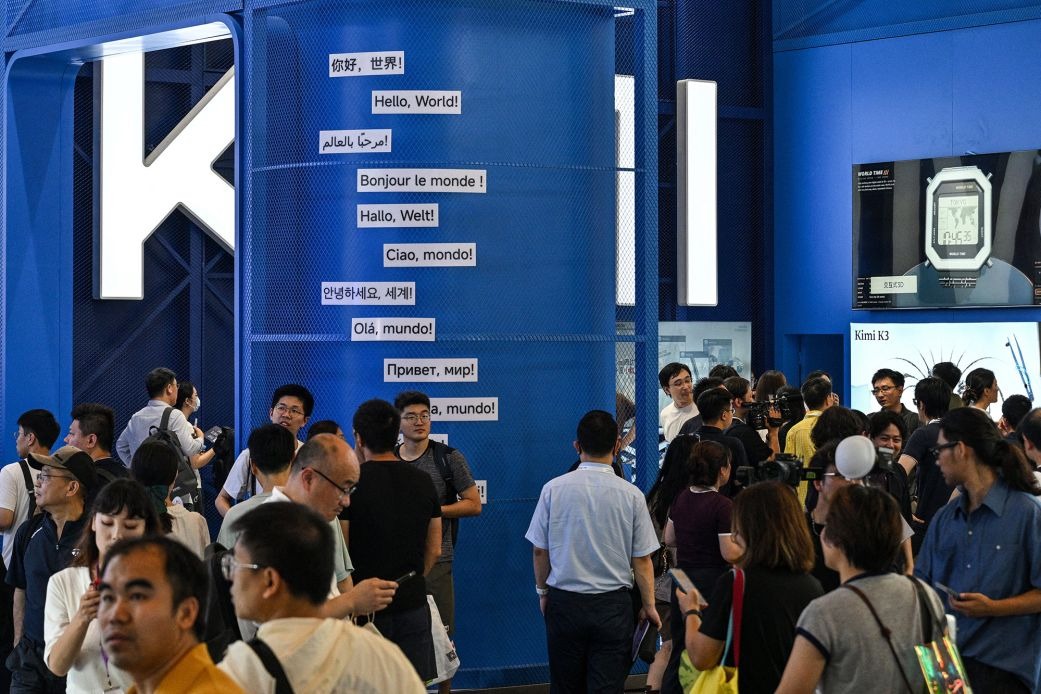
This divide in international strategy has practical implications for the Global South. According to Eric Olander, editor-in-chief of The China Global South Project, developers in these regions often find inexpensive Chinese models from firms like DeepSeek or Moonshot more practical than premium, subscription-based Western systems that require access to foreign cloud providers. Data from OpenRouter, an AI model marketplace, indicates that global usage of Chinese models surged from under 15% to more than 54% in the past year alone, with DeepSeek leading the charge.
The competition also became a central point of discussion during the recent summit between Trump and Xi. While Xi advocated for a collaborative approach, urging the two nations to “draw on each other’s strengths, not guard against each other,” he also emphasized a commitment to joint dialogue on risks and the prevention of AI misuse. Despite these diplomatic efforts, deep-seated mutual mistrust remains. Observers, such as George Chen of The Asia Group, note that Beijing views American actions, including export controls and potential AI restrictions, as a calculated effort to contain China’s technological rise. “The two sides can continue their dialogue on AI, exchange views on its risks and benefits, and jointly prevent the misuse and abuse of AI,” he added. The technology became a key focus of the Trump-Xi summit this week, amid concerns about AI’s potential threat to humanity and growing calls for a global oversight body. Proposals discussed before the two leaders’ summit – underscoring the entrenched mutual mistrust amid contrasting visions on AI, but the summit has yielded little progress on AI beyond a formal dialogue and a bilateral communication channel.
Tensions are further exacerbated by US accusations of industrial-scale theft of trade secrets. Companies like Anthropic and OpenAI have alleged that Chinese laboratories have utilized “distillation”—training their models on the outputs of American systems. Yet, the situation remains complex; many Western tech giants, including Microsoft, Meta, and Nvidia, have expressed opposition to broad restrictions on open models, highlighting a rift between private industry and federal policy. Furthermore, due to the porous nature of current export regimes, experts suggest it is difficult to quantify exactly how much reliance Chinese developers place on such methods.
For many international businesses, the decision-making process is rooted in practicality rather than geopolitical allegiance. Companies—including American firms such as Shopify, Airbnb, and DoorDash—are increasingly adopting Chinese models for their flexibility and lower costs. Chucheng Feng of Hutong Research suggests that the market will force a trade-off: organizations must decide if they prefer an expensive model that is six months ahead or a significantly cheaper alternative that is only slightly behind.
Ultimately, the definition of success in the AI race remains fluid. Olander draws a parallel to the smartphone market, where Apple captures the vast majority of profits despite holding a smaller user base. He suggests a similar outcome may emerge in AI, where the United States maintains high-value profits while China secures a massive global user base. Even if firms like DeepSeek or Moonshot struggle for profitability, the broader Chinese tech ecosystem, supported by companies like Huawei and ZTE, stands to gain significant traction by providing the underlying infrastructure and services for the next generation of digital tools. But Apple eats up 90% of the profits,” Olander said, adding that the likely outcome of the AI race may mirror Apple’s case, where the US holds the profits while China accumulates the user, fewer people use Apple products.