Photographer Federico Veronesi’s passion for African wildlife began during his childhood in Milan, Italy, where he was born in 1975. Inspired by nature books, his parents took him on his first Kenyan safari at age six. The experience left a lasting impression, and in 2002 he permanently relocated to Kenya. For the last 20 years, Veronesi has worked as a wildlife guide, leading photographers across the Maasai Mara National Reserve and other regions in Africa, while publishing three books over his career. And the three books I published Top tip: Explore ways to convey emotions to the viewer through your photographs, carefully choosing light, atmosphere, shooting angl, moved to Kenya in 2002 High point: Probably this award. My parents took me on my first safari in Kenya – I cried on the plane home, feeling I was being torn away from the savanna I’d dreamed of, somewhere I really loved, when I was six. I love to follow them in different habitats. They retain some vegetation and act as a lifeline for the elephants, who follow them from the hills in the west towards the Atlantic Ocean, even though there is no water in these rivers.
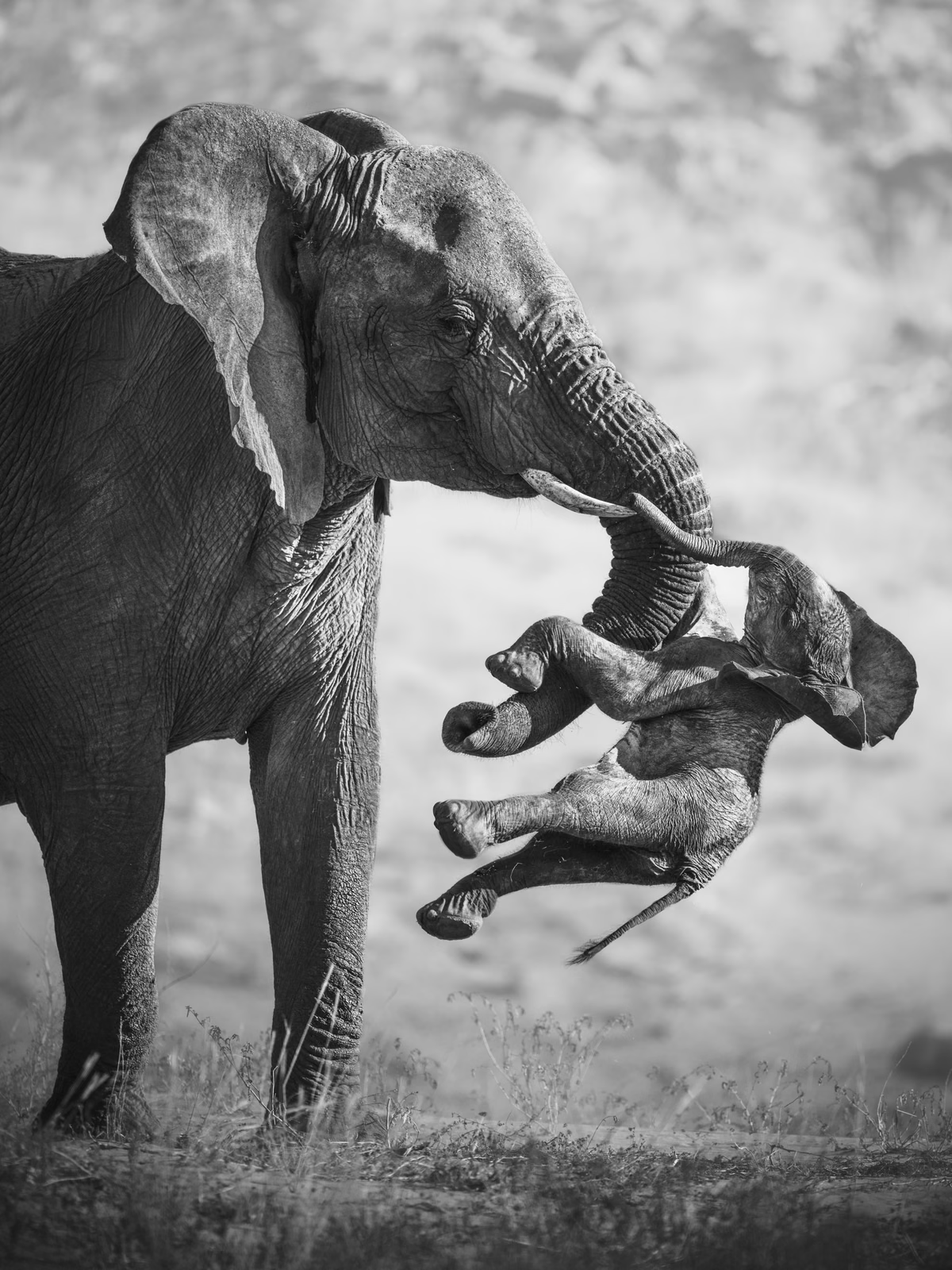
Although he frequently captures big cats, elephants remain his primary focus due to their powerful presence across diverse landscapes. While tracking a herd in a dry riverbed in Namibia last September, Veronesi and his group noticed unusual drag marks in the sand. Expecting to find a male elephant displaying dominance, they instead came across an adult female holding a dead calf lifted between her tusk and trunk. Especially big cats, but elephants are still my favourite subject, i’ve spent time photographing other animals. Dominating the landscape and making it come alive, they have this extraordinary presence. We had been following a group of elephants walking along a dry riverbed as night fell.
Veronesi photographed the moment another elephant approached, causing the female to raise the body slightly. The resulting image, which won the adult grand title at the Wildlife Photographer of the Year competition, offers a complex and emotionally open depiction of animal grief. The herd was followed for several hours as the female persistently carried the calf, pausing only to feed before heading into unreachable rocky terrain.
It was later revealed that 17 out of 19 calves born in that specific region over the past four years have died, though researchers have not yet determined the exact cause of the mortality rate. Furthermore, field researchers identified that the female in the photo was not the calf’s mother. Having suffered a miscarriage two years earlier, she had established a pattern of retrieving stillborn calves born to other females in the area.
Veronesi chose a monochrome presentation for the award-winning photograph, a medium he prefers for highlighting texture and eliminating visual distractions to emphasize raw emotion. While he occasionally uses color—such as contrasting red-earth elephants against greenery in Tsavo, Kenya, or white-clay elephants in Etosha, Namibia—black-and-white photography allows him to better convey the psychological depth and complex internal lives of animals. And they can also live in extremely arid areas, such as the deserts of Namibia, where this photograph was taken, they are extremely adaptable – in Kenya they’re associated with the savanna and acacia woodland.
He advises aspiring photographers to carefully consider lighting, atmosphere, angles, framing, and backgrounds to evoke deeper feelings in their viewers. The winning photograph is currently on display at the Natural History Museum in London as part of the Wildlife Photographer of the Year exhibition, which runs until July 11, 2027.