

Why Texting Changed So Fast
Texting transformed almost overnight, but the seeds were planted years ago. Smartphones became extensions of our personalities, social media changed our attention spans, and messaging apps slowly replaced face-to-face conversations. In 2026, texting has evolved into something much more than basic communication. It’s an emotional shorthand. It’s all about branding. You’re projecting your mood. You can think of texting like digital fashion – every choice you make tells someone something about you.
The rise of AI-powered messaging tools is a major reason for this shift. People use smart keyboards, AI rewrites, predictive replies, and tone adjusters every day without even thinking about it. According to 2026 reports, younger users increasingly use AI to rewrite awkward messages, soften tones, and improve clarity. What’s the result? There’s a smoother feel to conversations but they’re also strangely polished. It’s sometimes too polished. People now look for “human imperfections” in messages because perfectly structured texts sound robotic.
Meanwhile, texting completely replaced phone calls as the dominant communication method. For most people in the United States and United Kingdom, messaging has replaced many voice calls. Unless it’s urgent or emotionally important, calls are considered interruptions now. It can feel like someone knocking on your door at midnight when you get a random call without warning.
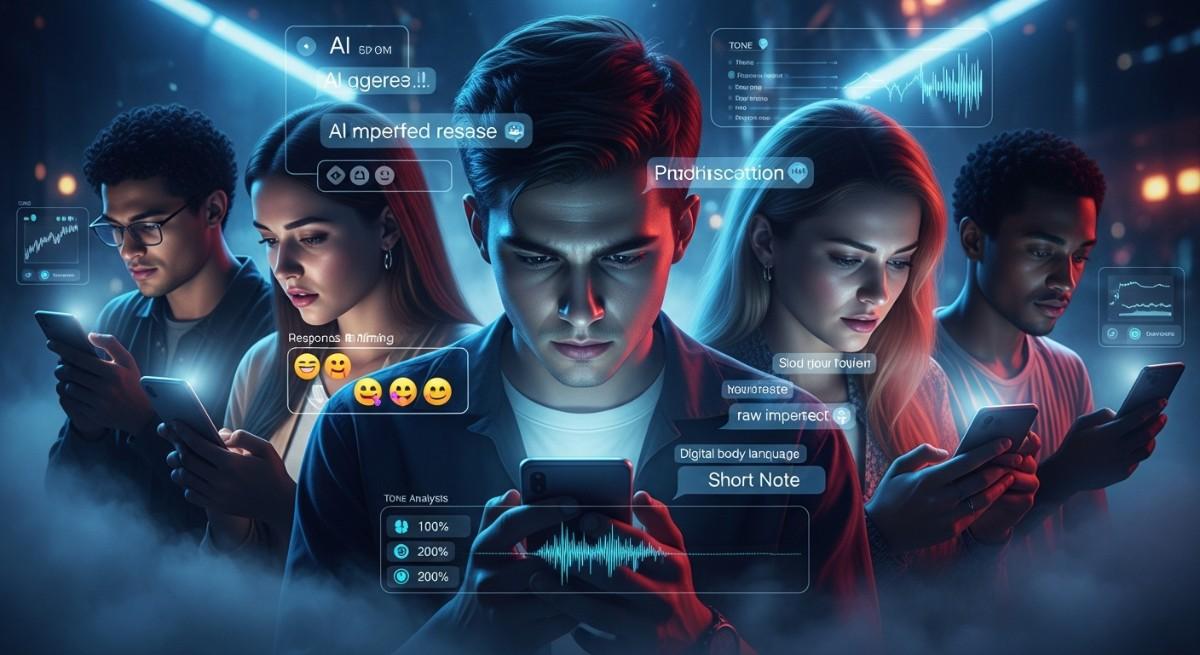
Because people are always reachable, texting became emotionally loaded. Smartphones erased the old line between “available” and “offline.” This created new anxieties, new expectations, and eventually new rules. People in 2026 don’t just read texts anymore, they analyze tone, timing, punctuation, emoji choices, and even typing patterns like detectives.
Texting in 2026 feels completely different from what it looked like in 2015. Simple “hey” messages and random emoji spam are fading fast. Nowadays, texting is a weird mix of speed, psychology, AI assistance, voice notes, social signals, and digital body language. You can sound cold with one misplaced punctuation mark. It can trigger anxiety if you don’t respond right away. Even the way you use lowercase letters says something about you. Nowadays, texting is more than just communication – it’s reputation management.
According to recent messaging reports, texting still dominates global communication. In 2026, studies showed that messaging is the most popular communication method across multiple generations, outpacing voice calls in both personal and professional settings. Texting with AI, RCS messaging upgrades, voice notes, and “micro-messaging” are changing everything.
The Death of Long Paragraph Texts
Texting long paragraphs is dying, especially among younger generations. Instead of long, structured blocks of text, modern texting in 2026 favors fragmentation, speed, and rhythm. Communication analysts call this trend “micro-messaging,” where conversations happen through several tiny texts instead of one big one.
Here’s an alternative:
Hey, I was thinking we should grab coffee this weekend.
Now people text:
- Hey, I’m here.
- How’s the coffee?”
- It’s this weekend
- “Are you free?”
Even though it looks chaotic, there’s a reason for it. You can mimic the flow of real-life conversations with micro-messaging. This creates pauses, reactions, and momentum. Sending one huge paragraph can feel emotional, like dropping a suitcase onto someone’s lap. It feels lighter and more conversational to send smaller messages.
There’s also a psychological reason why short texts are so popular now. It’s hard to keep up with digital communication. With work chats, social apps, notifications, and group messages, our attention spans are stretched thin. There’s too much focus required for long messages. Modern life requires less mental energy, so short bursts of communication are better.
It’s ironic, but shorter texts usually get more emotional responses. Tiny messages feel more authentic and spontaneous. It’s easy to sound artificial or rehearsed when you’ve carefully crafted a paragraph. Many users now associate overly formal texting with AI. Users on Reddit became suspicious of messages that sounded “too perfect” throughout 2026.
That doesn’t mean thoughtful communication is gone. There was just a change in shape. Compared to formal essays, modern texting is more like jazz improvisation. It’s fast, reactive, emotional, and intentionally flawed.
Voice Notes Became the New Phone Call
The explosion of voice notes is one of the biggest texting shifts in 2026. People still avoid full phone calls, but they’re relying more on audio clips to communicate emotion. You can think of voice notes as a middle ground between texting and calling. Without the pressure of live conversation, they provide tone and authenticity.
Modern voice notes are usually short–often between 5 and 15 seconds–instead of the long, rambling messages people used to hate. A tiny audio clip can convey more emotion than dozens of text messages.
What’s the deal with voice notes? The emotional context gets stripped away when you text. Sarcasm can be misunderstood. The jokes don’t work. You can’t hear the tone anymore. It’s easy to fix with a short voice message. In someone’s voice, you can hear hesitation, excitement, nervousness, or warmth. There’s something more human about it.
There are still unwritten rules. In line at the grocery store, nobody wants a five-minute audio essay. Because they demand uninterrupted attention, long voice notes are seen as selfish. Clips that are concise and focused are more popular. Your voice note looks like a podcast episode, you’re probably breaking the new social code.
Dating dynamics have also changed dramatically thanks to voice notes. The sound of someone’s voice creates intimacy much faster than plain text. People use voice messages to check their vibe before meeting in person. Voice notes reveal confidence, humor, energy, and emotional intelligence like no other form of communication.
The interesting thing about voice notes is that they represent a return to humanity in an increasingly AI-driven world. Voice clips still sound raw and unmistakably human, even as text messages get more polished with automation.
The Hidden Meaning Behind Punctuation
There was a time when punctuation was about grammar. Punctuation is about emotion in 2026.
A single period at the end of a text can make all the difference. It often feels colder or more passive-aggressive to write “okay.” Younger generations interpret punctuation emotionally instead of grammatically.
It happened because texting evolved into conversational speech. Now people type like they talk. In casual texting, grammar rules are dropped in favor of emotional tone. Lowercase letters are friendly. There’s nothing soft about a lack of punctuation. It can feel aggressive or intense when you use extra punctuation.
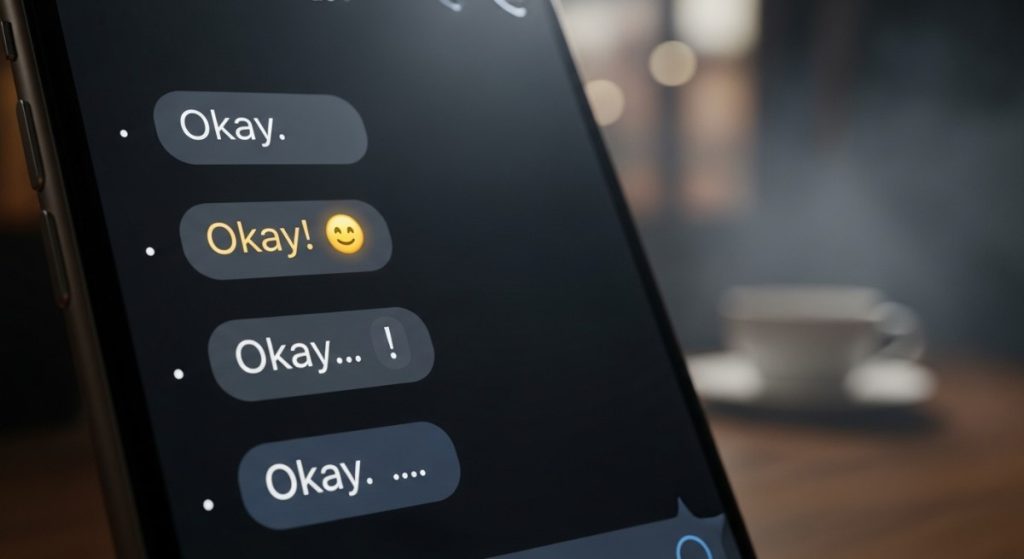
Consider these examples:
| Text | Perceived Tone |
|---|---|
| Okay. | Casual |
| Okay! | Friendly |
| Okay… | Uncertain |
| Okay. | Cold or annoyed |
It sounds ridiculous until you realize millions of people do it subconsciously.
It’s especially popular among Gen Z because it projects relaxed energy. It can feel emotionally distant or overly corporate when you use perfect grammar. This trend also overlaps with AI anxiety. Many users intentionally text imperfectly to sound more authentic because AI tools produce polished, grammatically correct text.
Emoji culture has also changed a lot. People now use emojis strategically instead of flooding texts with them. An emoji can completely change the tone. It can feel outdated or performative to use too many emojis. Subtlety is the modern rule.
In 2026, texting will be more like body language than written language. Whether you intend it or not, every little detail communicates emotion.
AI Texting Assistants Are Everywhere
Texting has become everyone’s co-pilot thanks to AI. AI-assisted messaging is now deeply integrated into phones and apps, from grammar correction to emotional tone adjustment. Most people don’t even think about it anymore. It’s just a matter of tapping suggested replies, rewriting awkward sentences, or asking AI to make their texts sound less aggressive.
Millennials are increasingly using AI to edit or rewrite messages instead of starting conversations. It’s important because people still want authenticity. Chatbots don’t make people feel like they’re talking directly to someone.
AI’s influence is becoming more obvious. There are a lot of people complaining about “AI vibes” in conversations now. Messages that sound overly supportive, perfectly structured, or emotionally balanced can make you suspicious. Throughout 2026, Reddit discussions reveal AI-generated communication styles are becoming more popular.
As a result, there was a strange social reversal. Now mistakes are valuable. It’s easier to prove authenticity when there are typos, slang, chaotic formatting, and spontaneous wording. Having imperfections became social proof that there’s a real person behind the screen.
Professional texting has also been transformed by AI. With AI tools, employees can draft replies instantly, so workplace communication is faster and more polished. However, there’s a danger of emotional flattening. A sterile conversation starts when everyone uses similar AI-generated tones.
In 2026, the smartest texters will use AI like seasoning instead of the whole dish. They let AI improve clarity while keeping their own voice. We’re not trying to sound perfect. You want to sound human.
Read Receipts and Reply Anxiety
Texting comes with invisible psychological pressure. People constantly monitor response behavior with read receipts, typing indicators, online statuses, and message timestamps. It triggered something called “reply anxiety.”
Read receipts significantly increase stress around replying, according to recent texting statistics. If someone sees you read their message, silence suddenly feels powerful. Emotional tension can even come from a delayed response.
People now disable read receipts entirely because of that. Some people intentionally take their time to reply to protect their mental space. Fast replies are appreciated, but not expected in 2026. Everyone feels overwhelmed by constant connectivity, so digital boundaries became socially acceptable.
It’s interesting how texting etiquette varies depending on the relationship type. In romantic conversations, quick responses are expected, moderate delays are normal, and work chats depend a lot on company culture. Communication became about timing.
As well, people are learning that being available doesn’t mean you have to do anything. If someone sees your message, they don’t owe you a response right away. It’s part of a broader cultural shift toward healthier digital habits.
There used to be a promise of convenience with texting. You feel like you’re carrying around hundreds of tiny social obligations all day.
The New Dating Rules of Texting
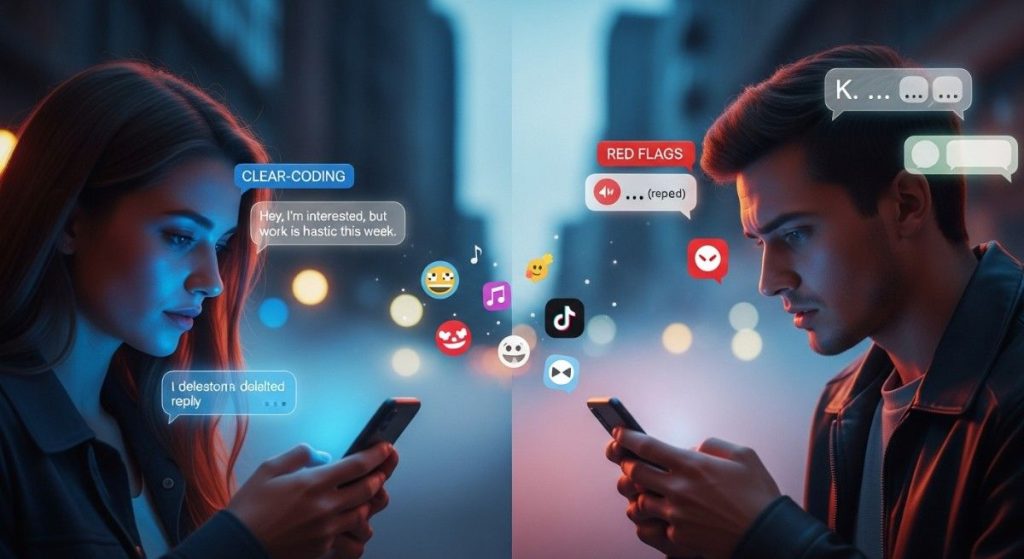
The way we text in 2026 shapes our dating behavior. Even before they meet, they look at each other’s response speed, emoji use, punctuation style, humor, and emotional openness. Compatibility testing started with texting.
One of the biggest trends in modern dating is “clear-coding.” It encourages emotional honesty and direct communication instead of vague mixed signals. People value clarity more than pretending not to care.
Rather than disappearing for days, many daters now just say:
Hey, I’m interested, but this week is crazy.”
I used to feel vulnerable with that level of transparency. I feel refreshed now.
Meanwhile, texting red flags got more sophisticated. Patterns are easy to spot:
- It might feel like AI generated text if it’s too formal
- Low interest based on constant one-word replies
- It can feel emotional when you use too much punctuation
- Uncontextualized delayed replies create distrust
- Emojis overused may seem performative
Also, dating conversations got more multimedia. Memes, voice notes, TikTok links, and reaction images all have meaning now. The best way to show someone you care is to send them a meme.
Isn’t that the funniest part? The way people text is more important than what they say in modern dating. The way you communicate became a form of chemistry.
Work Texting Etiquette in 2026
Communication in the workplace has changed dramatically since younger generations started working.
There’s been a big change in corporate texting.
Email chains have been replaced by messaging platforms in many workplaces, and employees expect quick, flexible communication.
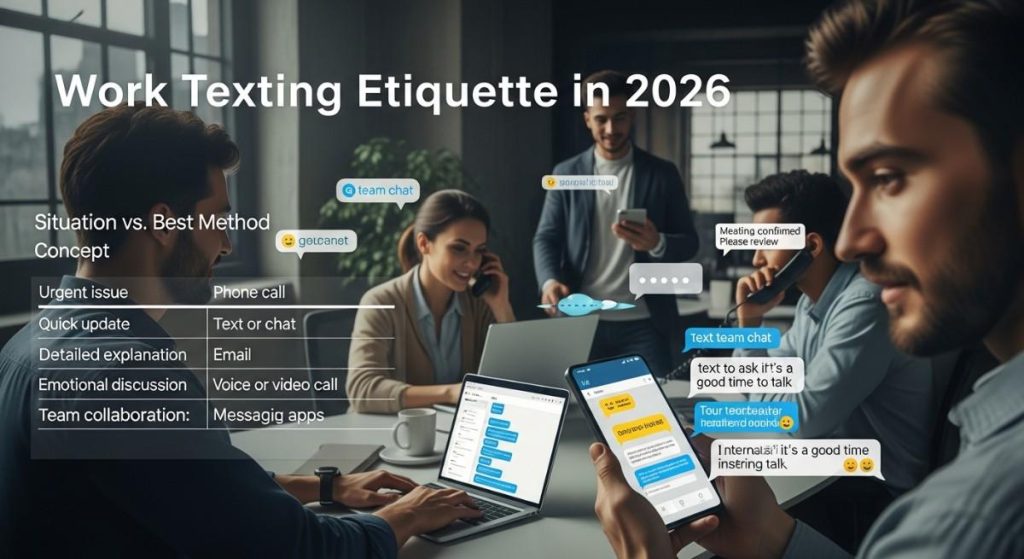
Texting at work comes with its own set of rules. It doesn’t mean “careless” to be casual.
In 2026, the best professional texters will understand context switching. Their communication is relaxed when it’s appropriate and structured when it’s not. When you’re talking to clients, lowercase messages and emojis might look unprofessional.
There’s also a growing expectation of asynchronous communication. No longer do workers assume every message needs immediate attention. To reduce burnout, many companies encourage healthier response boundaries.
Here’s a quick breakdown of modern workplace communication etiquette:
| Situation | Best Method |
|---|---|
| Urgent issue | Phone call |
| Quick update | Text or chat |
| Detailed explanation | |
| Emotional discussion | Voice or video call |
| Team collaboration | Messaging apps |
Calling people is also becoming more selective. Phone calls without warning are getting more intrusive, especially for younger workers. First, many employees send a quick text to see if there’s a good time to talk.
In 2026, work communication will be more about efficiency, emotional intelligence, and clarity.
Cross-Generational Texting Conflicts
There’s a different way to text for every generation, and those differences can cause misunderstandings. Lowercase letters, short fragmented texts, memes, and voice notes are Gen Z’s favorite. There’s a balance between casual texting and clear structure with millennials. Depending on who you’re talking to, Gen X may prefer direct texts or actual phone calls.
There’s an interesting generational clash around texting habits in 2026, according to Reddit discussions. Older people think rapid, fragmented messaging is chaotic, while younger people think formal grammar is cold.
There’s even a difference in response expectations between generations. It’s common for younger texters to treat conversations like streams that pause and resume naturally. A more complete, structured exchange might be expected from older generations.
In fact, Gen Xers often describe themselves as communication “adapters.” They grew up with phone calls but learned texting later.
Here’s the biggest lesson: texting is cultural. There are different dialects of digital communication among different groups. When people assume their own texting style is universal, problems happen.
In 2026, smart communicators adjust their texting style depending on who they’re talking to. Social skills became valuable because of that flexibility.
Conclusion
Texting in 2026 isn’t just about sending words. It’s a complex social language shaped by AI, psychology, generational culture, digital anxiety, and emotional signals. There are layers of meaning in tiny details like punctuation, response timing, voice notes, capitalization, and emojis.
Millions of people follow the new rules of texting instinctively every day, even though they’re not officially written anywhere. There was a shortening of messages. It became more personal with voice notes. Artificial intelligence became both helpful and suspicious. Reading receipts made me feel pressured. The value of authenticity has surpassed perfection.
Even inside tiny glowing chat bubbles, modern texting reflects a deeper truth about human communication: people still crave connection, warmth, honesty, and emotional understanding. The format changed, but the emotional needs stayed the same.
Those who communicate best in 2026 aren’t necessarily the fastest texters or the most grammatically correct. In a digital-first world, they understand tone, empathy, timing, and authenticity.
FAQs
1. Why do young people avoid punctuation in their texts?
Punctuation is more emotional than grammatically important to younger texters. There’s something about lowercase text without punctuation that makes it seem softer and more casual.
2. Are voice notes replacing phone calls?
Most of the time, yes. They’re great for friendships and dating, since they provide emotional tone without requiring a full conversation.
3. Why do AI-generated texts feel strange?
AI-generated messages can sound too polished, structured, or emotionally balanced. There’s a subconscious association between human communication and small imperfections.
4. Is it rude not to reply immediately in 2026?
No, not always. Due to healthier digital boundaries and less constant pressure, modern texting culture increasingly accepts delayed responses.
5. What is micro-messaging?
In micro-messaging, you send multiple short texts instead of one long one. You’ll feel more casual and interactive because it mimics natural conversation flow.