


What Is Artificial Intelligence?
Computer systems designed to perform tasks that normally require human intelligence are called artificial intelligence, or AI. The tasks include learning, reasoning, making decisions, understanding language, recognizing images, and solving problems. Consider how humans learn from experience. Instead of emotions and intuition, AI systems use massive datasets, mathematical models, and computing power.
Artificial intelligence is about creating machines that can recognize patterns and make predictions. Asking an AI assistant a question or using an app that recommends movies based on your interests is interacting with AI. Your behavior is quietly analyzed, compared with millions of other patterns, and a personalized response is generated. In a matter of seconds, sometimes even milliseconds, that process happens.
There are three things that have fueled the rise of AI: powerful computers, tons of data, and better algorithms. The early computers couldn’t handle advanced AI systems because they didn’t have the processing power. Today, cloud computing and specialized AI chips have changed everything. Companies are investing billions in AI infrastructure because demand for intelligent automation is skyrocketing. Global enterprise AI spending could reach $644 billion as adoption accelerates across industries.
It’s common for people to picture AI as robots walking around like humans, but most AI lives in software systems. Artificial intelligence is used in search engines, social media feeds, fraud detection tools, medical diagnostic software, and navigation apps. AI is like a digital brain layered over the internet and modern computers.
The History and Evolution of Artificial Intelligence
Intelligent machines have been around for a long time. Mathematicians and philosophers have imagined artificial minds for centuries. Scientists started asking a big question about AI in the 1950s: can machines think? One of the most transformative technologies ever invented was born out of that single question.
AI systems in the early days were extremely limited. Those rules were manually programmed by humans. These systems could play chess or solve equations, but they weren’t flexible. The machine just fails if something unexpected happens. Researchers quickly realized intelligence isn’t just about following instructions. Adaptation, learning, and pattern recognition are all part of human thinking.
Rather than relying solely on hardcoded instructions, computers learned from data with machine learning. Everything changed when this shift happened. Instead of telling a machine every possible answer, developers could train it with examples. AI models got better at detecting patterns on their own over time. In turn, this led to improvements in speech recognition, computer vision, and recommendation systems.
Public interest in artificial intelligence surged after generative AI tools came out. Artificial intelligence chatbots, image generators, coding assistants, and autonomous agents have become mainstream almost overnight. It took generative AI longer to reach global scale than either the internet or personal computers. From a niche academic field, the technology has influenced nearly every industry.
Accessibility is one of the reasons AI exploded so fast. There are now millions of ordinary people who can interact directly with AI systems without any technical knowledge. Students use AI for research, businesses automate customer service, and marketers create content quickly. Artificial intelligence has effectively moved from laboratories to our everyday lives.
Types of Artificial Intelligence
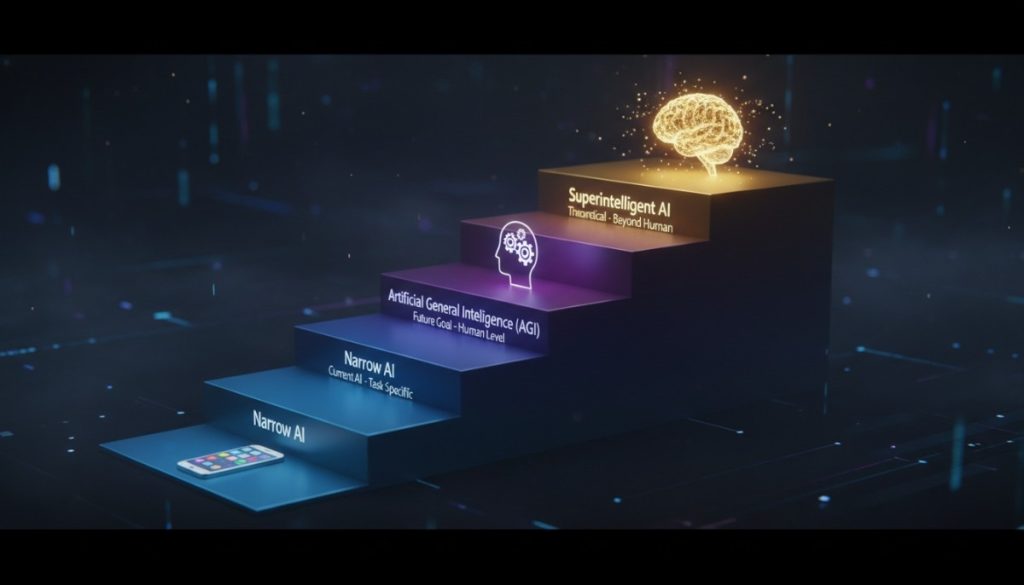
The level of intelligence and capability of artificial intelligence are generally divided into different categories. Having an understanding of these categories helps explain where current technology stands and where it’s going.
Narrow AI
A lot of AI systems today are narrow AI, also known as weak AI. These systems are designed to do specific tasks well. AI image tools can create artwork, voice assistants can understand spoken commands, and recommendation systems can predict your preferences. But each system is specialized in a narrow area and can’t think beyond that.
Modern technology is dominated by narrow AI because it’s practical and commercially viable. Businesses use it for automation, analytics, customer service, and operational efficiency. AI-powered recommendation systems on streaming platforms are great examples of narrow AI. Based on your behavior patterns, they recommend personalized content to you.
General AI
The term ‘Artificial General Intelligence’ (AGI) refers to machines that can understand and perform anything a human can. AGI would be able to adapt to different fields without having to retrain. Although many technology companies are actively researching advanced AI reasoning systems, this is mostly theoretical.
Researchers love AGI because it could revolutionize science, medicine, engineering, and education. You can have an AI that solves complex diseases, invents new technologies, and understands emotional communication at the same time. According to some experts, AGI may emerge within decades, but others argue it’s still a long way off because humans think so complexly.
Superintelligent AI
Finally, superintelligent AI is often discussed, a form of intelligence that surpasses human capability in almost every aspect. We’re both excited and scared about this concept. Those who support superintelligent AI think it can solve all humanity’s problems, including climate change and disease. The critics are worried about losing control and having to deal with ethical issues.
The debate over superintelligence is like the debate over fire in ancient times. Civilization was transformed by fire, but it was also dangerous. AI represents a similar dual-edged technological force that can both advance and disrupt.
How Artificial Intelligence Works
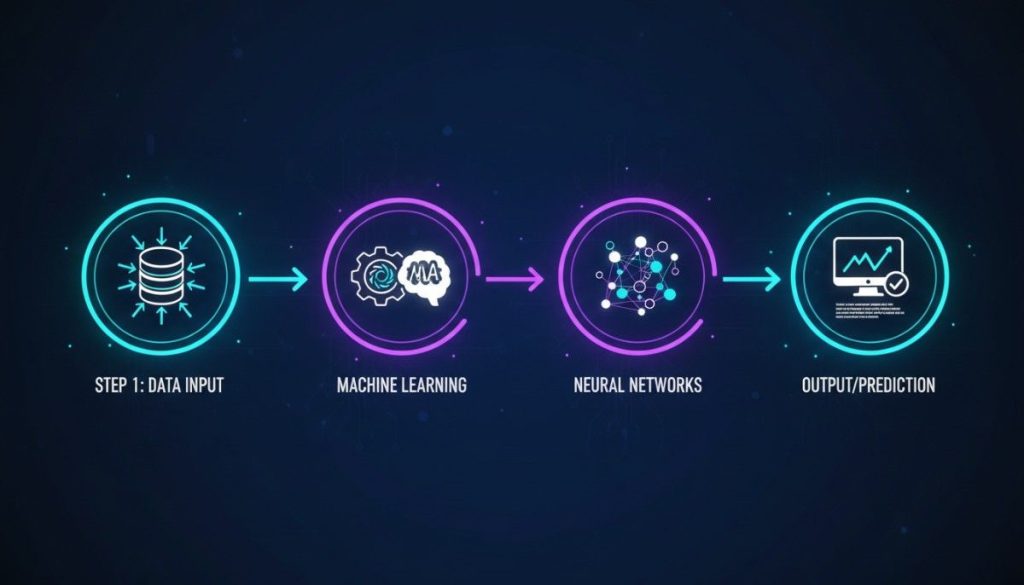
In artificial intelligence, huge amounts of data are processed and patterns are found within them. AI systems get better at predicting outcomes and improving performance when they get more data. Basically, AI learns from repeated exposure and feedback.
Machine learning algorithms
The backbone of modern AI is machine learning. Developers train algorithms with datasets instead of programming explicit instructions. Algorithms like these identify patterns and relationships independently. You can train an AI system to recognize cats in new images by using thousands of cat pictures.
There are three types of machine learning: supervised, unsupervised, and reinforcement learning. Unsupervised learning identifies hidden structures without predefined labels, while supervised learning uses labeled data. Like training a pet, reinforcement learning allows systems to learn through rewards and penalties.
Neural networks and Deep Learning
The human brain inspired neural networks. Interconnected layers process information and make decisions. In deep learning, huge neural networks handle complex tasks like generating images and understanding language.
Deep learning systems are mostly responsible for modern AI breakthroughs. Models can analyze speech, generate text that looks like human text, and even create realistic videos. The AI-powered language models process billions of words during training, so they can produce natural-sounding responses.
Natural language processing
NLP, or Natural Language Processing, lets machines understand and create human language. Artificial intelligence chatbots, translation tools, virtual assistants, and search engines use NLP. The technology bridges the gap between humans and machines.
NLP algorithms analyze grammar, context, and intent when you ask an AI assistant a question. You might think it’s magic, but it’s actually based on probability calculations and statistical language modeling.
Real-World AI Applications
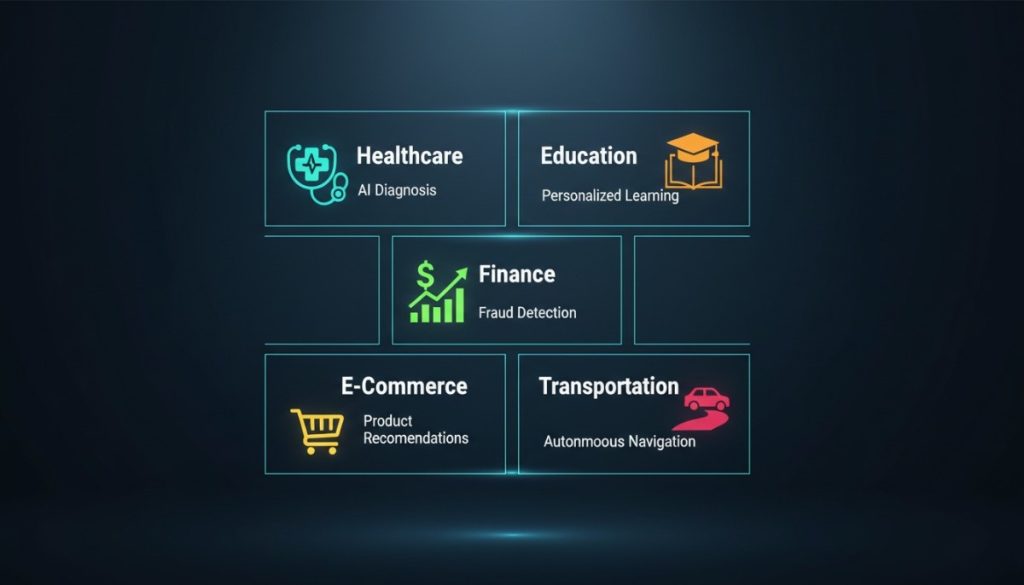
The use of artificial intelligence has become deeply ingrained in modern society. Many people don’t even realize how much it affects industries. The AI revolution isn’t a science fiction thing anymore; it’s an active infrastructure that powers businesses and services all over the world.
| Industry | AI Application | Impact |
|---|---|---|
| Healthcare | Disease diagnosis | Faster medical decisions |
| Education | Personalized learning | Improved student engagement |
| Finance | Fraud detection | Better security |
| E-commerce | Product recommendations | Higher sales conversions |
| Transportation | Autonomous navigation | Increased efficiency |
AI in Healthcare
One of the biggest AI revolutions is happening in healthcare. Artificial intelligence can help doctors diagnose diseases, analyze medical images, and predict diseases. Using AI, some cancers can be detected earlier than traditional methods, potentially saving lives.
Also, hospitals use AI for scheduling appointments and managing patients. As a result, healthcare workers have less work to do and are more efficient. Researchers are exploring AI-driven drug discovery, where algorithms identify potential treatments faster than traditional lab methods.
AI in Education
Artificial intelligence has made education more personal. Smart tutoring systems adapt lessons based on student performance, so learners can progress at their own pace. It’s easy to identify weaknesses and make recommendations based on AI.
AI assistants are increasingly used for research, language learning, and writing help. Automated tools reduce teachers’ repetitive grading and administrative work, too. Educators and learners benefit from AI’s digital co-piloting.
AI in finance.
The banking industry relies heavily on AI to detect fraud and analyze risk. Artificial intelligence monitors transactions in real time and flags suspicious behavior. It improves security while reducing losses.
Artificial intelligence is also used by algorithmic trading systems to analyze market patterns. Predictive analytics powered by machine learning is becoming increasingly important to financial firms.
AI in E-Commerce
AI is used extensively by online shopping platforms to personalize customer experiences. A recommendation engine suggests products based on your browsing history, purchases, and demographics. Customer support is also provided by AI chatbots.
AI adoption among retailers continues to grow rapidly, even though many businesses are still learning how to scale these systems. In the modern e-commerce world, AI-driven marketing, inventory management, and dynamic pricing are essentials.
The Impact of AI on Jobs and Society
With artificial intelligence, the global workforce is reshaping at an unprecedented rate. There are a lot of jobs being automated, but there are also a lot of new career categories developing. I feel like we’re going through another Industrial Revolution, where machines changed agriculture and manufacturing.
It’s possible to increase productivity dramatically with automation. Artificial intelligence can do repetitive tasks faster and more accurately than humans in a lot of situations. Time is saved, costs are reduced, and efficiency is improved. It also raises concerns about job displacement.
Interesting enough, AI isn’t just destroying jobs; it’s creating new ones. A lot of people are getting into AI engineering, data science, cybersecurity, prompt engineering, and AI ethics. Intelligent systems need specialists who know how to build, manage, and regulate them.
There’s also a big difference between regions when it comes to workplace AI adoption. India, for example, has a remarkably high level of AI usage among employees, far above global averages. AI-driven productivity is catching on faster in some countries than others.
AI is evolving along with society. Intelligent systems are increasingly used for communication, entertainment, navigation, and information discovery. It’s almost like an invisible digital companion woven into modern culture.
Risks and Challenges of Artificial Intelligence
Even though AI has incredible potential, it also comes with serious risks. With technology this powerful, there are a lot of questions about privacy, security, and accountability.
Data privacy is one of the biggest concerns. In order to train AI systems, massive datasets are needed, which often include personal info. When this data is mishandled, sensitive details can be exposed or surveillance concerns are raised. Regulators and governments around the world are debating how to balance innovation with privacy.
Another growing challenge is cyber security. Reports show cybercriminals are using AI tools more and more to automate attacks and exploit vulnerabilities. It’s getting harder and harder to detect phishing scams, fake voices, and deepfake videos generated by AI.
There’s still a big problem with bias in AI. Artificial intelligence learns from human-generated data, so it can inherit prejudices. It’s possible to get biased results if biased data enters the system. There’s potential discrimination in hiring, lending, policing, and healthcare.
There’s also a growing concern about misinformation. Online, AI-generated content spreads fast, making it hard to tell truth from fiction. Politics and digital deception are particularly fearful because of deepfake technology.
Even experts who develop AI systems acknowledge the need for better governance. Artificial intelligence is advancing faster than many laws and regulations can keep up. We’re building a powerful engine and learning how to control it responsibly at the same time.
The future of artificial intelligence
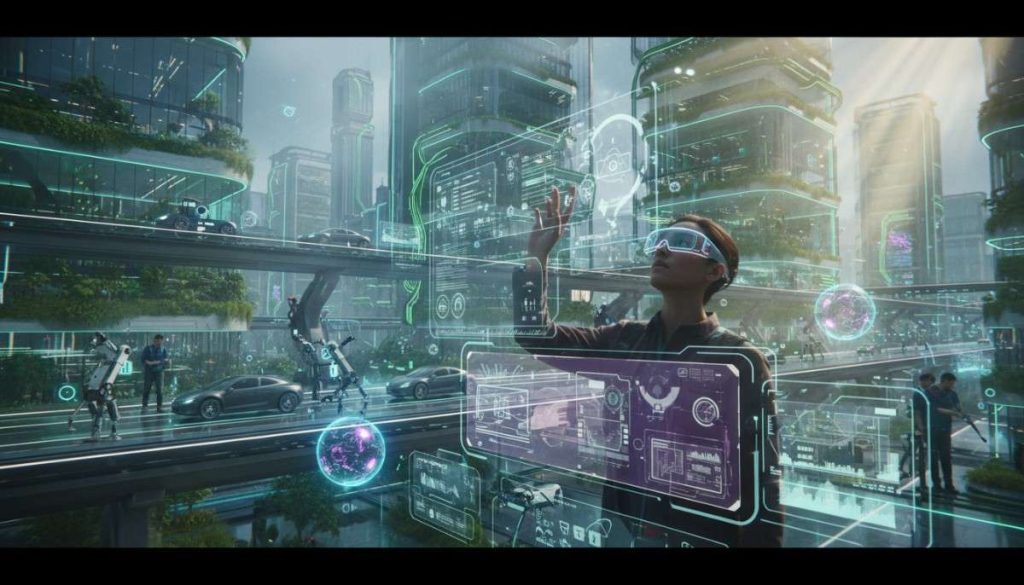
There’s a lot to look forward to in the future of AI. AI companies are racing to build increasingly autonomous systems capable of reasoning, planning, and executing themselves.
Artificial intelligence agents are one emerging trend. Multi-step tasks can be done without constant human supervision. AI agents could eventually manage schedules, conduct research, book travel, and even coordinate business operations.
Technology companies are investing heavily in AI infrastructure and advanced reasoning models. It’s one of the biggest technological developments in human history, according to industry leaders. AI companies are competing like crazy, so innovation is accelerating.
The next decade will be defined by human-AI collaboration. AI could boost productivity rather than replace humans entirely. People like writers, programmers, doctors, engineers, and designers can use AI to be more creative and efficient.
The relationship between humans and AI is like that between pilots and autopilots. As humans keep oversight and judgment, the machine assists, optimizes, and handles complexity. If managed responsibly, that partnership could unlock extraordinary progress.
However, society must remain cautious. We need ethical guidelines, transparent governance, and responsible development to make sure AI benefits humanity. Humans and intelligent machines will have a different relationship in the future because of the choices we make today.
Conclusion
Artificial intelligence has evolved from an ambitious scientific experiment to one of the biggest technologies ever. Search engines, healthcare systems, financial tools, educational platforms, and modern business operations are powered by it. Artificial intelligence is changing how people work, communicate, shop, learn, and solve problems.
Innovation and economic growth are huge opportunities with this technology. We can improve productivity, speed up scientific discovery, and solve global problems with it. Meanwhile, AI introduces ethical dilemmas about privacy, bias, security, and disruption of the workforce.
Humanity is at a turning point. AI is developing at an incredible pace, and how society guides it will have a huge impact on its long-term impact. Machines aren’t the only thing getting smarter in artificial intelligence. Together with those machines, humans decide what kind of world they want to build.
FAQs
1. What is artificial intelligence in simple words?
A computer or machine can perform tasks that normally require human intelligence, like learning, problem-solving, and understanding language, through artificial intelligence.
2. What are the main AI types?
There are three types of AI: narrow AI, artificial general intelligence (AGI), and superintelligent AI. There are a lot of narrow AI systems out there now.
3. How is AI used in everyday life?
It’s in search engines, recommendation systems, virtual assistants, social media feeds, online shopping, navigation apps, and customer service chatbots.
4. Can AI replace human jobs?
AI can automate certain tasks and replace some repetitive jobs, but it also creates new jobs in tech, data science, cybersecurity, and AI management.
5. Is artificial intelligence dangerous?
It’s not that AI is inherently dangerous, but misuse, a lack of regulation, bias, privacy issues, and malicious apps can cause serious problems.