


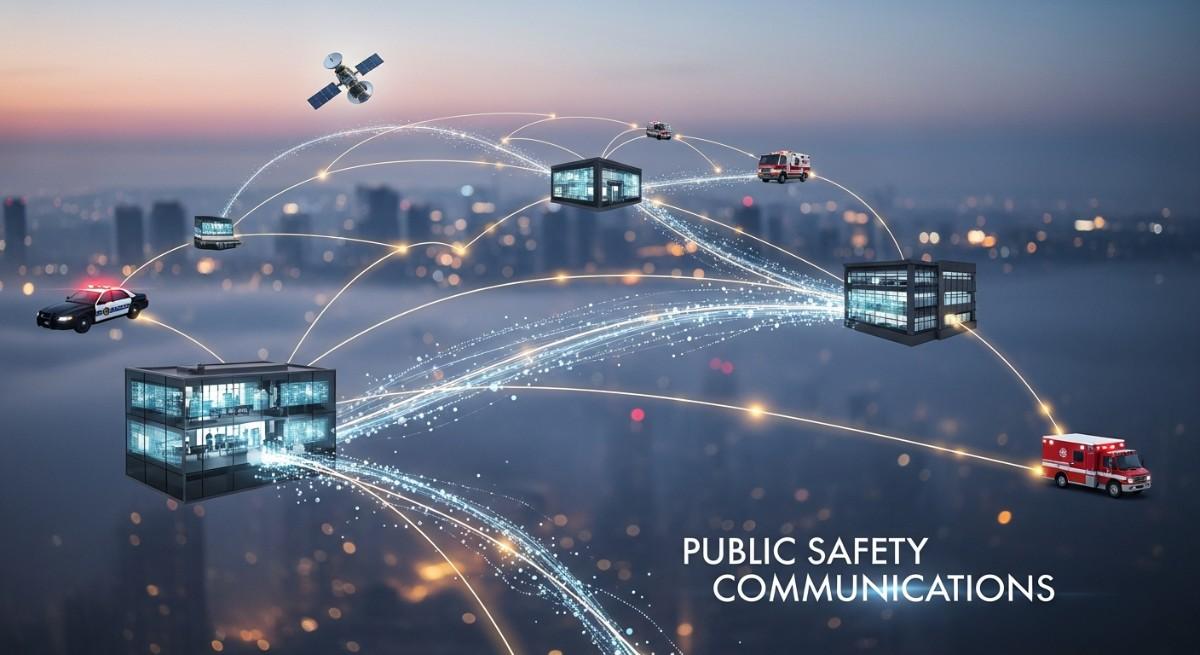
Understanding Public Safety Communications
What Public Safety Communications Means
Public safety communications keep emergency services connected during disasters, accidents, crimes, and medical emergencies. Just imagine how bad it would be without reliable emergency radios, dispatch systems, and emergency alerts. The chaos would spread faster than help could arrive. Technology, networks, protocols, and systems that allow police officers, firefighters, paramedics, and disaster response teams to communicate instantly and accurately are called public safety communications.
They include emergency dispatch centers, radio networks, 911 services, mobile broadband, satellite systems, and increasingly, cloud-based platforms powered by artificial intelligence. The main thing they do is make sure the right information gets to the right people at the right time. Even a delay of seconds can mean the difference between life and death in an emergency.
Recent years have seen an increase in the complexity of emergencies, so these systems are more important than ever. Coordination between multiple agencies is crucial during natural disasters, cyberattacks, and mass casualty incidents. 78% of first responders said that resilient communication networks helped them communicate better during emergencies, according to the Verizon Frontline Public Safety Communications Survey 2025.
Voice calls over radios aren’t enough for modern public safety communication. There’s now real-time video sharing, GPS tracking, drone feeds, multimedia messaging, AI-assisted dispatching, and cloud integration. It’s changing from isolated communication networks to connected digital ecosystems that can handle emergencies quickly and effectively.
WHY RESOLVABLE COMMUNICATION SA
Communication is the nervous system of emergency response when disaster strikes. Emergency personnel don’t know what to do without it. Think about a firefighter who enters a collapsing building without updates from command staff, or a paramedic who doesn’t get patient information. When there’s a communication breakdown, it’s more than just an inconvenience, it’s a danger.
Situational awareness depends on reliable public safety communication. Teams can be coordinated, police officers can get threat intelligence, and medics can prepare before they arrive. Public safety outcomes and operational efficiency improve dramatically with this level of coordination.
The reliability of networks has become a major concern for first responders. Surveys show that communication outages are on the rise, especially during severe weather events. Increasing concerns about system outages, burnout among emergency workers, and cyber vulnerabilities have been reported in the 2025 Pulse of 9-1-1 report.
Also, communication systems build trust between governments and citizens. Public warning systems, evacuation notifications, and emergency alerts help communities respond quickly to floods, hurricanes, terrorist attacks, and earthquakes. These systems are like digital lifeboats that guide people through uncertain times.
As technology advances, public expectations keep rising. People expect emergency systems to support text messaging, image sharing, video calls, and location tracking. To meet these expectations, public safety agencies are adapting quickly while making sure their networks stay secure and resilient.
The evolution of EMERGENCY COMMU
From analog radios to digital networks
From crackling analog radios to sophisticated digital ecosystems, public safety communication has come a long way. Emergency services used analog radio frequencies decades ago. They were limited in range, susceptible to interference, and often incompatible across agencies. During large-scale emergencies, neighboring police departments and fire departments often struggled to communicate.
Everything changed when digital transformation happened. Compared to traditional radio systems, digital radios provide better sound quality, encryption, GPS capability, and interoperability. During emergencies, agencies can share information seamlessly across regional and national networks.
Broadband communication has accelerated this evolution even more. Mobile networks let emergency responders access maps, databases, surveillance footage, and live video streams. Interoperability and integration between land mobile radio systems and broadband technologies remain key priorities for modern public safety infrastructure, according to NIST research.
The evolution is like upgrading from a flashlight to a fully connected command center. These days, communication systems don’t just transmit voice; they deliver intelligence, analytics, and real-time data. Identifying threats faster, coordinating more effectively, and making smart decisions under pressure is easier with emergency teams.
Cloud-based emergency systems are also possible because of digital communication. Instead of physical hardware, agencies now use scalable digital platforms that improve flexibility and disaster recovery. Cities are modernizing their emergency response operations, so this transition is essential.
The Rise of Next Generation 911 (NG911)
The traditional 911 system was built mainly for voice calls. Modern emergencies require more than just voice. It’s the next generation of 911, designed for the digital age.
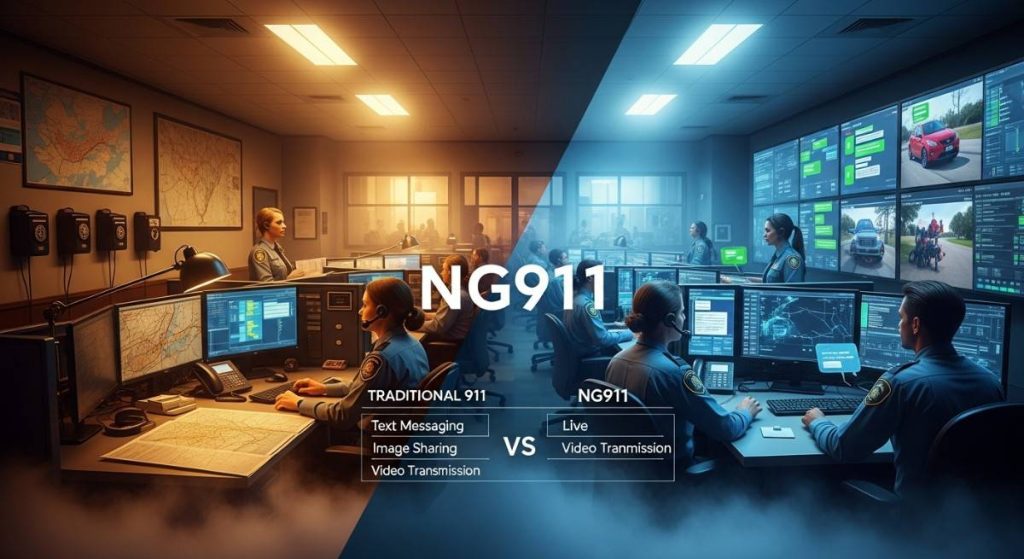
With NG911, citizens can send text messages, photos, videos, and precise GPS locations directly to emergency dispatchers. Imagine being able to share live video of a car crash or active shooter situation with emergency personnel. A capability like that changes response dynamics a lot.
The NG911 infrastructure is getting invested in fast by telecommunication providers and public safety agencies. Picture and video messaging has been added to AT&T’s emergency network for 911 systems, helping dispatchers get a better sense of the situation before responders arrive.
Here is a quick comparison between traditional and NG911 systems:
| Feature | Traditional 911 | NG911 |
|---|---|---|
| Voice Calls | Yes | Yes |
| Text Messaging | Limited | Fully Supported |
| Image Sharing | No | Yes |
| Video Transmission | No | Yes |
| GPS Accuracy | Basic | Advanced |
| Cloud Integration | Limited | Extensive |
| Real-Time Data Sharing | Minimal | High |
The NG911 system also makes it easier for people with disabilities to use it. During emergencies, text-based communication can save the lives of people who are deaf, speech impaired, or can’t speak. Emergency response will be more inclusive, responsive, and effective with these improvements.
Core Components of Public Safety Communication Infrastructure
Dispatch Centres and Emergency Call Handling
Public safety operations are powered by dispatch centers. Every emergency call, radio request, or incident alert goes through a centralized communication hub. Emergency responders and the public are connected by these professionals.
Dispatch centers have evolved into sophisticated command environments with AI-assisted software, digital mapping, and real-time monitoring. The dispatcher doesn’t just answer the phone anymore. Their job is to analyze incoming information, prioritize incidents, coordinate units, monitor field activity, and maintain operational awareness across entire jurisdictions.
The cloud-native emergency platforms are getting more popular because they’re scalable and resilient. The traditional systems may be overwhelmed or damaged during major disasters. With cloud-based systems, you can distribute operations across secure digital environments.
The emergency call center faces a lot of challenges, too. Burnout among dispatchers is a big problem. EMS centers around the world are facing mental health stress, staffing shortages, and rising call complexity, according to the 2025 Pulse of 9-1-1 survey.
Dispatchers have a lot on their plates. Someone could be going through the worst moment of their lives on every call. Professionals who work in these environments need to be able to communicate effectively, make decisions quickly, and be resilient emotionally.
Land Mobile Radio Systems
Public safety operations still rely on Land Mobile Radio (LMR) systems despite advances in broadband and cloud. During disasters, police, firefighters, and EMS teams still rely on radio communication because it’s reliable, fast, and resilient.
The LMR system offers direct push-to-talk communication, so responders can coordinate instantly without dialing numbers or using commercial cellular networks. Radios often work when consumer communication systems go down in remote areas or when networks fail.
Newer broadband technologies must be integrated with legacy radio systems. It’s important for agencies to maintain compatibility while going digital. In public safety communications today, blending mission-critical voice communication with broadband capabilities is a big priority.
Today’s radio systems have encryption, GPS tracking, emergency alerts, and interoperability. Advanced systems even connect directly to drones, cameras, and AI analytics.
Broadband and 5G connectivity
Public safety communication is changing faster than experts predicted thanks to 5G technology. Responders can access massive amounts of data instantly while operating in dynamic environments with high-speed broadband.
Officers can stream body camera footage to command centers live. During rescue operations, firefighters can access building blueprints. Transmitting patient vitals to hospitals before they arrive is possible for ambulances. Faster, smarter, and more informed emergency responses are made possible by these capabilities.
5G connectivity is a top priority for 25% of public safety agencies, according to Verizon’s 2025 survey.
Here are some benefits of 5G in public safety:
- Communication with ultra-low latencies
- Video transmission is faster
- Operational improvements for drones
- Processes AI better
- Real-time mapping
- Improved mobile connectivity
However, broadband dependence introduces cybersecurity risks and infrastructure vulnerabilities. When cellular networks go down during a disaster, agencies must have backups.
The Role of Artificial Intelligence in Public Safety
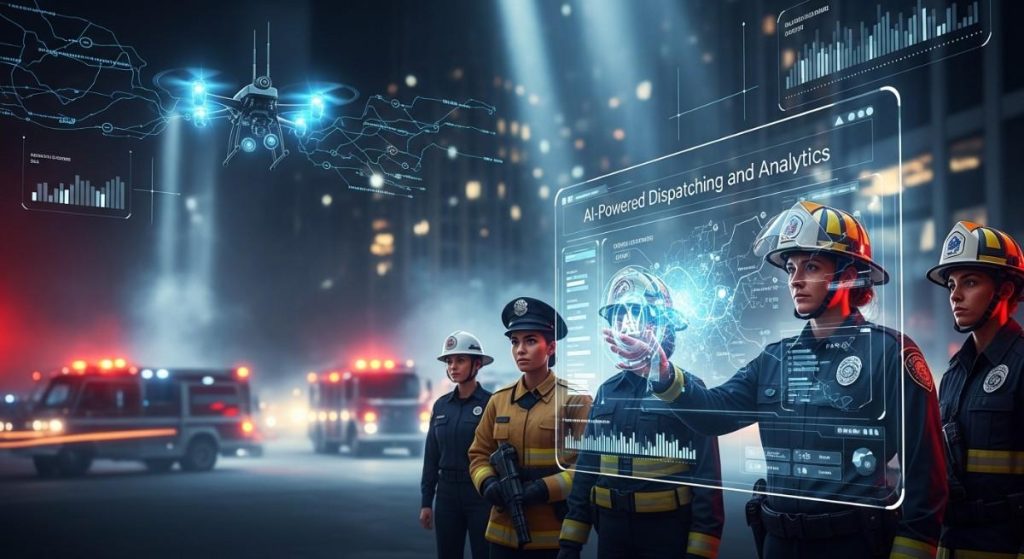
AI-Powered Dispatching and Analytics
Public safety communications are becoming predictive ecosystems thanks to artificial intelligence. An AI-powered dispatch tool can analyze incoming emergency calls, identify keywords, prioritize incidents, and recommend optimal response strategies in seconds.
You can think of AI as a digital copilot assisting emergency personnel. Human responders aren’t replaced, but it dramatically improves efficiency and situational awareness. Analyzing surveillance feeds, detecting suspicious behavior, identifying accident patterns, and predicting emergencies are all things AI can do.
Within five years, first responders will use 46% more AI than they do now, according to the Verizon Frontline survey.
AI applications in public safety now include the following:
| AI Technology | Public Safety Use |
|---|---|
| Predictive Analytics | Crime and disaster forecasting |
| Speech Recognition | Faster emergency call transcription |
| Video Analytics | Threat detection |
| Automated Dispatching | Incident prioritization |
| Facial Recognition | Suspect identification |
| Drone Automation | Search and rescue support |
This technological shift is accelerating rapidly because emergency agencies face increasing pressure to respond faster with fewer resources.
Predictive Emergency Response Systems
Using historical data, weather patterns, traffic analysis, and behavioral modeling, predictive systems predict emergencies before they happen. In many cities worldwide, it’s already happening.
For example, predictive policing software identifies high-risk crime areas. Environment-monitoring systems predict wildfires and alert authorities before they spread. Using flood monitoring tools, you can get evacuation warnings based on rainfall and river data.
By using these systems, agencies can allocate resources proactively instead of reactively. More strategic emergency management reduces casualties and improves operational readiness.
AI also makes resource deployment more efficient. Based on predictive risk assessments, ambulances, patrol units, and fire crews can be positioned dynamically. Response times are shortened and personnel resources are optimized.
Cybersecurity Challenges in Public Safety Communications
Rising Threats to Emergency Communications Networks
Communication systems are becoming more digital, so they’re more vulnerable to cyberattacks. Today, emergency communication networks are prime targets for hackers seeking disruption, financial gain, or political leverage.
Recent incidents involving fake emergency alerts and compromised radio infrastructure show how serious these threats are. A hacker hijacked radio equipment and broadcast fake emergency messages and offensive content through compromised systems, the FCC said.
There are a lot of devastating consequences when cyberattacks hit public safety systems:
- Emergency dispatch was disrupted
- Emergency alerts that aren’t true
- The blackout of communication
- Response time is a bit slow
- Breach of data
- Panic
Emergency networks are like cities’ circulatory systems. It’s possible for entire emergency operations to collapse if attackers disrupt communication.
Protecting Critical Communication Infrastructure
Public safety agencies can’t ignore cybersecurity anymore — it’s mission-critical. Governments and agencies are investing heavily in encryption, network monitoring, zero-trust architectures, and AI threat detection.
In Verizon’s 2025 survey, 67% of public safety agencies have implemented new cybersecurity protections.
Here are some modern cybersecurity strategies:
- A multi-factor authentication system
- Radio communication that’s encrypted
- Cybersecurity frameworks for the cloud
- Continual vulnerability testing
- Monitoring your network in real time
- System for backup communication
Cybersecurity regulations are also getting tougher for critical infrastructure, including emergency communication systems.
Public Safety Communications for Police, Fire, and EMS
Police Communication Systems
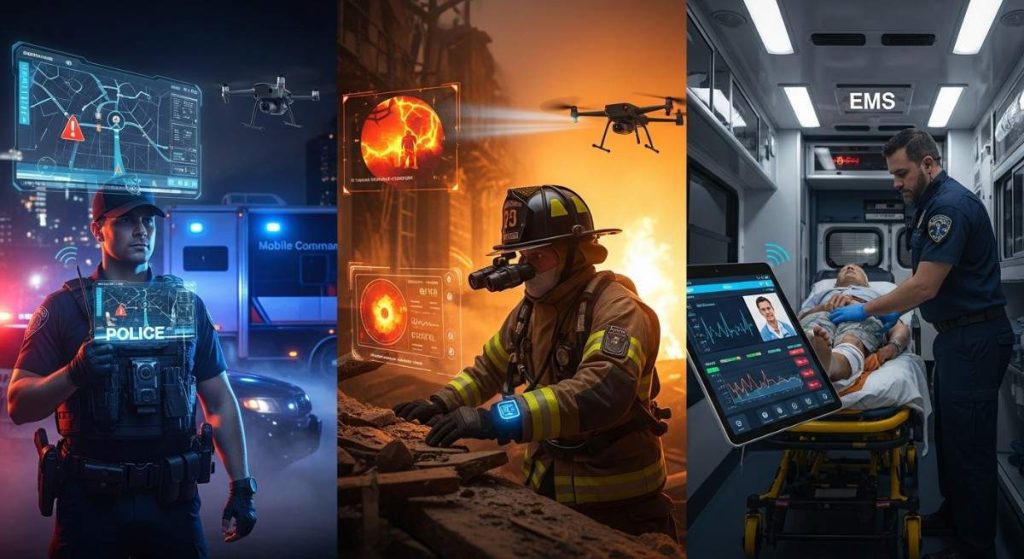
Law enforcement agencies rely heavily on fast and secure communication. Officers in the field need instant access to criminal databases, surveillance systems, GPS navigation, and emergency alerts.
Modern police communication now includes body cameras, AI-assisted analytics, mobile command centers, and integrated cloud platforms. Some agencies are experimenting with augmented reality systems and drone coordination to improve tactical awareness.
Fire Department Coordination
Firefighters operate in highly dangerous environments where communication failures can become fatal within seconds. Communication systems help track crew locations, coordinate evacuations, monitor hazards, and relay structural intelligence during incidents.
Emerging technologies such as thermal drones and wearable sensors are improving firefighter safety significantly. Real-time communication allows command centers to adapt strategies dynamically as conditions change.
Emergency Medical Service Connectivity
EMS teams require rapid access to patient information and hospital coordination systems. Communication delays can directly affect survival rates during strokes, heart attacks, and trauma incidents.
Modern ambulance communication systems support telemedicine, live patient monitoring, GPS routing, and hospital data integration. These capabilities improve treatment preparation before patients even arrive at medical facilities.
Emerging Technologies Reshaping Public Safety
Drones, Robotics, and Real-Time Video
Drones are rapidly becoming standard tools in emergency response operations. They provide aerial surveillance, thermal imaging, search-and-rescue support, and disaster assessment capabilities.
According to recent public safety surveys, daily drone use among responders could triple within five years.
Robotics are also entering hazardous environments where human responders face significant danger. Bomb disposal robots, autonomous rescue devices, and AI-driven surveillance systems are transforming operational safety.
IoT and Smart City Integration
Smart cities are integrating communication systems with traffic sensors, environmental monitors, surveillance cameras, and emergency alert platforms. This interconnected ecosystem improves situational awareness and emergency coordination.
IoT devices can automatically detect gunshots, monitor air quality, identify traffic accidents, and alert emergency responders instantly. These technologies create a proactive public safety environment rather than a purely reactive one.
Challenges Facing Public Safety Agencies
Budget Constraints and Staffing Issues
Technology upgrades are expensive. Many agencies struggle to modernize aging infrastructure while managing limited budgets and staffing shortages.
Communication systems require continuous maintenance, cybersecurity upgrades, training, and interoperability testing. Smaller jurisdictions often face significant financial barriers when attempting modernization.
Interoperability Problems Between Agencies
One of the biggest historical challenges in public safety communication has been interoperability. Different agencies frequently use incompatible systems, slowing coordination during large-scale emergencies.
Modernization efforts aim to eliminate these silos by building unified communication standards and integrated digital platforms.
Future Trends in Public Safety Communications
Cloud-Based Emergency Platforms
Cloud technology is becoming central to emergency communication modernization. Cloud systems improve scalability, disaster recovery, remote accessibility, and data sharing.
Agencies are increasingly adopting cloud-native platforms because they reduce infrastructure costs and improve operational flexibility.
AI, Automation, and Real-Time Data Sharing
The future of public safety communication will revolve around intelligent automation. AI-driven systems will analyze incidents faster than humans alone, while real-time data sharing will create unprecedented situational awareness.
The emergency responder of the future may operate within a fully connected digital ecosystem involving drones, AI dispatchers, predictive analytics, and wearable technology working together seamlessly.
Conclusion
Public safety communications sit at the center of modern emergency response. They connect dispatchers, responders, hospitals, governments, and citizens during moments when every second matters. As emergencies become more complex, communication systems are evolving rapidly through AI, 5G, cloud computing, drones, and cybersecurity innovation.
The future of public safety will depend on resilience, interoperability, and intelligent technology integration. Agencies that embrace modernization today will be better prepared to protect communities tomorrow. Communication is no longer just a support function in emergency response—it is the backbone of public safety itself.
FAQs
1. What is public safety communication?
Public safety communication refers to the systems and technologies used by emergency services such as police, firefighters, EMS, and disaster response agencies to coordinate during emergencies.
2. What is NG911?
NG911, or Next Generation 911, is a modern emergency communication system that supports text messages, photos, videos, GPS data, and advanced digital communication.
3. Why is cybersecurity important in public safety communications?
Cybersecurity protects emergency communication networks from hacking, outages, fake alerts, and data breaches that could disrupt emergency response operations.
4. How does AI improve emergency response?
In emergency response, AI helps analyze incidents faster, assists dispatchers, predicts emergencies, automates workflows, and improves situational awareness.
5. What role does 5G play in public safety?
The 5G network allows for faster data transmission, low-latency communication, live video streaming, drone operations, and real-time data sharing.