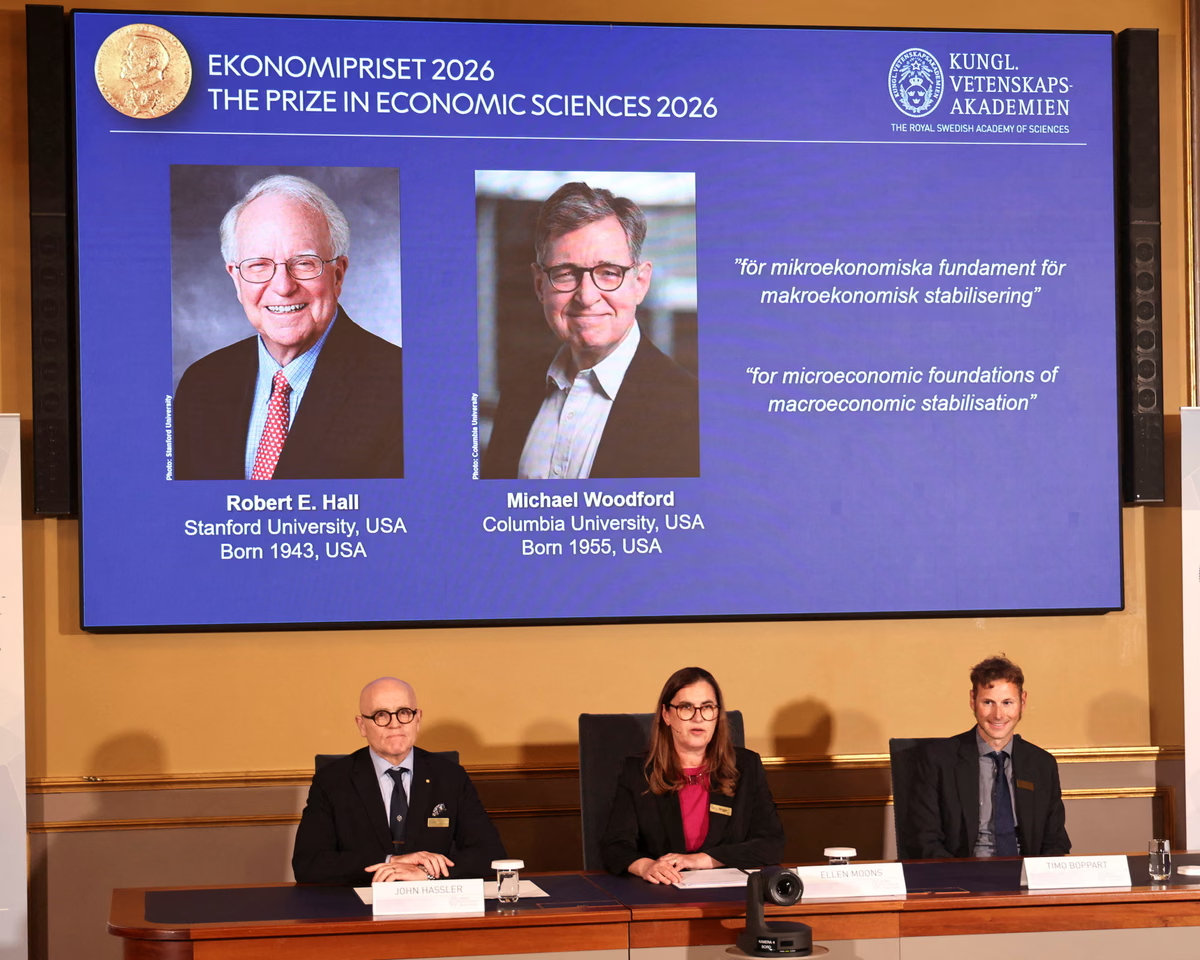
Robert Hall of Stanford University and Michael Woodford of Columbia University have been awarded the 2026 Nobel Prize in Economic Sciences. The Royal Swedish Academy of Sciences recognized the pair for their pioneering development of the “microeconomic foundations of macroeconomic stabilisation.” Their research, which earned them a shared prize of $1.2 million, has provided policymakers worldwide with improved instruments to manage economic peaks and troughs, effectively helping to prevent prolonged recessions and inflationary spirals. Two US economists have won the 2026 Nobel economics prize for their work developing models that help central bankers and finance ministers to stabilise their countries, avoiding long recessions and runaway inflation. According to the Royal Swedish Academy of Sciences, It was recognising the pair for generating “a paradigm shift in stabilisation policy”, awarding them the prize worth a combined $1.2m (£900,000). Based on how individual households and businesses collectively affect an economy through their actions, hall and Woodford demonstrated how traditional models could be reconstructed.
The academy credited the researchers with generating a “paradigm shift in stabilisation policy.” By evolving the concepts established by John Maynard Keynes, the laureates addressed the limitations of traditional models—most notably those that failed to account for the stagflation, weak growth, and unemployment seen during the oil shocks of the 1970s. Their New Keynesian framework allows institutions to quantify the impact of policy decisions on business cycles, serving as a vital resource for central banks and finance ministries.
Hall’s specific contribution focused on incorporating forward-looking consumer behavior, departing from the rigid, mechanical rules of thumb previously used to link GDP, unemployment, and inflation. Building upon this, Woodford constructed a comprehensive macroeconomic stabilization framework. This system proved essential following the 2008 financial crisis, offering a roadmap that guided the global economy away from the threat of a secondary great depression.
Committee chair John Hassler noted that the laureates provided a stable theoretical foundation that equips governments to handle volatile shocks, such as energy crises or shifts in household consumption. A key outcome of their work is the practice of “forward guidance,” where central banks communicate expected future interest rate paths. While critical for stability during the 2008 crisis and the Covid-19 pandemic, the strategy has faced scrutiny; Fed chair Kevin Warsh has warned against creating ambiguity through such guidance, and former Bank of England governor Mark Carney famously faced criticism for his inconsistent signaling. And the Covid pandemic, when interest rates were cut to record lows, that became an important tool after the 2008 financial crisis. Though – the current chair of the US Federal Reserve, Kevin Warsh, has argued it should only have a “limited and circumscribed” role in normal times, to avoid “creating ambiguity in the name of clarity”, forward guidance has had its critics. And in 2014, the then Bank of England governor, Mark Carney, was labelled an “unreliable boyfriend” for dropping hints over interest rate rises that never came to pass.
Upon hearing the news, Woodford expressed his elation, describing the recognition as a tremendous honor and a surprise. Columbia University president Jennifer L. Mnookin commended the achievement, noting that the duo’s collaboration has fundamentally reshaped stabilization theory. Beyond his theoretical contributions, Hall is widely recognized for categorizing US economists into “freshwater” and “saltwater” schools, distinguishing between those focused on neoclassical, free-market approaches and those centered on Keynesian interventions. It’s a surprise but I’m feeling very good about it,” he told reporters in Stockholm by phone after receiving the news. Hall is also known for coining the idea that US economists can be divided into freshwater and saltwater varieties.
The Nobel Prize in Economic Sciences, officially titled the Sveriges Riksbank Prize in Economic Sciences in Memory of Alfred Nobel, remains a central fixture in global economic discourse. The models developed by Hall and Woodford continue to be the primary tools used by international authorities to navigate modern economic upturns and downturns.