Yemen’s internationally recognized government has announced the launch of an all-out military campaign aimed at reclaiming all territory currently held by Houthi forces. President Rashad al-Alimi confirmed the shift in a televised address on Sunday, vowing to re-establish the authority of state institutions across the entire nation.
The announcement follows a series of escalating strikes involving the Iran-backed Houthi group and the Saudi-led coalition. Recent fighting has seen significant shifts in territorial control, most notably last month when the Houthis captured the country’s entire Red Sea coastline. This move effectively secured the strategically vital Bab al-Mandab Strait shipping lane and denied Saudi Arabia access to an alternative oil export route. The strategy benefited the Houthis’ main sponsor, Iran.
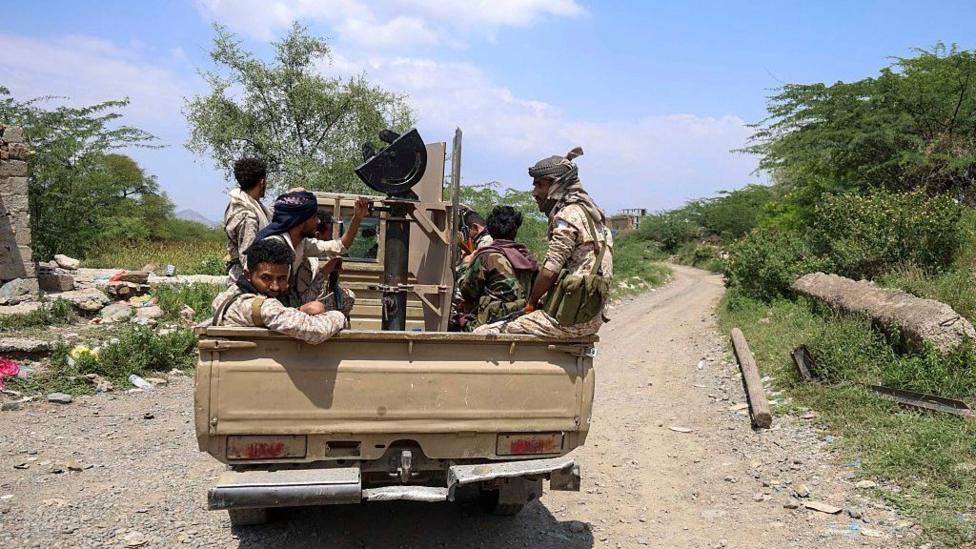
As part of the intensified campaign, government forces have targeted Houthi positions throughout the country, including strikes in the capital, Sanaa, and the northern stronghold of Saada. In the south-west, fighting remains concentrated around Taiz. Military sources report that the Houthis recently severed a crucial supply line between Taiz and the interim government capital, Aden, effectively encircling the city. Farea Al-Muslimi, a research fellow at Chatham House, noted that while the Houthis may not fully control the area, they have successfully achieved their objective of isolating the city. Amid fighting between Yemeni government forces and Houthis, soldiers ride in the back of a pick-up truck on a dirt road near Taiz. According to both operations successfully achieved their objectives,” the spokesman, In a statement. “The strikes were precise, causing large fires at the targeted sites.
The Houthi movement responded to the government’s pressure by claiming responsibility for a major drone and ballistic missile attack against Saudi Arabia. Military spokesman Yahya Saree stated that the operation targeted Saudi Aramco facilities in Riyadh and the oil-rich Khurais region. The Houthis claim the strikes were a direct retaliation for approximately 50 coalition airstrikes conducted over a 12-hour window. Saudi Arabia has yet to officially comment on these specific claims, though the kingdom has historically dismissed similar reports as fabrications meant to project strength. According to the Iran-backed group, It had struck sites belonging to Saudi national oil company Aramco, in response to what it described as 50 Saudi-led coalition strikes in 12 hours. Flames burn at a facility belonging to Saudi oil giant Aramco south of Riyadh on 3 October. Smoke rises from the site of an air strike in Sanaa on 4 October. Leading an international coalition, riyadh intervened in the war the following year.
Observers suggest that President al-Alimi’s decisive military posture likely carries the approval of Saudi Arabia, his administration’s primary benefactor. The war, which originated in 2014 when the Houthis seized control of Sanaa, has devastated the nation. After a period of relative calm, hostilities resumed in July against the backdrop of broader instability across the Middle East. As a consequence, the global economy – could pay if it launched a new all-out war against the Houthis, but it has once again shown the price Saudi Arabia – and.
The Houthi-run Al-Masirah television network confirmed that Saudi-led coalition retaliatory strikes continued into Sunday, reporting at least two civilian casualties. Meanwhile, on the ground, security analysts note that the Houthis continue to challenge state forces, complicating the government’s ambitions to secure the capital—which has remained under Houthi control for over a decade.
This renewed push for control underscores the ongoing risks to regional economic stability, particularly concerning the flow of oil. As the conflict intensifies, the humanitarian situation in what remains one of the world’s poorest nations continues to deteriorate, further complicating the prospects for a lasting peace.