


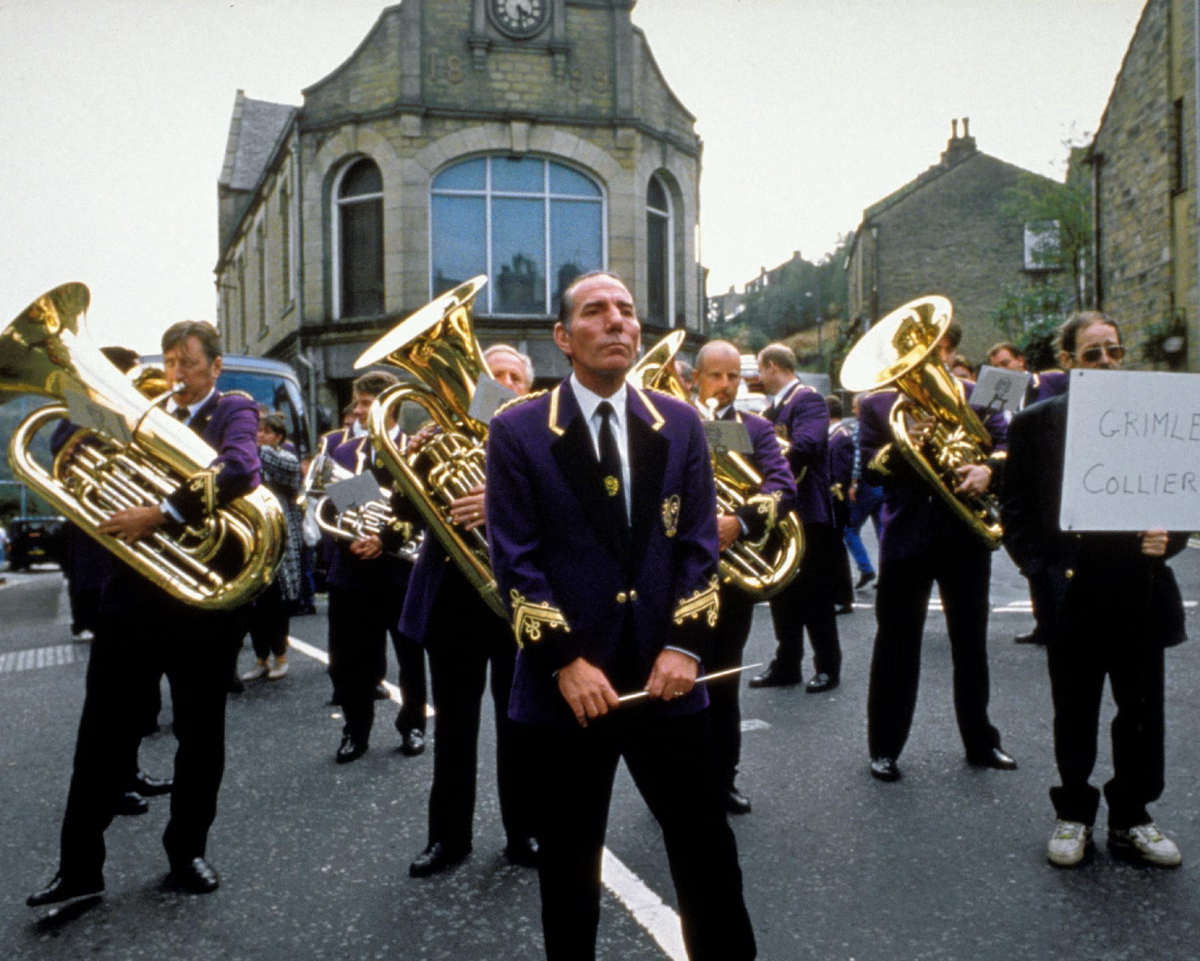
Mark Herman’s 1996 filmBrassed Offa poignant and overtly political story centered on a struggling colliery brass band, remains one of the British public’s most cherished works of cinema. As it marks its 30th anniversary, the film continues to resonate, notably appearing as one of the favorite films of the new Prime Minister, Andy Burnham. To add to the plaudits, Andy Burnham recently named it as one of his four favourite films.
Reflecting on the milestone, Herman admits he is flattered by the Prime Minister’s endorsement, noting with a laugh that he would have been far more surprised had the selection been a film likeNotting Hill. Herman recalls that when the film was first released, his expectations were modest. He had anticipated that its appeal might be confined to a 10-mile radius around the town of Barnsley for about two weeks, rather than becoming a lasting cultural touchstone that eventually reached number 85 on the BFI’s list of Top 100 British Films. “On the face of it, a brass band film is not an easy pitch but word of mouth really rolled and suddenly it went on and on in places for months,” he recalls. “I thought it might be popular within a 10 mile radius of Barnsley for about two weeks,” laughs Herman. “So yeah, it’s amazing.”. “It’s really interesting hearing teens and 20-year-olds talking about the film, because it’s such an old film for them, but it really hits them.
The narrative, which features performances by Pete Postlethwaite, Tara Fitzgerald, and Ewan McGregor, follows the miners of a fictional South Yorkshire town facing industrial decline. Herman notes that the film’s success was driven by word-of-mouth as it balanced political commentary with comedy. He suggests that audiences who arrived expecting a serious political drama found humor, while those seeking comedy were met with a firm message regarding the impact of government policy on mining communities. It captures the hopelessness felt by former miners who struggled to keep themselves out of the dole queue during the slow and painful destruction of the mining industry by the Tory government, set in the fictional industrial South Yorkshire town of Grimley a decade after mineworkers brought themselves to destitution trying to save their livelihoods.
To commemorate three decades since the film’s debut, the real-life Grimethorpe Colliery Band—the inspiration for the story—is scheduled to perform the soundtrack live at the Royal Albert Hall alongside a special screening. For Herman, returning to the venue offers a surreal contrast, given that the original production used the Birmingham Town Hall as a substitute because the London site was deemed too expensive and visually inaccurate.
Herman believes the film’s enduring popularity stems from its universal exploration of being oppressed. He observes that even younger generations, for whom the 1990s setting is history, find the themes still relevant today. Despite this, he remains pessimistic about the current landscape of the British film industry. He notes that in the “old days,” studios were willing to take risks on mid-budget projects, whereas today’s environment favors either blockbusters or micro-budget films, leaving little room for the type of cinema he prefers to make. Because it’s still relevant and still plays, they get the message everybody got 30 years ago.
Reflecting on his career path, which led from Bridlington to the National Film and Television School, Herman acknowledges that the advice to network in London likely remains pertinent for aspiring filmmakers. However, he maintains that while networking might have secured him more projects, it may not have resulted in films he felt as passionate about. His recent preferences include the biographyI Swearand the comedy-dramaThe Ballad of Wallis Island. I think anybody who went got a sort of bonus they might not have expected.
The legacy of the film remains inseparable from the realities it depicted, such as the long-term economic and social damage inflicted on pit towns. A defining moment remains Postlethwaite’s climactic monologue regarding the importance of people over music, a sentiment that has since been immortalized in culture. As the anniversary screening approaches, Herman acknowledges the strange thrill of witnessing his work projected in the very venue the characters in his film could only dream of reaching.