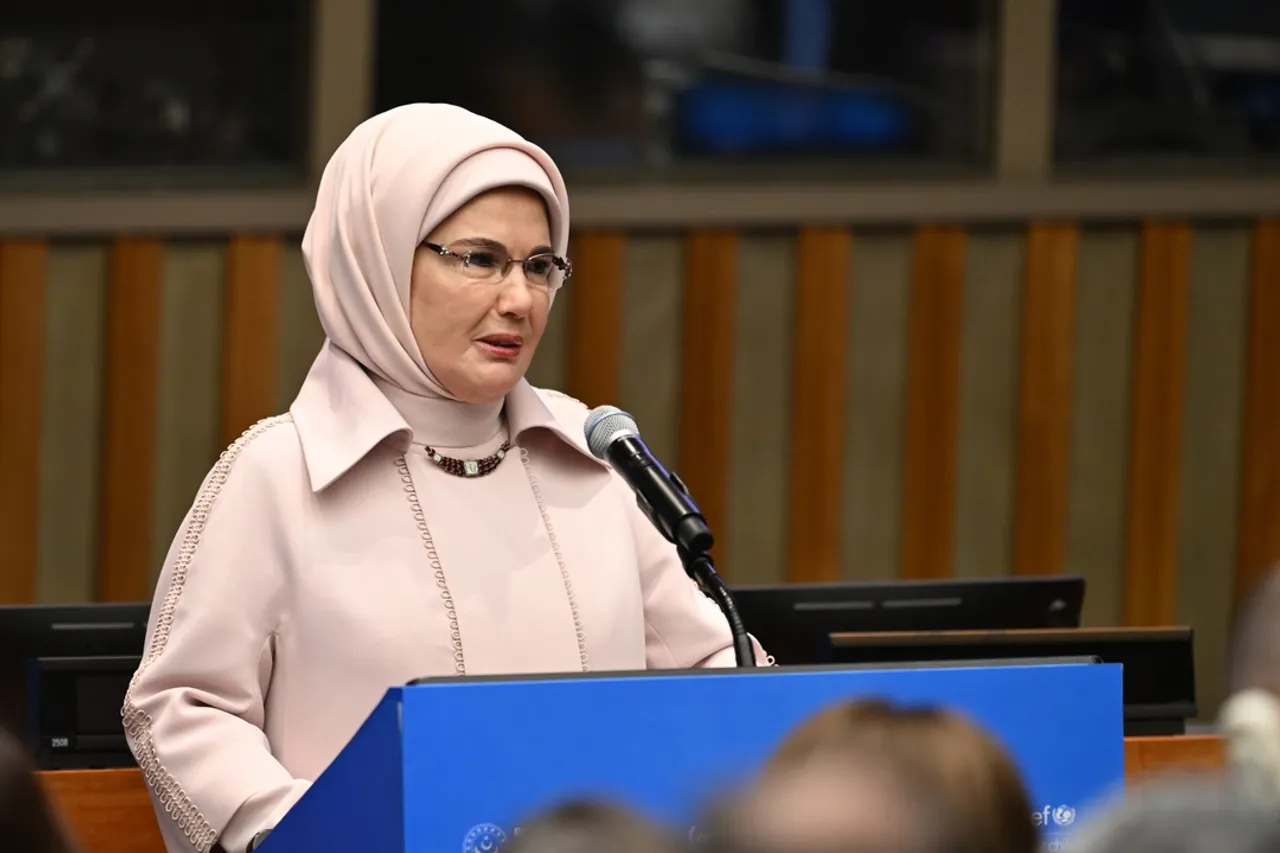
First ladies and spouses of global leaders have called for a unified international framework to safeguard young users, as Türkiye’s Emine Erdogan pressed the United Nations to set shared global standards for digital safety. The push comes amid growing concerns over how technology companies influence children’s lives, often prioritizing profit over the well-being of minors. Who highlighted the growing risks children face online and the need to make their safety a shared international responsibility, the discussion brought together first ladies and spouses of heads of state and government from 13 countries.
During a high-level event at UN headquarters on September 21, Erdogan argued that domestic legislation is insufficient to contain the reach of multinational technology corporations. She urged for a coordinated, global response to address challenges that have moved beyond local borders.
The discussion, titled “The Invisible Architecture: Building Safe Digital Systems for Children,” was held during the 81st United Nations General Assembly high-level week. The gathering was organized under Erdogan’s auspices in collaboration with UNICEF and the Office of the UN Special Representative of the Secretary-General on Violence against Children, bringing together representatives from 13 different nations.
Erdogan emphasized that technology has evolved from a simple communication tool into a systemic force that reshapes daily life. She cautioned that society must not remain a passive observer as these systems define a new type of human experience. Urging a shift in approach, she stated that children’s safety should not be an afterthought or an added feature to digital platforms, but the fundamental starting point of their design. “We cannot be a mere onlooker to technology, which we have invented ourselves, inventing a new human type that will serve its purposes in front of our own eyes,” she said.
While noting that Türkiye has implemented early legal and technical measures regarding children’s social media usage, she warned that disparate national regulations hinder standardization. She proposed a UN-led framework supported by consistent monitoring and reporting to create a healthier digital ecosystem. However, individual national regulations can make standardisation difficult when companies operate globally.
The call for international cooperation resonated across the summit. Lebanese Prime Minister’s spouse Sahar Salam noted that digital threats ignore sovereign borders, making it impossible for any single country to protect its children alone. Similarly, Romania’s First Lady Mirabela Gradinaru compared the lack of international internet boundaries to road safety, arguing that local solutions are no longer adequate for global digital issues.
The discourse also addressed the broader spectrum of digital dangers, including privacy violations, cyberbullying, and data harvesting. Queen Mathilde of Belgium asserted that children should not be treated as variables within the business models of tech giants, emphasizing that their rights and dignity must remain paramount.
Burundian First Lady Angeline Ndayishimiye acknowledged the potential digital technologies provide for African youth, but warned that these benefits must not come at the cost of safety. Kenyan First Lady Rachel Ruto echoed this sentiment, declaring that a child’s data, location, and behavior are integral to their future and should not be treated as tradeable commodities.
Artificial intelligence emerged as a major focal point for future protections. Diana Fox Carney, spouse of the Canadian Prime Minister, warned that AI represents the next frontier in child exploitation, stating that childhood should not be surrendered to the very technologies humanity has created. Serbian First Lady Tamara Vucic suggested that equipping children with AI literacy is essential, while calling for international cooperation on standards for educational use. But by whether children can benefit from it safely, gambian First Lady Fatoumatta Bah Barrow argued that technological progress should be measured not simply by innovation.
Practical measures were also discussed, with Lithuanian First Lady Diana Nausediene encouraging the development of robust age-verification technologies that prioritize data privacy. Chilean First Lady María Pía Adriasola Barroilhet urged adults to model responsible behavior, noting that parents must be willing to disconnect from their own screens to set a precedent for younger generations.
Concluding the session, Guatemalan First Lady Lucrecia Eugenia Peinado Villanueva called upon technology companies to place the rights of the child at the center of their operational models, while stressing the need for governments to provide comprehensive support to schools and families.