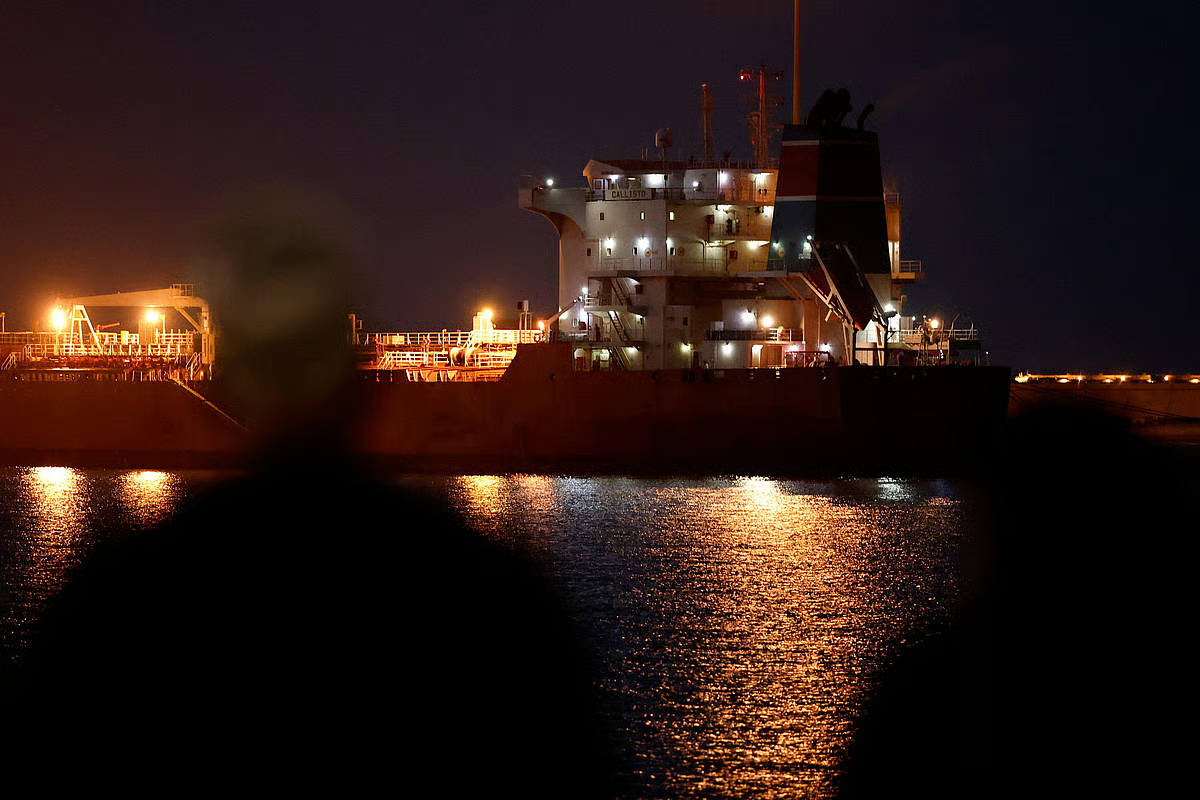
Gulf oil producers are continuing to transport unexpectedly high volumes of crude oil through the highly contested Strait of Hormuz. Backed by military support, including assistance from the US Navy, these energy exporters are maintaining the vital flow of global energy supplies despite escalating regional conflict and direct pressure from Iran. The rebound reflects a complicated effort by Gulf producers and the US.
Key Geopolitical & Market Developments
- US blockade on Iran: Policy shift — or ‘regime change’?
- Oil surges as Trump rejects Iran deal, Murban jumps 3%
- Hormuz mystery: Saudi oil loadings surge ‘7-fold’
- Oil prices surge to multi-month highs
- Brent at $105.70 as Gulf states halt Hormuz talks
Data from marine-tracking firm Kpler shows that crude oil and petroleum-product transits through the strategic channel averaged 13.1 million barrels per day last week. This volume represents nearly 80% of the 17.1 million barrels per day that typically passed through the strait before the outbreak of the war.
According to Matt Smith, Kpler’s director of commodity research, the sustained high transit volumes indicate that Tehran’s leverage over the shipping route has diminished. Smith told CNN that Iran is attempting to reassert its influence and deter shippers by ramping up attacks on commercial tankers in the area.
To bypass these security threats, Gulf nations and their international partners have deployed a complex logistical strategy. Tankers are operating under direct military escorts, utilizing “dark” transits by switching off their Automatic Identification Systems (AIS), and rerouting specific export flows to keep maritime channels active. Saudi Arabia has also redirected some of its crude back toward the Strait of Hormuz following disruptions to its alternative inland transport route.
Despite the current viability of these shipping arrangements, energy analysts warn that the situation remains highly unstable. The high-risk operations are sustained by immense US military resources. Meanwhile, global petroleum inventories are steadily declining as the market increasingly relies on stockpiles to cover supply vulnerabilities rather than securing a permanent, peaceful solution for transit safety.
Since the conflict erupted, the global energy market has successfully mitigated a worst-case supply shock. Energy producers have utilized land-based pipelines, coordinated military-protected shipping lanes, and increased regional output. While these actions have prevented Brent crude from skyrocketing to extreme levels, they have forced a heavy reliance on emergency storage and tactical logistics. Those measures have limited the immediate supply shock and helped prevent crude prices from reaching the extreme levels feared at the start of the conflict.
For energy consumers in Asia, Canada is rapidly scaling up as a new major supplier, while Russia remains a deeply entrenched and much larger supplier in the region. For Asian markets, Canada is emerging the fast-growing new supplier.
An assessment by JPMorgan on September 17 revealed that global crude and refined product inventories had dropped by approximately 555 million barrels since the outbreak of the conflict with Iran. This drawdown is significantly lower than JPMorgan’s initial worst-case model, which projected a potential inventory decline of 1.6 billion barrels. According to jPMorgan had previously modeled a far larger possible draw of about 1.6 billion barrels, but, Actual draws were only around one-third of that.
However, the investment bank cautioned that stockpiles could eventually run too low to compensate for sudden supply halts or delays. While significant inventory buffers still exist in Europe, China, Japan, and South Korea, persistent disruptions in the Middle East risk drawing these reserves down to a critical “stress threshold.”
Under such conditions, JPMorgan warned that oil prices could rise sharply enough to force a reduction in global demand to rebalance the market. Natasha Kaneva, JPMorgan’s head of global commodities strategy, told CNN that forecasting has become nearly impossible under current conditions. Writing in a note to clients, Kaneva stated that the bank no longer has a baseline forecast because they do not know how to model the conflict’s final outcome, emphasizing that the key concern is whether the global distribution system can withstand a prolonged crisis. Her central point is that the crucial issue is no longer only how long the war lasts.
Saudi Arabia’s East-West Pipeline, also known as Petroline, has served as a critical alternative route during the crisis, carrying roughly 6 million barrels per day—just below its maximum capacity of 7 million barrels per day. This pipeline allows Saudi Arabia to bypass the strait to export oil and feed its domestic refineries along the Red Sea coast. Allowing exports to avoid the Strait of Hormuz altogether, the pipeline carries crude from the kingdom’s eastern oil-producing areas to Red Sea facilities.
However, this critical backup route faced severe pressure when drone strikes forced a temporary shutdown. Along with Houthi threats to shipping in the Red Sea, the incident sparked fears that both primary export alternatives for the region were compromised. Capital Economics estimated that the disruption to Saudi Aramco’s infrastructure temporarily knocked out up to 4% of the global oil supply.
Although quick repairs allowed Saudi Arabia to restore pipeline operations within a week, analysts noted that a month-long shutdown of the system could have blocked up to 120 million barrels of crude from entering the market. Currently, Petroline has restarted and tanker loadings at Yanbu have resumed, with throughput estimated between 2.0 and 2.65 million barrels per day. Kpler expects these flows to increase, supported by satellite imagery showing rising activity at major Red Sea terminals.
Despite the market’s capacity to absorb these shocks, ordinary consumers and businesses continue to face severe financial strain. Although oil prices have not yet surged to $150 per barrel, high fuel costs remain a heavy burden for households and commercial enterprises. Yet it is far from secure, but the renewed traffic masks a deeper problem: the present arrangement may be functioning. Why drivers and businesses still feel pain.
Diesel prices have been hit particularly hard by refining constraints and fuel transport issues alongside the geopolitical conflict. In the US, the average retail price of diesel exceeded $6 per gallon for the first time on September 11, settling around $6.05 to $6.06 per gallon. In Europe, diesel prices climbed from €2.159 per liter on September 14 to €2.226 per liter during the week of September 21. Because diesel fuels freight networks, agriculture, and manufacturing, these high fuel prices are driving up operational costs across the wider global economy.
Important Details
- Get Updates on Topics You Choose.